Showing posts with label Books and Writers: Children’s Literature. Show all posts

12 May 2017

Anne with an Execution


Amybeth McNulty as Anne in the new series.

NOTE: Netflix and the Canadian Broadcasting Corporation are producing a “new, darker take” on Lucy Maud Montgomery’s beloved Anne of Green Gables. Called Anne with an E, the series premieres this week. As the success of Riverdale attests, “new, darker takes” are all the rage these days, and there’s really no reason not to push Anne Shirley even further toward the darkness.

We open with scenic vistas of Prince Edward Island. But the skies are ominous, wind tears through the trees, and we hear thunder and lightning in the near-distance.

MATTHEW CUTHBERT: (Voiceover) You stay away from that girl, if you know what’s good for you!

GILBERT BLYTHE: (Voiceover) But — but I don’t even like her! Everybody in Avonlea thinks there’s something wrong with her!

CUT TO: Interior, schoolroom. GILBERT pulls ANNE’s hair. She wheels on him and raises her slate to strike him.

MATTHEW: (Voiceover) You heard me. You just stay away from her!

CUT TO: GILBERT’S lifeless body on the schoolroom floor. Blood pools around his head. We hear a girl screaming.


“That Gilbert Blythe is the best-looking boy in town … or was.”

CUT TO: Interior, Avonlea Town Hall. TOWNSFOLK are arguing. A MOUNTIE enters.

COOPER: Sorry to trouble you folks. I’m Officer Dale Cooper of the Royal Canadian Mounted Police. I understand there’s a missing person.

CUT TO: ANNE and DIANA BARRY, exterior Green Gables.

DIANA: But Anne! No one has seen Gilbert Blythe since you hit him with your slate! Do you know anything about this?

Wordlessly, ANNE turns and faces the camera. Her hair is green.

CUT TO: Interior, Green Gables.

MARILLA CUTHBERT: Officer Cooper, my brooch has gone missing.

COOPER: Things in Avonlea aren’t as peaceful as they seem, eh?

CUT TO: Exterior, White Way of Delight, thunderstorm.

DIANA: Anne! Anne! Where are you going?

ANNE: I’m going to find Gilbert — dead or alive — if it’s the last thing I do!


The victim was found right about here, eh?

CUT TO: Interior, Avonlea Constable’s Office.

COOPER: Murder in Avonlea? I’m going to need another cup of that damned fine tea, Mrs. Lynde.

CUT TO: Exterior, Lake of the Shining Waters. Rain, heavy fog. ANNE and GILBERT are in a rowboat.

GILBERT: Anne, we’re sinking!

CUT TO: Interior, Green Gables.

COOPER: I take it you two aren’t married.

MATTHEW: (Looks meaningfully at MARILLA, then) We’re brother and sister, sir.

MARILLA: (Gazes inscrutably.)

CUT TO: Exterior, forest. Tight close-up on ANNE. She has seen something unspeakable.

ANNE: (Screams)

BLACKOUT


It begins….


Read more!

17 May 2012

Wild Things

Maurice Sendak, with a few friends

The author Jean Craighead George has died, just days after Maurice Sendak’s passing, an event that provoked an outpouring of nostalgic tribute and critical appreciation. “Death comes in threes,” they say, and really, I’m not sure the world of children’s literature can stand another such loss. Again and again in their stories and pictures, Craighead George and Sendak evoked the call of the wild, and a child’s fascination with the kinds of danger that lie “outside over there.” Yet what strikes me is the reassurance that both writers offer, too. As Max learns, you can return home after a wild rumpus, and your soup will be waiting for you.

Jean Craighead George

Craighead George’s My Side of the Mountain was a veritable pillar on which my childhood home was based, especially because my brother loved the book so much. The book recounts the adventures of Sam, a pre-pubescent Thoreau who goes off to live by himself in the woods. Craighead George writes beautifully of the natural world, and she details her protagonist’s ingenuity so carefully — yet so matter-of-factly — that even modern, mechanized, entirely mother-dependent suburbanites like us found ourselves wanting to follow him into the wild, and believing we were quite capable of doing so.

Reading My Side of the Mountain is something like watching Fred Astaire, whose grace appears so effortless that you think, “I could do that.” Whereas in reality, of course, you could not. Sam himself nearly dies on his mountain, and I daresay that neither Linc nor I would have lasted one paragraph out there. That didn’t stop us from dreaming, and it’s something of a miracle that Linc stayed home.

Portrait of my brother as a young bear

Part of Craighead George’s great achievement lies in her ability to make Sam’s survival seem so cosy: he doesn’t merely live in the woods, he makes a home for himself there. Maybe Craighead George — and Sendak — would have told their stories differently if they were writing for grownups, but the scary parts are always balanced by comfort. I found Higglety Pigglety Pop! absolutely terrifying when I was a boy, yet there it is: Jennie finds peril but also friends and a new kind of home with the World Mother Goose Theatre, and at the story’s end, she assures us she gets plenty to eat. (Granted, she’s eating mops, but what’s important is that she’s not hungry.) Sendak’s Max and Mickey get home safely, too, and so does Craighead George’s Sam.

Utterly terrifying: Jennie’s specialty act

In an exceedingly rare instance of my turning down a book because it was “too girly,” I never read Craighead George’s other masterpiece, Julie of the Wolves. This is especially ironic because there’s no doubt that Julie could have beaten the stuffing out of me — or perhaps my awareness of that fact is really what held me back. But there’s no question that she and Sendak both lent something mystical and exciting to our young lives: not least the prospect that my brother, who also identified so closely with Else Holmelund Minarik’s Little Bear (drawn by Sendak), might run off like Sam or Jennie, and that I’d have to go looking for him, outside over there.

We were very tame children, really, but we dreamed of wildness. Now you know two reasons why.


Read more!

18 March 2012

The Enchantments of E. Nesbit

Thoroughly Modern Edith Nesbit:
Her short hairstyle was much remarked-upon in her day.


There is this to be said about owning books, and keeping them all about you: when you wake in the middle of the night, you may pull down to read something you’ve meant to read for a long time, owned but never gotten around to, held on to for the promise it holds. I first heard of the children’s fantasy novels by E. Nesbit in another set of children’s books, those of Edward Eager, who pays tribute to her by name in such (relatively) modern classics as Half-Magic and Magic by the Lake. But somehow, in the years since elementary school, I’d never managed to read anything by Nesbit until now.

The work that came to hand was The Story of the Treasure Seekers, Nesbit’s first book for children, published in 1899. Although it turns out to be quite magical, it’s not a fantasy novel, but grounded in reality that intrigued me and that speaks quite clearly to our own Recession-battered times. The tale takes place during an economic downturn, and its principal characters, the five Bastable children, are determined “to restore the fallen fortunes of our house.”

The Bastables, as seen in a BBC adaptation.
(Which I have not seen.)


Mercifully, the Puffin edition I have owned for at least 20 years contains an introductory essay and a biographical sketch: thus I learned that Edith Nesbit (1858–1924) was the wife of Hubert Bland and one of the founders of the Fabian Society. Suddenly the correct context was established. Naturally the Bastables aren’t upper class! And naturally they seek treasure not in a fairy kingdom but in the everyday Britain around them. The results are completely charming and unlike any other books of the period I know.

We must begin by admitting that the beloved Alice and even Dorothy Gale are rather stiff little Victorians: they have to be, because in Wonderland and Oz they’re surrounded by such fanciful creatures that we as readers require their sobriety as a sort of polestar, to keep us from spinning out of control until we fly altogether out of the book. (Child-characters in other Victorian-era books have no such excuse.) The Bastables, on the other hand, don’t inhabit a fantasy land; while virtuous enough, yes, they’re anything but prigs.

Because their widowed father has no money to send them to school, they’ve got days to fill. Being bright and imaginative, and getting along remarkably well as playmates, this is no great hardship in itself. But because they are the inventions of a Fabian Socialist, they want to do something productive: they want to get money, even if it means earning it. Beyond that, they are allowed quirks and wit that most other late-Victorian authors would seem unwilling to suggest as possibilities. You can almost hear them: “What if some child happened to read this book, and exhibit such behavior? No, wiser to show them only paragons and cherubim as models!”

Spying on the grownups’ conversation:
An illustration from the original (or nearly so) edition.


The Bastables are nice children yet imperfect, like real boys and girls. They’re close-knit but they do vie for dominance; they disagree, and they even bicker a bit — just a bit. They’re rather mean to the boy who lives next-door, and some of their treasure-seeking plans entail robbery and other ungentlemanly vices. Though Nesbit doesn’t rub our noses in squalor, the way Dickens might have done, she certainly never lets us forget the grit and the sheer want that the Bastables confront each day. The family are “shabby genteel,” as my grandmother used to say, but the suggestion is that worse privations may be looming just offstage.

The book is narrated by one of the Bastable children, who insists from the first page that he must remain anonymous until the end of the story — and then a paragraph or so later reveals his identity inadvertently. I’ll keep his secret, just so that you can enjoy it yourself, but in the reading what this means is that certain of his descriptions and his justifications for his character (to whom he doggedly refers in the third person) deliver plenty of ironic humor.

Indeed the conflict between expectations and reality is the core of the book and the source of most of its laugh-out-loud comedy. Again and again, the children’s ideas turn out to be mistaken when tested. Becoming a detective, or getting one’s poems published in a newspaper, or meeting a princess, or rescuing a wealthy man, or starting one’s own business aren’t so easy or rewarding as they are in other authors’ books. When the Bastables decide to publish their own newspaper, the results are in fact hilarious, perhaps one of the greatest examples of sustained comedy in a single chapter of any children’s book from any period I can think of.

Hubert Bland, Nesbit’s husband and father of her children.
With Nesbit, unlike other Victorian authors, you continually get the sense that she actually knew real boys and girls —
and rather liked them.


If you were an imaginative child yourself — and chances are, you were, or you wouldn’t have read this far — you’ll recognize yourself in Nesbit’s pages, and like me, you may see much of the world you inhabit today. I’m struck by the realization that the Bastable boys, including Oswald with his reverence for Kipling, were just the right age to die in the Great War. But I’m not sure anyone ever constructed a greater monument than this book to the promise of their generation.

Shortly after The Story of the Treasure Seekers, Nesbit turned her remarkable sensibilities toward the writing of fantasy, and after polishing off this first book in two sittings, I turned to what is perhaps her most famous novel, Five Children and It. Here, too, we get a realistic setting remote from the privileged realms where other authors’ characters live: these children go on vacation, but not to some palace but to an ordinary house outside London, where there is no seashore and no enchanted forest but an ordinary sand pit to play in. When they do meet a fairy, it’s a remarkably ugly, peevish one, and when it grants their wishes, it does so in ways that are complicating and often vexing, more fun for the reader than for the Five Children.

It’s here that my appreciation for Edward Eager’s work grew: his books truly capture Nesbit’s spirit, transport it to modern-day America, and nurture it with care. I have a few more of Nesbit’s books already close to hand — and in turn she’s made me want to return to Eager’s, which are on my shelf still, too — and I daresay I’ll have more to say on the subject sometime soon.


Read more!

18 January 2012

Hamilton’s ‘Anthony Burns’

The book’s cover features an illustration by Leo and Diane Dillon, whose work enhanced Hamilton’s The People Could Fly
so eloquently.


Continuing my exploration of the work of the late author Virginia Hamilton, and doing so in the most haphazard way, I have stumbled across a lovely book, from 1988, that is a compendium of many of the best qualities that made her such a compelling writer. Not the least of these is, it’s a helluva good story, excitingly told.

Aimed I think at high-school kids and those junior-high students who are strong readers, Anthony Burns: The Defeat and Triumph of a Fugitive Slave reads like historical fiction: with its Boston setting, roiling political background, and its hero with a crippled hand, it may even recall that landmark of the genre, Esther Forbes’ Johnny Tremain. But it’s all true, as Hamilton makes clear with a thoughtful afterword and an extensive bibliography.

Hamilton shows us Burns, a young man who finds himself the center of a riot in 1854. As is sometimes the case with such figures, Burns is de facto a passive figure during the most dramatic event of his life, since he’s being held prisoner (in shackles and under heavy guard) at the very moment he’s a cause célèbre. But creating passive heroes is not what Hamilton is about.

And so she shows us Burns’ inner thoughts, active even as he’s confined and facing the prospect of forcible return to his master in Virginia: Anthony retreats within himself, reliving his past in vivid flashback sequences, making of the narrative a counterpane of past and present. This technique makes absolute sense, chiming as it does with what we know about survivors of prison camps and other such ordeals. (Hamilton doesn’t say whether any of the real-life Burns’ writings or statements corroborated her narrative approach, but I wouldn’t be surprised.)

The book is full of smart psychology, and Hamilton shows us, for example, what a mixed blessing is Anthony’s as a very young boy, because he’s the special favorite of John Suttle, the man who owns him (and who cannot stop himself from repeating that Anthony is his property). Yes, Anthony gets somewhat better treatment than the other slaves, but this in turn exposes him to rumors and resentment from whites and blacks alike on the plantation. Anthony is still a slave, and even John Suttle’s affection can’t be relied on: he takes Anthony on pony rides, yes, but then knocks him off the saddle to the ground. The boy cannot — must not — complain.

Hamilton doesn’t need to spell out her message: there was no such thing as comfortable or “nice” slavery, nor any way to make the condition tolerable, and we understand why young Anthony feels the need to escape. Sure, some of his jobs are cushier than others; he never works in the fields, though he does plenty of manual labor, including in a sawmill, where a white man’s negligence leads to the accident that cripples 13-year-old Anthony’s hand. Other slaves have it worse, but that doesn’t make his situation better.

And so, as a man, Anthony retreats to his memories not out of sentimentality but out of pride: his memories are his own, and no one can take them from him: that is what makes them a source of comfort.

You see what an astute observer of psychology — of the human spirit — Virginia Hamilton could be. The rest of the book is full of comparable insights and intriguing characterizations. And if Anthony isn’t the most active participant in the courtroom drama, he remains the heart of the story.

Drawing on memoirs and testimony, Hamilton makes those trial scenes very suspenseful (what a great movie this story would make!), and it’s another mark of her method that she doesn’t condescend: legal terms are used, with the apparent presumption that her readers are smart enough to look ’em up if they don’t know ’em already.

Along similar lines, you don’t have to read the appended historical texts (including not only the works in that bibliography but also excerpts from the Fugitive Slave Act, nightmarish), but you can: as with The People Could Fly, Hamilton isn’t merely telling (or spoon-feeding) stories, she’s giving her readers the tools they need to learn and to make the stories their own. Fascinating.

She does keep you guessing, though. Two of the scenes that you expect to play on a grand scale are kept brief, remarkably non-violent, and really rather understated: the sawmill accident and the riot itself. It’s clever strategy, because you wind up paying closer attention to other, subtler or more obscure points in the plot: in a way, Hamilton knows that your imagination has filled in the big scenes, so she doesn’t have to.

And so it’s not only for the stories — which she has uncovered with such thoughtful care — that I’m returning to Virginia Hamilton’s books. It’s for the way she goes about her business, and for the sense she gives me that I know her now, though I never met her. With each book, she’s shared a bit of her soul with me.

Virginia Hamilton’s page at Amazon.com can be found here.

Virginia Hamilton’s page at Scholastic Books can be found here.


Read more!

16 December 2011

Hamilton’s ‘The People Could Fly’

During the 1992 election campaign, I was taking calls in the newsroom when a viewer called to protest not something any CBS personnel had said (whew) but an inappropriate remark by one of the candidates. Ross Perot’s reference to a difficult situation as a “tar baby” was, she said, bigoted.

The conversation struck me. Sure, the core problem was that she didn’t want Perot — an old white guy with no particular track record on civil rights — using black folklore to his own purpose. And yet it struck me as sad, on purely literary-aesthetic grounds, that such a vivid metaphor might be off-limits.

Virginia Hamilton

Already in 1992, the author Virginia Hamilton had devoted much of her prolific career to reclaiming black folklore, beginning with some of her earliest books in the mid-1960s. She stripped the stories of their Joel Chandler Harris–Walt Disney-accented minstrelsy, restored them to parity with the traditional tales of other cultures (much as the Grimms had done for Germany), and most importantly, placed them securely in the hands of a new generation, who might draw upon their wisdom and build a sounder future.

Her best-known collection, The People Could Fly, beautifully illustrated by Leo and Diane Dillon, won a slew of awards in the mid-1980s, and fully deserves the status of a classic. I returned to the book recently, and found joy there.

One of the illustrations by Leo and Diane Dillon

Here is the Tar Baby, and right off the bat we see what Virginia Hamilton is up to. Harris’ exaggeration of black speech — so thickly rendered that as a boy I couldn’t make sense of it — is gone. Instead, she gives us lucid prose that reflects but doesn’t overdo the oral tradition: “Brer” Rabbit is now “Bruh,” for example, and while he’s still the wily Trickster, outwitting his foes but sometimes undone by his own foibles, he’s presented now as a character, not a cartoon.

The stories are still fun, but they’re treated with respect — and so, in turn, is the reader. In like fashion, Virginia Hamilton follows each tale with a few paragraphs of background, to satisfy the curiosity of older readers, tracing the roots of the tradition throughout North America and Africa.

Several other tales depict scary-comic devils and the resourceful heroes who oppose them: one of the book’s greatest achievements is the constant evocation of the importance of intelligence in surmounting even the worst predicaments. Some of these heroes are boys, some are girls; some are princes, others are slaves.

Indeed, slavery, diaspora, and poverty enrich the stories: you get a clear sense of people sticking together and enduring hardship through the use of imagination and language. And the real whammy is saved for the last, the title story, one of the most poignant I know of.

The very phrase “the people could fly” is a poem, a complete story in its way, a signal of aspiration and redemption. For a time, it entered my everyday speech, and Dan Rather’s, too: for example, when Michael Jordan retired (for about ten minutes), Dan shook his head and said, “He could fly.”

On a school visit

I was inspired to return to the book at a party in Paris last year, when the friend of a friend mentioned that her mother was a writer. When she told me just who her mother was, I nearly fell over: I could hardly have been more surprised if she’d told me that her mother herself could, in fact, fly. Returning to New York and unpacking my books, I discovered that my copy of The People Could Fly had disappeared, probably given to one of my godkids. (“Of course I didn’t forget your birthday! See, I have a present for you right here.”)

So I went out and got a new copy, and look forward to reacquainting myself even further with Virginia Hamilton’s work. She was the first African American to win the Newbery Medal, for M.C. Higgins the Great, and her mystery novel The House of Dies Drear was a favorite among the girls I knew. There’s a lot to rediscover, and a lot I have yet to explore.

Leigh Hamilton

I won’t have the honor of getting acquainted with Virginia Hamilton herself; she passed away in 2002. But that daughter of hers? Leigh Hamilton is a knockout (literally — she boxes) who is also a very dramatic soprano.

She can fly, baby. I’m immensely pleased to know her — and looking forward to hearing her in person, instead of relying on YouTube clips!


NOTE: Among the pleasures of Virginia Hamilton’s website is a whimsical collection of facts, pictures, stories, and jokes about frogs. Even as you’re admiring her career and her œuvre, do take a minute to check out the fun.


Read more!

20 July 2011

Disney’s Latest ‘Winnie the Pooh’

With Disney’s latest foray into the Hundred-Acre Wood, I sensed again that the studio’s animation department (lately headed by John Lasseter, who brought Pixar to glory) is engaged in a serious, studious quest to rediscover what used to make its movies special. Surely it’s not nostalgia alone that makes us remember Lady and the Tramp more fondly than Brother Bear. So with Winnie the Pooh as with the recent Tangled, you can see Disney’s animators returning to specific scenes and elements from earlier, well-beloved films. Tangled ripped off “Kiss the Girl” from The Little Mermaid, for example, but Winnie the Pooh mines other Pooh movies and comes up with a modest, sweet entertainment that proudly upholds the tradition.

Characters scamper among the printed pages of a Pooh book, just as they did in the very first short subject, Winnie the Pooh and the Honey Tree, in 1966, and a kindly English gentleman narrates: now it’s John Cleese, then it was Sebastian Cabot. Character voices are perfectly matched to their predecessors, and they behave like themselves, too. Backgrounds again resemble the pen-and-ink and colored-wash illustrations by E.H. Shepard, color plates in fancier editions of A.A. Milne’s books, so that even when the foreground figures are a bit cruder (Piglet is barely a drawing at all), we get an atmosphere rich in mood and interest.

It must be very grand to know how to read.

Most importantly, the screenplay is based on three original Milne stories, so that you never feel as if the studio is taking unfair advantage of us: this time out, they’re not presenting us with tales told by a committee, slapping the Pooh label on any old “product” they can come up with, in confidence we’ll buy it anyway, and cheapening the beloved figures as they stray farther and father from their sources. Too often, Pooh feels like a mere market brand in Disney’s hands — but here, under the direction of Stephen Anderson and Don Hall, we’re getting the real thing, or close to it.

Some of Milne’s wit has been diluted for much younger audiences than he intended, the characters are quite a bit more simple-minded than the originals, and the new songs don’t rival the gems that the Sherman Brothers wrote for the early Pooh movies. The new melodies are as simple as can be, and lyrically there’s nothing to approach The Blustery Day’s
The rain rain rain came down down down
In rushing rising rivulets.
The river crept out of its bed
And crept right into Piglet’s!
Yet the new movie, like Milne’s books, is about Thinking as much as it is about Feelings, and there are moments that get everything exactly right, notably a scene in which Piglet tries to explain to his friends that he can’t tie a knot; and the movie is even bold enough to present darker colors and (slightly) scary stuff, in tacit recognition of the possibility that we love the old classics more because they engaged all our emotions more profoundly.

When Owl describes the monstrous Backson, the animation shifts to a different style (as if drawn in chalk) and we see what the various characters imagine — they take this monster’s threats very, very personally. It’s not unlike Pooh’s nightmare of Heffalumps and Woozles, in The Blustery Day.*

The youngest audiences may not spot the new movie’s borrowings and inspirations, but as I say, older audiences are likely to find reassurance and rebuilding trust in Disney. Our friends are treated with respect and care — and they are our friends, in the way that characters from the best books and movies are. They stick with us, they grow and change with us, and they can always be counted on to make us laugh or cry.

Winnie the Pooh and the Honey Tree was released a few months before my fifth birthday, the perfect age to discover the stories, and my grandparents gave my brother and me Milne’s books for Christmas that year. My aunt Loey and cousin Ruth made me a stuffed Pooh that was my constant bedmate until I went to college, whereupon he retreated to a discreet but watchful position on a shelf; in later years he wore a Ramones T-shirt.**

Watching the new movie, and remembering exactly why Christopher Robin is “Gon Out Bisy Back Son” and what it is that he does in the mornings — and what that inexorably leads to — I felt a sharp pang. I have just turned 50, I was sitting alone in a movie theater, and I’m really not sure I could handle a scene in which we come to an Enchanted Place, and in which we witness both the knighting of Sir Pooh de Bear and a solemn promise never to forget. The prospect of not being allowed to do Nothing anymore seems dire indeed — and so does the assurance that, whatever happens on the way, a little boy and his Bear will always be playing. I’m sentimental that way.

But mercifully, even under Lasseter’s administration, the Disney folks aren’t ready to end this series, or even to suggest that endings are possible. The Disney Store gets a screen credit in this movie, for heaven’s sake! We are not ready to close up shop. So be it. I’m eager for the Disney animators to keep learning the lessons of the classics, and eventually to put those lessons to practical use in fresher circumstances. For now, though, a little smackerel of crass Disney commercialism seems like a good thing.***


*NOTE: The final credits offer more proof of Lasseter’s influence: like the credits in a Pixar movie, they’re very long but enlivened with appearances by the movie’s stars. Thus we see Pooh and friends clambering up and down the titles, and we even get a fleeting game of Pooh Sticks. In Pixar fashion, there’s also a list of the babies born during the movie’s production, and a tribute to one colleague who passed away. And if you stick around until the final credits are finished, you’ll catch a glimpse of the Backson yourself. Waiting for his scene is really not a hardship, provided your movie-going companions aren’t too squirmish.

**Thanks to Ruth, Pooh has a twin, a graduation present, who wears a Brown shirt.

***That said, Pooh has been overshadowed entirely by Harry Potter this week. The theater where I saw Pooh was nearly vacant, whereas ticket sales for Harry Potter have broken records (and you don’t need to be Sybill Trelawney to have foretold that particular outcome).


Read more!

30 June 2011

Are You There, E.L. Konigsburg? It’s Me, Margaret

My too-long-delayed exploration of the more recent work of a favorite author, E.L. Konigsburg, continues apace, landing now on a pair of novels aimed at somewhat older readers. Where the books that earned Konigsburg my childhood admiration didn’t deny the existence of grownup themes, those weren’t the focus of, or even particularly relevant to, the stories she was telling. But sex makes an appearance in Silent to the Bone (2002) and The Outcasts of 19 Schuyler Place (2004), and suddenly Konigsburg is navigating waters that I might more readily associate with the works of Judy Blume than with those of the author of From the Mixed-up Files of Mrs. Basil E. Frankweiler. Konigsburg proceeds with her customary taste and sensitivity, while accommodating the evolving concerns of her audience. Kids today are savvier than her original readers (namely, this one) were in 1968, but Konigsburg is ready for them.

Both novels are set in the fictitious town of Epiphany, NY (also home to the protagonists of The View from Thursday), and concern members of the same, somewhat dysfunctional family, Margaret Rose Kane and her half-brother, Connor. Silent finds Connor leaving childhood behind as his best friend is accused of abusing a baby (with plenty of sordid whispers attached to the incident): it’s up to Connor to find out what really happened and to clear his friend’s name, a task made all the more difficult because his friend, traumatized, is unable to speak for himself. And yes, there’s an older woman involved, an English au pair whose sexual charms work on both boys, in ways for which they’re unprepared.

As Connor sets out to solve the mystery, he’s abetted by his half-sister, a technogeek loner who’s cooler than thou on all matters except the father they share. We see Margaret as a girl in Outcasts, set during the summer when her parents’ marriage fell apart. The extraordinary ability of little girls to cause each other pain — which comes into play in Konigsburg’s first book, Jennifer, Hecate, Macbeth, William McKinley, and Me, Elizabeth — is vividly depicted in the first chapters of Outcasts, in which Margaret spends a miserable few days in a rigidly managed summer camp. She’s soon rescued by her eccentric uncles, only to discover that their life’s work — “outsider-art” constructions that resemble the famous Watts Towers — are about to be destroyed.

As she fights to save the towers, Margaret finds an ally in Jake, the son of the summer-camp director, himself an artist and a grownup. His sex appeal is such that, to avoid complications with the girls at camp, he pretends to be an idiot, but Margaret sees through the pose quickly enough, and though she’d be unlikely to admit it as such, she develops a crush on him.

This is kid stuff, compared with the more intense sexuality that informs Silent, and yet the alert reader will note that, having “lost” Jake to another woman, Margaret as an grownup is single, with no known prospects. How great was her heartbreak? Should adult readers see her as a distaff counterpart to the narrator of Hartley’s The Go-Between?

Konigsburg doesn’t spell out the answers: she remains a model of discretion, to the point that I wasn’t certain how the boys in Silent responded to their English siren: a physiological reaction, an action, or what? In the other books I’ve read, Konigsburg keeps sex offstage, but here it plays an important role: a motive, but also a mystery to be solved later, after the book is done. Not for her the angst and explicit prose of other “young-adult” authors, but she does demonstrate an ability to address that audience honestly and forthrightly.

In many other regards, the Kane books fit squarely in Konigsburg’s oeuvre. These are smart, even smart-alecky, kids with curious intellects and offbeat enthusiasms. Margaret consciously mimics Herman Melville’s Bartleby when she declines to participate in summer-camp activities: I didn’t read “Bartleby” until I was in college, but Konigsburg’s characters tend to be more precocious than I. And if young readers are inspired to learn more about British slang, or the Watts Towers, or Melville’s fiction, or the psychology of trauma — as Konigsburg’s previous books may have inspired them to learn more about Michelangelo’s sculptures and about sea turtles — it’s all to the good.

There’s a big world out there to be explored, Konigsburg suggests, and she’s always encouraged us to step forward into it — when we’re ready, responsible, and with our wits about us.


Read more!

26 April 2011

Konigsburg’s ‘The View from Thursday’

In writing recently about E.L. Konigsburg and in sharing fond memories of her work, I was reminded that I’ve fallen behind: since I read her first novels for young people (Jennifer, Hecate, Macbeth, William McKinley, and Me, Elizabeth and From the Mixed-up Files of Mrs. Basil E. Frankweiler), she’s written many, many more. My happily nostalgic mood made me eager to pick up one of her newer books. I settled on The View from Saturday, with which Konigsburg won her second Newbery Medal, three decades after her first (for Mixed-up Files): the book promised an auspicious renewal to my intermittent rediscovery of a cherished author.

Moreover, I had just spent a few days with two of my godchildren, a little older perhaps than those whom Konigsburg depicts in The View from Saturday but very much in the spirit of her young characters: smart, funny, interesting, and just a little bit off-beat. So it was that the first thing that struck me was how much Konigsburg likes children — or at least, the smart, funny, off-beat ones. She writes about and for the kinds of kids who develop a sudden, overwhelming enthusiasm for sea turtles (or Michelangelo’s sculpture, or calligraphy, or baseball), who know magic tricks and the difference between hanged and hung, kids who (as one character in this book puts it) still ask “Now what?” instead of “So what?”

I was one of those kids, and so are Jeremy and Ilana; such kids are Konigsburg’s ideal readers. Part of the comfort — and the joy — of reading her books is the growing realization that, no matter how other kids treat us as oddballs, we are not alone. And a really cool lady is telling us a story that is, in some ways, about us.

This far into Konigsburg’s career, she has the assurance necessary to attempt a complex narrative structure, to write in several voices, and (as she explains in a note at the back of my paperback edition) to fuse several stories that were originally written as separate. I underscore: other writers could not do this, especially when aiming at younger readers, and others would waste a great deal of time calling attention to the achievement. Not Konigsburg. For example, one of her young narrators, Nadia, steadfastly refuses to use contractions, but Konigsburg trusts that her readers will care enough to notice.

Her ostensible subject is a sixth-grade team in a New York State Academic Bowl, and I dare say most writers would devote most of the story to the preparation and the contests. Konigsburg takes her own time getting there — which has the happy result of a more suspenseful, faster-paced account of the final round. What interests her is how the characters get where they’re going, more than what they do when they get there.

This philosophy extends to every part of her story-telling. There are, throughout the book, suggestions of what might happen to these children when they’re older: in particular, there’s an incipient romance between two of the children, Nadia and Nathan. Another character, Ethan, has traits that suggest he may eventually be gay. But Konigsburg doesn’t need to spell any of that out: these are kids, and where they are right now is already plenty exciting. Clearly, she is not the kind of adult who spends her time asking children what they’re going to be when they grow up.

Her sympathy with children as they are is, I suspect, the key to her enduring success, and the influence she has wielded over a couple of generations of readers like me. She appreciates us, she observes us, and she locates the stories that will be meaningful to us. When she writes about Nadia’s complex reaction to her parents’ divorce, or Julian’s even subtler reaction to his mother’s death, we don’t feel as if Konigsburg’s a therapist or a melodramatist, or talking down to us. It’s all matter-of-fact and respectful.

Kids are always on the lookout for grownups who are kindred spirits, and Konigsburg (perhaps because she is such a grownup) gets that, too. She gives us two adult characters, the teacher Mrs. Olinski and the parent Mr. Singh, who have problems of their own but who are wise, patient, and caring toward the four teammates. There seems to be a hint of romance between the grownups, but Konigsburg doesn’t spell that out, either: after all, this is a book about kids.

Konigsburg’s sense of humor is equally remarkable. Nathan’s narrative voice is hilarious, yet Konigsburg has the presence of mind to recognize that more than one chapter of it would probably exhaust most readers. (Fact, as Nathan might say.) No matter: she has plenty of good material, and she sprinkles it throughout the book. This makes her writing immensely appealing to adult readers (or to this one, at any rate).

The View from Saturday suggests that what other people consider trivia can in fact lead to glory, that the misfits among us have greater potential than other people recognize, that friendships make us stronger, and that the journey really does matter. While it’s probably best enjoyed by readers who already know at least some of the answers to the Academic Bowl questions, I recommend it without reservation — and yet again, I count myself lucky to have met its author.


Read more!

12 March 2011

E.L. Konigsburg

A close friend and former roommate, Elizabeth Chapman, used to work in publicity for a New York publisher. So it was with the benefit of experience that she once advised me: if ever I saw that an author I liked was signing books, I should go. Whereas readings typically draw somewhat larger crowds, and celebrity authors’ signings bring out all manner of fans, a book-signing by a “normal” author offered excellent chances of a conversation, brief but satisfying. Which is to say, something more than, “Could you please sign it ‘To Mittens with all my love’?”

It was with this sage counsel ringing in my ears that I left work in the middle of the afternoon, one day back in the 1990s, and headed downtown to Books of Wonder, the children’s bookstore in Chelsea. I’d seen an announcement that E.L. Konigsburg would be signing, and I hoped to tell her how much her novels — two in particular — meant to me growing up.

Konigsburg burst on the scene in 1968, scoring a double play: she won both the Newbery Medal and a Newbery Honor award. No one has done so before or since. Our family held the Newberys in high esteem, and I must have wasted little time before turning to the new laureate’s work. I started with her first book, the Honor recipient, Jennifer, Hecate, Macbeth, William McKinley, and Me, Elizabeth, then devoured her second, the Medal-winner, From the Mixed-up Files of Mrs. Basil E. Frankweiler. Both books (first pubished in 1967) made a tremendous impact on me, and they’ve stayed with me ever since.


Now I was able to tell her so, because when I arrived at Books of Wonder, Konigsburg and her publisher’s representative had signed the last customer’s books: we were pretty much alone in the store. We must have chatted for half an hour, while I bought new copies of old favorites, and she obligingly signed them all. Captivated by her conversation, I even bought a copy of Talk Talk, a collection of essays, so that her engaging voice would be available to me at any moment.

The more we talked, in fact, the more delighted I was: E.L. Konigsburg was the fulfillment of my childhood ideal, the really cool grown-up, exactly what I’d hoped and suspected she would be. Smart, funny, creative (of course), and interested in everything. Passionate about books and art and education. (She’s a former science teacher.) Resolute in her refusal to talk down to children — or to anyone.

It was like that fantasy of going to a friend’s house after school and finding out that his mom gives a damn. I could imagine her supervising elaborate art projects and quizzing me about what books I liked, playing new music and quoting Shakespeare. In reality, a couple of my friends’ mothers really were like that, as were Ann and Andrea, my mother’s best friends in our old neighborhood in Houston: we kids might spend most of the afternoon tearing down the house, but every now and then, these women would stick their heads in the playroom, challenge our minds, and open our horizons.

Konigsburg has written many books (and won a second Newbery Medal, in 1997), representing the broad spectrum of her interests, from baseball to Renaissance art; some are set in the American suburbs, others in the historical past. But Jennifer and The Mixed-up Files will always be special to me. To this day, I’ve seldom encountered any novels, for any reading public, that were more imaginative or more honest.*

The Mixed-up Files tells of a sister and brother who run away from home and “hide out in” the Metropolitan Museum of Art. Konigsburg’s ingenuity was so great in detailing exactly how it would be possible for two kids to live in the museum, that the Met had to change its security procedures: her scheme really would have worked, and real kids must have been tempted to try it. It’s like My Side of the Mountain, only with paintings. The subsequent movie adaptations** required the Met to overhaul security all over again, and yet it seems a small price to pay, since hardly anything ever devised can have done more than the Frankweiler story to get children excited about museums — and about art.

The heroine, Claudia, becomes obsessed with the statue of an angel, and sets out to learn whether its sculptor was Michelangelo; the answer, she believes, lies with the donor, the eponymous Mrs. Frankweiler. But clear-cut answers are hard to come by in real life, and Claudia has to do a great deal of growing up before she arrives at the truth.

Jennifer, Hecate, Macbeth, William McKinley, and Me, Elizabeth tells of the friendship between two lonely girls. Jennifer declares herself to be a witch and takes on Elizabeth as her apprentice; their sorcery games are depicted with Konigburg’s habitual attention to detail. But they also represent a power struggle between the girls, and the ups and downs of their friendship are often painfully evocative. There’s nothing cutesy or condescending — or melodramatic, for that matter — about this tale, which remains one of the most probing psychological portraits of childhood I’ve ever read.

Both books are illustrated with Konigsburg’s own pen-and-ink drawings. She’s a polymath, not a professional artist, and the sometimes-amateurish quality of the drawing lends her stories a quirky accessibility: the lack of polish makes them seem more real. And as a (naïf?) child reader, my only clue that Jennifer is black came from Konigsburg’s illustrations.

Konigsburg told me that hearing from grown-up fans is a particular pleasure for her; apparently, it’s not unheard-of for two people to discover a shared enthusiasm for her books, then to fall in love and marry. A few have even named their children after Claudia and Jamie Kincaid.

I can’t remember all the things we discussed that afternoon, but we closed down the shop, and I was running late for the Evening News. I hurried back to my office on a kind of golden cloud, with extra copies of Mixed-up Files for colleagues who hadn’t read it yet. And I phoned Elizabeth Chapman with the happy report that the author had more than lived up to my most cherished expectations.

Not for the first time, I wished that I’d known E.L. Konigsburg when I was growing up. But then, it occurred to me: I had known her, in a way, all along.

UPDATE: The Metropolitan Museum of Art has embraced Mixed-up mania, at least enough to provide answers to “Frequently Asked Questions” about the book. The questions and answers can be found on the museum’s website, here. (Thanks to Michael Leddy for bringing this to my attention.)


*NOTE: Konigsburg’s gift for clear-eyed, realistic characterization is wonderfully demonstrated in Jamie Kincaid, the heroine’s brother in Mixed-up Files. He’s a smart-aleck, very funny without being a miniature Henny Youngman (as so many sassy kids in the movies are), while Claudia’s affection for him (sometimes mingled with exasperation) is always wholly believable.

**The first of these adaptations, starring Ingrid Bergman as Mrs. Frankweiler, featured the young Madeline Kahn in a cameo role. A later adaptation starred Lauren Bacall as Mrs. Frankweiler. There have been stage adaptations, as well, including at least one opera.


Read more!

02 February 2011

Arrietty on Page and Screen

Rite of passage: Outfitting Arrietty for her first borrowing expedition.

Mary Norton’s stories about the Borrowers, tiny people who live by pilfering humans’ food and everyday objects, are fantasies, but they’re serious. They stand among the most imaginative and eloquent I know on the subject of yearning: for freedom and adventure, for security and home, for luxury and comfort, for sufficiency and survival. These desires naturally conflict, and Norton’s books ably explore the collisions, making them appealing to the producers of movies and television. If the stories aren’t quite irresistible to those producers, it’s because of the technical demands that arise from the interactions of little Borrowers in the big human world.

Mary Norton

The books made a profound impact on me when I was young, and beyond the emotional chords Norton struck, she seemed to be addressing me directly. Her heroine, Arrietty, was a writer, like me; the first human she met was a dreamy, lonely Boy, and the old country house in which they lived seemed to resemble that of my grandparents. In Arrietty’s father, Pod, a strong, silent type with a gift for engineering, I could see elements of my father (though in her mother, Homily, house-proud and nervous, I didn’t see much of my own). Arrietty’s adventures not only captured but also stimulated my imagination, and stories about her were among the first I ever wrote.

This may help to explain why previous screen adaptations of The Borrowers have failed to win my complete admiration: I take every element personally. Only one (a 1973 Hallmark Hall of Fame television production) stuck to Norton’s historical setting: the Borrowers live in late-Victorian England, a period which inspired the scale miniatures and dollhouses that still define the form.* Most successful was a 1992–93 BBC adaptation starring Ian Holm and Penelope Wilton, while a big-screen movie (1997) strayed so far from the source material that it’s best forgotten here.

All the adapters felt compelled to tinker with the plot and characterizations — albeit seldom as much as Disney did, when adapting Norton’s Bedknobs and Broomsticks. (Why Norton — a sometime actress with the Old Vic who surely understood the demands of drama — needs so much help is anybody’s guess.)

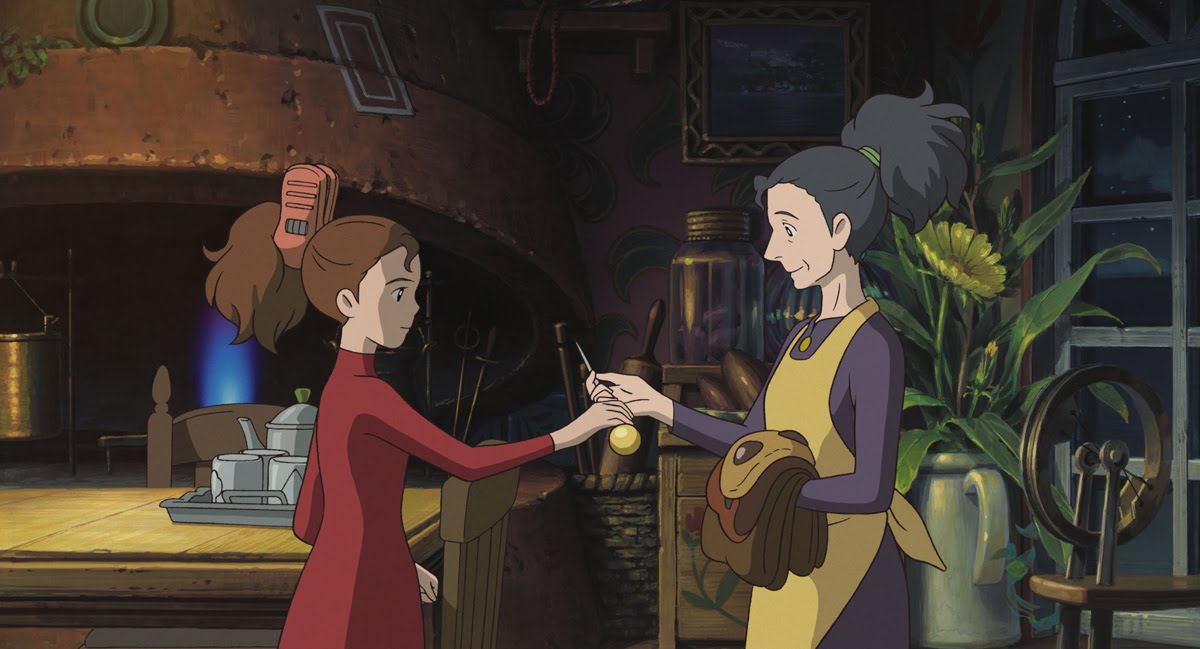
The housekeeper Mrs. Driver (here called Haru) is less menacing, more comical than in the book, but she’s the movie’s villain.
Robin Williams portrays her in the English-language verison.


Now the Japanese animators, Studio Ghibli, best known for the lush, brilliantly imaginative films of Hayao Miyazaki, have turned to the story, and Arrietty the Borrower (Karigurashi no Arietti) is the result. It opened in Japan on my birthday, and is currently in wide release in France, where a Borrower is called a chapardeur. (Now you know.)

Questions of scale need not trouble animators much, and Ghibli’s artists excel in careful architectural renderings and beautifully painted backgrounds that help to ground the fantasy, much as Norton’s prose does. The studio’s productions typically center on strong heroines, and Norton’s stories have one in Arrietty, whose fascination with humans invariably leads to crisis for her family. Ghibli movies have a penchant for pretty but largely ineffectual heroes, and in the Boy (here called Sho), the Borrowers provide one of those, too.

Sho, the boy: Non-threatening crush.
Ghibli heroes tend to be good-looking but weak.


Finally, many Ghibli movies also feature anti-war and environmentalist themes, and here I might have expected the Borrowers to come up short, as it were. There’s no war and almost no violence, but in the new movie that bears her name, one character reminds Arrietty that the Borrowers are an endangered species. And so this is an auspicious matchup of story and interpreters.

That’s not to say that Ghibli director Hiromasa Yonebayashi (at the helm of his first feature) didn’t make changes. The first of these is to update the story, as his predecessors did: no Borrowers in Victorian dress. When everything is set in the present, one must lose Norton’s original framing device, too: in The Borrowers, the first book in the series, we return to the house in Befordshire, where the Boy’s sister, now an old woman, tells the Borrowers’ story to her young relative, Kate; the reader experiences the adventure in flashback chapters.

Arrietty and Homily

Moving the story to Japan makes sense, to a degree — there are similarities in social conventions that boost the film, as they do the novels — though that may limit the movie’s appeal to audiences in other countries. The house and furnishings look Western, and they’re not alone: I’d always presumed that Borrowers in Asia would look Asian, but that’s not the case now. Ghibli’s Arrietty looks much like the redheaded English rose depicted in the American editions’ illustrations, by Beth and Joe Krush.

In the transplantation, we lose some of Norton’s linguistic wit: the Borrowers’ names “sound borrowed,” as she observes, but it’s probably useless to try to translate them. (You can’t imagine my surprise when I found out what a real “homily” or “arietta” was.) Ghibli’s Borrowers retain the family name, Clock, though they seem to live behind the kitchen cupboard, presumably because younger Japanese audiences don’t know what the English word “clock” means.

Pod takes Arrietty borrowing.

Pod has become something of an action star: far from the potbellied paterfamilias of the books, this dude is pumped. So much emphasis has been put on Homily’s nervousness that we lose sight of her tougher inner resources, and she becomes a largely comic figure. The friendship between Arrietty and the Boy has been romanticized — improbably, and yet perhaps necessarily, because (from what I can tell) Japanese girls require a love story in their entertainments.

These changes may not matter — apart from the fact that I believe Mary Norton got it right in the first place — but other divergences are more important. In the movie, the Clocks own quite a lot of furniture that doesn’t look as if it’s been made from cast-off objects; instead, tables and chairs and even smaller accessory items look as if they’ve come from a dollhouse, at a point in the story when the family still make what they need, out of what they can find. (Only later, in the movie as in the book, do they start raiding the dollhouse, at the Boy’s instigation.)

Class conflict: The dollhouse, focus of Homily’s bourgeois aspirations.

Norton’s Borrowers are decidedly not elves or fairies, and they possess no magical powers whatever. (It would be far easier for them to get out of scrapes if they did.) Studio Ghibli movies are usually full of magic and mysticism, but Yonebayashi manages to resist temptation — until the end, when Arrietty communicates telepathically with a housecat, for no discernible reason other than to speed up the final sequence.

Behind the wainscoting

Norton shows us much of Arrietty’s isolation through her longing to go outdoors, into the vast world that she can see only through a grate, but from the first scene, Yonebayashi portrays her running free in the garden; she’s also got insect pets. Presumably Arrietty’s affinity for nature — abundantly gratified in the later Borrower books — was part of what drew the Ghibli folks to her story, but indulging it too soon doesn’t help her character arc. (In the book, it’s significant that Arrietty and the Boy first talk outdoors, where they are free — where Arrietty has never before set foot — rather than inside the house.) She emerges onscreen as a much less developed, more conventional, and therefore less satisfactory, heroine.

Bambi might feel at home here.

And yet she’s still recognizably Arrietty. For the most part, Yonebayashi and his team stay true to the story and characters, and the artwork is lavish. You have to go back to early Disney animation to find backgrounds as richly colored and evocative. There are four more books to cover, and Arrietty the Borrower concludes with the possibility, if not the outright promise, of a sequel. Yonebashi even introduced Spiller early (and winningly), so the groundwork has been laid, and I’d be pleased to see Studio Ghibli return to this material. Indeed, as the Clock family explore earth, water, and air, the Ghibli artists might find themselves in their element.

Mary Norton published The Borrowers Aloft the year I was born, and I had finished reading the series by 1971, when she published the novella Poor Stainless, a cautionary tale about Arrietty’s cousin. In 1982, she published the last of the series, The Borrowers Avenged.

Ready for a sequel: Spiller demonstrates his prowess.

I pounced on the book as soon as it was released in the U.S., and afterward, intensely moved, I wrote Mary Norton a long fan letter — explaining what the books meant to me, how they’d inspired me to build miniatures and to write stories. I ran on and on about the characters, and pretty much begged her to write one more story.

She was an old woman by then, and though I’ve been given to understand by other children’s authors (E.L. Konigsburg, for example) that this is the kind of letter a writer loves to read, Mary Norton didn’t answer me. Maybe she never got the letter; maybe she was overwhelmed by my effusions.

And maybe you are, too. Go see a movie.


*NOTE: The Borrowers faithfully adhere to the 1/12 scale (also known as “inch-to-foot”) on which traditional dollhouses and furniture are constructed; they’d be hopelessly lost in Barbie’s Dream House. I’ve always suspected that memories of her own playtime inspired Mary Norton to write these stories. Too many practical details are too apt to be accidental, and a reader can almost picture her crafting matchbox bureaus and bottle-cap saucepans for a “family” of dolls that, under her watchful eye, will take on lives of their own.


Read more!