Showing posts with label Janice Hall. Show all posts

20 November 2017

Joyce Castle Toasts Bernstein, Janice Hall Forgoes Opera at Urban Stages


Lenny and Joyce during the first performance of Arias and Barcarolles.
With Michael Tilson Thomas also seated at the piano, and baritone John Brandstetter.

Joyce Castle captivated me from the minute we met, more than 30 years ago. Since then, I continually discover that she’s had that effect on other people, too, many of whom I admire in their own right. When I interviewed director Harold Prince, for example, we concluded our conversation with praise of Joyce — almost as if we were trying to one-up each other, or competing for the presidency of her fan club.

Leonard Bernstein thought highly of Joyce, too: at one rehearsal, the height-challenged composer was so delighted that he pulled up a chair and stood on it to kiss her. Joyce sang the first performance of his Arias and Barcarolles, and she won the hearts of New York audiences (and a Grammy Award) playing the Old Lady in his Candide at City Opera in the 1980s. Joyce has sung Bernstein’s music all over the world, easily embracing both his show tunes and his “classical” compositions. She’s got the musicianship — and, importantly, the sense of humor — to field anything Bernstein throws her way.

Bernstein’s centennial (officially in August 2018) is already being celebrated by orchestras and other musical groups around the country. When Urban Stages invited me to produce a show for its annual “Winter Rhythms” series, I thought it would be nice to stage a tribute now, before audiences are overloaded with his music. Naturally, I thought of Joyce. Would she be interested in making a “special guest star” appearance in a Bernstein tribute? “Why don’t I do the whole thing?” she replied.

And that is how Joyce Castle will be making her first New York appearance in more than six years, on December 16, at 7 pm, in LENNY! A Toast to Bernstein on the Eve of His Birthday. With her longtime collaborator Ted Taylor on piano, Joyce will share songs and stories, reminiscing about the composer — and I couldn’t be more thrilled.


A long way from Rovno Gubernia: Joyce as the Old Lady in São Paulo, with conductor Marin Alsop.

This year’s “Winter Rhythms” series features 22 shows in 12 days, to benefit Urban Stages’ remarkable educational and outreach programs. The series kicks off on December 12 with a tribute to composer and music director Barry Levitt, whose sudden death this fall hit the cabaret community hard: remembering him in song is the perfect celebration of a much-loved man. People are very excited about the tribute to Broadway book-writer Michael Stewart on December 18, featuring Chita Rivera, Jim Dale, and Charles Strouse. On December 21, there’s a concert performance of Stephen Cole and Matthew Martin Ward’s After the Fair, marking that show’s twentieth anniversary; and the series wraps up with a concert of Disney songs on December 23. Over the 12-day period, more than 100 artists will perform, a who’s who of New York’s musical scenes, and every year, producer Peter Napolitano makes sure there’s something for every musical taste. Click here for a complete listing and descriptions of all the shows.


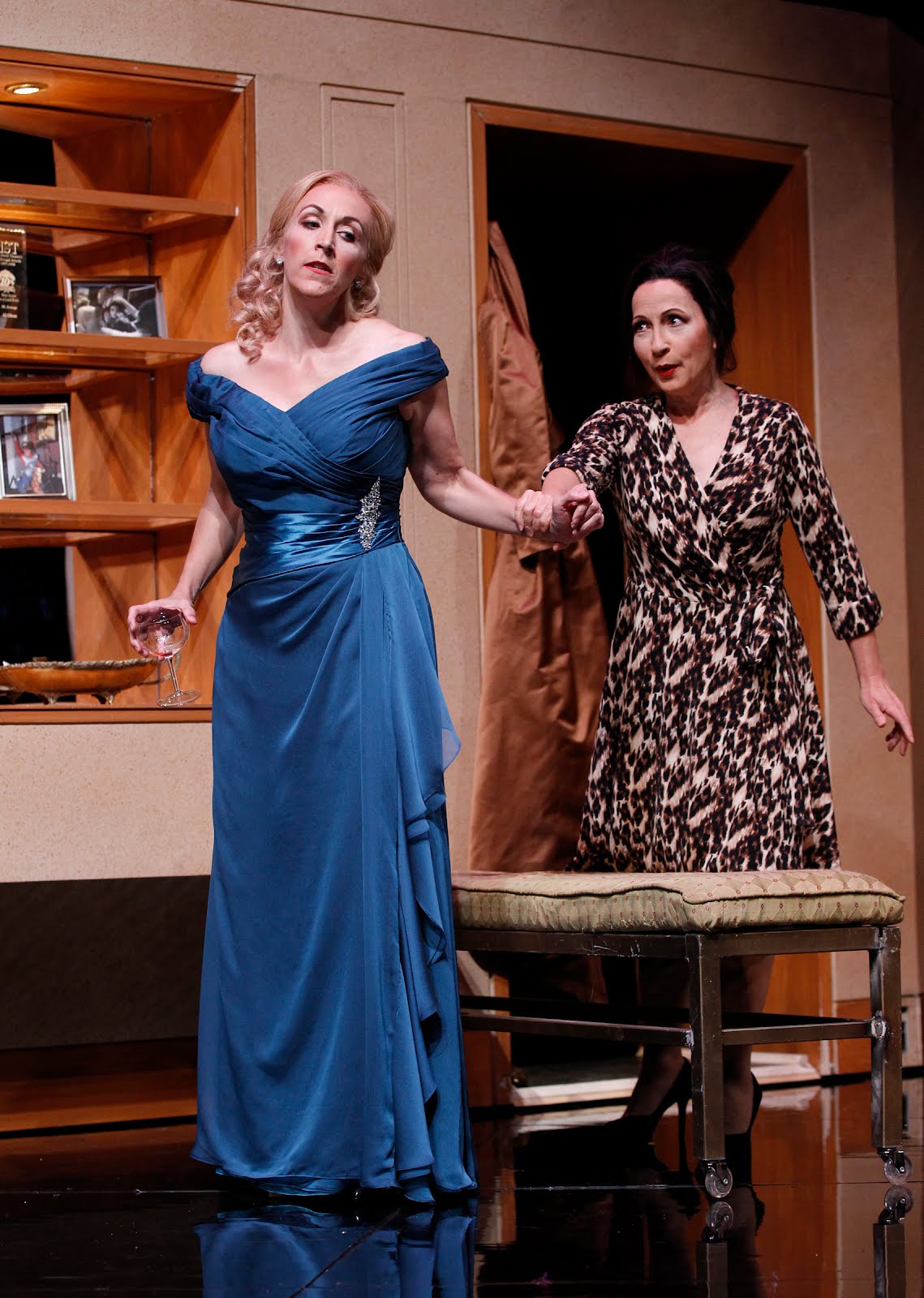
Janice Hall draws on her own experiences from her operatic career.

I’m especially looking forward to Janice Hall’s “The Opera Show with No Opera” on December 16 at 3 pm. I first saw Janice in an opera, Britten’s The Turn of the Screw, opposite Joyce Castle herself, and it was Janice who ushered me into the cabaret community. For this show, Janice will tell the stories of great operas — using songs by everybody from Billy Joel to the Smashing Pumpkins. “You’ll laugh. You’ll cry. Just like at the opera,” Janice promises. Peter Napolitano directs, and Matthew Martin Ward is music director.

If you want to see both Joyce’s and Janice’s shows (and you do), you can get a discount by clicking here.


Read more!

17 June 2013

From Opera to Shakespeare with Janice Hall


Jason Wilson (Claudius) and Janice Hall (Gertrude).
Wilson is by far the youngest Claudius I’ve seen in a grownup production,
which lends his scenes with Gertrude an additional sexual charge.
Gertrude was a cougar: who knew? And yet it makes sense.
Photo by Russ Rowland.


I have sometimes used the word “reinvention” to describe what Janice Hall is doing as a performer — and her latest work persuades me that I should stop it. As she expands her horizons beyond the opera house and into cabaret and “legit” theater, she is adapting, perhaps, as she applies her skills to different forms, but she remains very much the same artist.

The performance in question is Janice’s assumption of Shakespeare’s Gertrude in the Seeing Place Theater’s production of Hamlet, currently running in repertory with Tom Stoppard’s Rosencrantz & Guildenstern Are Dead through June 29 and 30. (Janice plays Gertude in the Stoppard play, too.) Janice previously appeared with the troupe in Sam Shepard’s A Lie of the Mind, and to see Brandon Walker and Erin Cronican’s productions of these plays, one is struck by the similarities between the Shepard and the Shakespeare, particularly in Walker’s performances as the tormented American and the melancholy Dane.

As the Queen of Denmark, Janice brings to the stage a number of strengths, and while she may have picked them up on the street corner when she was a kid, for all I know, it’s certain that she honed them in opera. Really, I am beginning to think that all actors ought to spend a little time in the opera house before they turn to Shakespeare.

After all, for the greatest part of her career, Janice has been communicating with poetry. It must be said that very few opera librettos rival Shakespeare’s plays, but they do contain poetry. In Shakespeare, however, the actor must take on the roles that singer and composer take in opera. She must locate the music in the text, and then give voice to it. Even more challenging is the fact that she must locate the music all over again, every time she steps onto the stage.

And yet it’s absolutely imperative that she do so, because speeches in Shakespeare demand structure — or else the audience won’t be able to follow them. Even in a play as universally familiar as Hamlet. These Danes tell one another stories, such as Gertrude’s account of Ophelia’s death, which is in a very real sense an aria.* Again, Janice has been telling stories onstage this way all her life, and the approach she uses works in other kinds of theater, too: consider the way that another classically trained singer, Dixie Carter, constructed Julia Sugarbaker’s tirades on Designing Women.

Another great advantage that opera brings to Janice when tackling the Bard is command. Most of the major characters in Shakespeare, like most of the major characters in opera, are nobly born and accustomed since childhood to giving orders. Even Violetta and Cio-Cio San (to name two of Janice’s roles) have servants. This isn’t a question of being bossy, necessarily, but it does suggest an authority, a kind of confidence: Janice plays characters who, like Queen Gertrude and nearly everybody else in Hamlet, expect to be obeyed. (That’s one reason the Gravedigger’s scene is so much fun: he’s tweaking the Prince with the reminder that death is more powerful than any king.)

In Hamlet, the nobility of the characters is key not only to the fulfillment of the Aristotelian dictates for tragedy but also to understanding the stakes in the play. Shakespeare doesn’t give us Hamlet’s exact age, but he’s over 30 (his boyhood playmate, the jester Yorick, has been dead for 23 years), and in most societies, that’s very much considered maturity.** The laws of primogeniture therefore would deliver the crown to Hamlet, not to Claudius, the dead king’s younger brother.

Claudius’ hasty marriage to Gertrude thus takes on political significance, beyond the currents of sex and alcohol that run through Shakespeare’s depiction of them. Their alliance enforces his claim to the throne. And as a result, he needs her more than she needs him, and he’s naturally more alarmed by Hamlet’s attempts to influence her.

Janice is a little bitty slip of a thing in real life, and soft-spoken in all my interactions with her. But she is always gracious — which is, after all, part of being regal and fundamental to Gertrude’s character — and onstage she knows how to convey the necessary bearing and authority of a monarch. This works even in an updated Shakespearean production, such as this one, and in turn it heightens the effectiveness of the more basic, domestic passages in the play. Look at her exasperation whenever Hamlet starts to complain yet again about the marriage to Claudius. She’s like a suburban mom tired of her teenage son’s rebelliousness: she’s heard this rant a million times, and when will he ever let it drop? And yet she’s still every inch a queen.

Another actor friend, that eminent Shakespearean Andrew Weems, told me long ago that he’d developed an interest in opera (long after I’d tried and failed to steer him that direction), because he wanted to learn “how to roar.” He didn’t mean mere loudness, of course (I think he was born knowing how to do that much), but rather a sense of command, of grandeur in the occasion. Marilyn Horne talks about something similar in master classes, when she tells young singers, “You’ve got to be big.”

So much of opera, like so much of Shakespeare, entails bold passions, which an audience can’t fully appreciate unless the performer can rise to them. For singers, as I say, the trick is to find the inner music of the text — and to sing out, even when speaking.

So quite beyond my usual awestricken admiration for Janice’s talents and her success in finding new outlets for them, her performance as Gertrude has helped me to grasp several ideas that have been kicking around in my head for some time. That’s one of the lovely things about Shakespeare: there’s always something new, even in Hamlet. And it’s the mark of an artist to help us to understand anything in new ways.

There’s much else to recommend the production, and I do also want to single out Erin Cronican’s Ophelia, whose ultra-contemporary sassiness is absolutely faithful to the words on the page and helps her to build a surprisingly effective character — recognizable and yet still registering all the horror and pity of the poor girl’s plight.

And in the mad scene, she sings, too. So there.

Hamlet by William Shakespeare
May 31–June 29
Thursdays, Fridays, and Saturdays at 7PM
Also Tuesday, June 25 at 7PM
Rosencrantz & Guildenstern Are Dead by Tom Stoppard
June 1–30
Wednesdays at 7PM, Saturdays and Sundays at 2PM
The Seeing Place

At ATA Sargent Theater
314 West 54th Street, 4th Floor
New York
For more information and to order tickets, click here.


*NOTE: Gertrude’s speech inspired Hector Berlioz, among others. Ambroise Thomas cheated by letting Ophélie act out what Gertrude tells us about. But that’s what we might expect from a composer who lets Hamlet survive at the end of his opera.

**I except myself from this analysis, of course. I was Peter Pan when I was 30, and I still am.


Read more!

01 June 2012

Fort Worth Opera Festival 2012: Heggie’s ‘Three Decembers’

Matthew Worth (Charlie), Janice Hall (Madeline Mitchell),
and Emily Pulley (Bea).
Illustration by WVM©


Over the years, Fort Worth Opera has devoted a significant focus to smaller, contemporary pieces, with winning results. And while new chamber operas are being written (and perhaps with greater frequency now than ever) and there’s plenty of cachet attached to a world premiere, there’s also great value in returning to recent work by rising or established composers. A second hearing for some will be an entirely new experience for most audiences, and between those parameters we may arrive at new insights and judgments. A case in point: last year’s production of Glass’ Hydrogen Jukebox was downright astonishing, and effectively created a consensus that this is among the most important works of the late-20th century.

This year’s Fort Worth Opera Festival features two contemporary works, Mark Adamo’s Lysistrata and Jake Heggie’s Three Decembers, the latter of which, an intimate family portrait, is the featured chamber opera this year. Although both these operas were heard first at Houston Grand Opera, Fort Worth is, in a very real sense, making its own, ongoing investment in both composers: Adamo’s Little Women was a highlight of the 2004–05 season, and Heggie’s Dead Man Walking created a sensation at the 2009 Festival.

Heggie’s work has been heard locally in connection with his residency at University of North Texas in 2010–11 and at Dallas Opera, which saw the world premiere of his Moby-Dick in 2010 and will unveil another new opera, Great Scott, in 2015 (with Joyce DiDonato in the lead). So there’s abundant reason to reexamine Heggie’s catalogue and to join in what is becoming a lively conversation here: few communities have the luck to play such an important role in a composer’s career. Certainly New York doesn’t hear him so often as the Metroplex does.

Fort Worth lavished great care on Three Decembers, giving the piece a brilliant production and every chance to make a favorable impression. Certainly many in the audience connected with the emotional themes of the piece, a portrait of a dysfunctional family.

Bea (Pulley) and Charlie (Worth) reminisce
on the Golden Gate Bridge.
Photo by Ellen Appel©
Courtesy of Fort Worth Opera

Three Decembers concerns Madeline Mitchell, a Broadway star whose pursuit of professional success has wounded both her grown children. Gradually we see that her elder child, Bea, is going through the motions in a basically loveless marriage; apparently, she’s an alcoholic, too, though that possibility is treated most superficially in Gene Scheer’s libretto, based on a play by Terrence McNally. More thoughtful is the treatment of Bea’s brother, Charlie, whose homosexuality — and whose AIDS-stricken lover — Madeline has never quite accepted.

Creating effective showcases for artists he cares about is one of Heggie’s principal artistic goals, it seems to me, and he’s very much succeeded here. He designed the role of Maddy for Frederica Von Stade, with whom he’s enjoyed a long artistic collaboration and a close friendship; last year, Joyce Castle assumed Maddy’s crown in Central City, Colorado; and here in Fort Worth, Janice Hall took the role. Maddy is given ingratiating vocal music (including a show-stopping Broadway number), a sympathetic character, and just enough dramatic heft to earn multiple ovations by the evening’s end.

Janice, who’s enjoyed several noteworthy triumphs in Fort Worth, really rose to the occasion, with smooth yet characterful vocal lines and a powerful physical presence that told you not only that Maddy was a star but also that you’d be a fool to cross her.

Soprano Emily Pulley played Bea in Central City; here, she offered a poignant eagerness, mostly just trying to reach out to her mother and brother yet hesitant and painfully lacking in self-confidence. Baritone Matthew Worth cut a handsome figure onstage and lavished buttery tone on Charlie’s sorrows and frustrations.

Presenting Madeline Mitchell.
Janice Hall, photographed by Ellen Appel©
Courtesy of Fort Worth Opera


Candace Evans, new to the company, directed with a sure sense of the flow, abetted by Bob Lavalee’s ingenious set designs. Rondi Hillstrom Davis might have done more to accentuate Bea’s character (she dressed too much like her mother, I thought), but she really captured Maddy’s theatricality and Charlie’s desire to be more like other people. Christopher Larkin conducted the chamber ensemble from backstage, and for coordinating the instrumental and vocal forces, he deserves abundant praise.

But there are limits to what a conductor can do to redeem a score, and this is far from Heggie’s best work. While I enjoyed his easy way with melody and his penchant for waltz numbers, I found his orchestrations twinkly, frailer even than the realities of chamber music require, to the point that they undermined the drama onstage.

In truth, there was precious little drama at all. Much of the blame for this lies with McNally and with Scheer, of course. They give us glimpses of the family in 1986, 1996, and 2006, ostensibly around Christmastime, with cards and reunions and observances. The opera’s title is misleading, however, since some scenes take place in other months, notably June for the Tony Awards. Far more serious contrivances emerge almost immediately.

The family is still recovering from the loss of Maddy’s husband, Bea and Charlie’s father, when the children were quite young. Somehow we’re supposed to believe that our protagonists reflect on this loss only on those occasions when we see them, beginning two decades after the father’s death. Thereupon, the characters talk — but do almost nothing. Granted, there are plenty of operas where people merely stand around and sing about their predicament, but those aren’t as intimate as this one: we’re not sitting right next to the singers, and they’re not addressing problems identical to our own.

And with regard to those problems, as they’re addressed here, I respectfully point out that the emotional response of the audience doesn’t suggest that the artistic treatment of is fully dimensional or particularly meaningful. People get choked up over Kodak commercials, too.

The only thing that passes for action in Three Decembers is a terrible confession that Maddy makes, for the simple reason that, if she doesn’t, there’ll be no story. Talk about contrivance! Maddy might have confessed 15 years earlier; she might do it 15 years later; she might hold her tongue altogether. The confession is almost entirely unprovoked and unmotivated, and Heggie doesn’t even do his bit by ratcheting up the tension in the music before Maddy lets fly with the truth. Thereupon all three characters respond to her announcement by talking some more, dooming our hopes that something might actually happen here.

And yet I didn’t hate Three Decembers. I found much to admire in this score, and I believe strongly in the value of reexamining a composer’s work from time to time. This was the first time I’d heard this particular score, and I’m not sorry Fort Worth mounted it. But Heggie, Scheer, and McNally have all proved themselves capable of better work, and such an underdeveloped piece may not deserve all the trouble required — from producers and listeners alike — to score the artistic and emotional points its creators didn’t manage on their own.


Tony Awards-night tensions: Pulley and Hall as Bea and Maddy.
Photo by Ellen Appel©
Courtesy of Fort Worth Opera


Read more!

11 May 2012

Fort Worth Opera Festival 2013 to Include Me

In last year’s production of Ariadne at Houston Grand Opera,
Jon Kolbet (left) played the Major-Domo. Here, he’s joined by
Rodell Rosel as the Dancing Master and, as the Composer,
a certain Miss Susan Graham.


Fort Worth Opera begins its 2012 Festival this weekend with an exciting quartet of works both old and new — on which I’ll be reporting at the end of the month, when I fly to Texas for the final weekend of the Festival. But because the company’s general director, Darren Keith Woods, is a believer in strategic long-term planning, today also marks the official announcement of next year’s Festival offerings.

For 2013, Fort Worth Opera will present Puccini’s La Bohème, Donizetti’s The Daughter of the Regiment, and Richard Strauss’ Ariadne auf Naxos, as well as a contemporary work, Tom Cipullo’s Glory Denied, in keeping with the company’s commitment to the music of our time. And that commitment will be extended next year, as Fort Worth Opera inaugurates its Frontiers program, a showcase for short excerpts from larger works by emerging composers, to be selected by a panel of experts from a variety of fields related to opera. Frontiers performances will be free of charge, and — rather unusually, to say the least — an integral part of the program will be the opportunity for the public to offer feedback to the composers.

So often it seems to this observer that fledgling composers are left to their own devices: they have to figure out on their own (and sometimes very far from the opera house) what audiences will and won’t like, and once new work has been performed, composers are cut loose with little guidance or analysis of their successes and failures. Fort Worth Opera aims to change all that.

Joyce Castle as the Marquise, with John Stephens as Sulpice and Robert Gibby Brand as Hortensius, in Lyric Opera of Kansas City’s Daughter of the Regiment.
Who wouldn’t want to get in on the fun?
Photo by Cory Weaver.


For those of us who have been coming to Fort Worth repeatedly over the years, the casts for these works are a real treat, featuring many returning artists who are local favorites, as well as some distinguished first-timers in the area. Those of us who marveled at young baritone Wes Mason’s tour-de-force performance in Jorge Martín’s Before Night Falls will be eager to see him as the painter Marcello in Bohème, for example, and soprano Ava Pine will add to her radiant Fort Worth résumé the title role of Marie in Daughter of the Regiment, opposite no less than the great Joyce Castle as the Marquise of Berkenfeld and Darren Woods himself, making a rare return to the stage as Hortensius, the Marquise’s butler.

Other returning favorites include soprano Marjorie Owens as Ariadne and baritone Michael Mayes, taking the lead in Glory Denied. Among the company debutants are star soprano Mary Dunleavy as Mimì and rising tenor Sean Panikkar as Rodolfo in Bohème — and I’m eager to hear the always impressive soprano Caroline Worra once more (in Glory Denied).

There’s one name you won’t find in the season announcement, though it’s of immense potential interest. It’s mine.

Donovan Singletary as Figaro, Andrea Carroll as Susanna.
Fort Worth Opera Festival 2012.
Photo by Ellen Appel.

Meine gnädige Damen und Herren, it is my great pleasure to announce that I’ll be returning to the stage after an inexplicable absence of 30 years, to play the speaking role of the Major-Domo in Ariadne auf Naxos. Mine is the responsibility to tell the young Composer (mezzo Cecelia Hall) that his dead-serious opera must be performed at the same time as a boisterous commedia dell’arte routine, because the wealthy patron (inspired by Molière’s Bourgeois Gentleman) wants to hurry up and get to the fireworks display he’s planned for the end of the evening.

Oh, and one more thing — I will be saying all of this in German.*

As Anna Russell would say, I’m not making this up, you know.

Fort Worth’s Three Decembers cast: Janice Hall (seated),
Emily Pulley, and Matt Worth.
Fort Worth Opera Festival 2012.
Photo by Ellen Appel.


While I’m trying not to throw the tempo off the track, everybody else will be singing, of course, including tenor Corey Bix in the heroic role of Bacchus and soprano Audrey Luna as the singing acrobat Zerbinetta (both making their company debuts), under the baton of Fort Worth Opera Music Director Joe Illick. Stage director David Gately, who’s guided some of the company’s most memorable productions, will tell me where to go.

Technically, this isn’t my opera debut, since I played a soldier in the firing squad in Providence Opera Theatre’s production of Puccini’s Tosca, many years ago. This new assignment is a good deal more demanding, however: the entire plot hinges on what I say, and I have to remember not to shoot the tenor this time.

E avanti a lei — tremo! Carter Scott as Floria Tosca.
(Really. She doesn’t usually dress like this.)
Fort Worth Opera Festival 2012.
Photo by Ellen Appel.


No less an Ariadne authority than Susan Graham has warned me to waste no time in learning my lines. I’ve already gotten in touch with Terry Quon, an estimable opera buff herself and my German teacher back at J.J. Pearce High School in Richardson, just down the road from Bass Hall.

I have also bluntly and without shame asked Darren to find money in the costume budget that would allow for an extra supernumerary in Daughter of the Regiment. Really. I could be a soldier, a valet, a villager, an ottoman or an end table. I’m not choosy. I’m not even greedy. I just want to be part of the fun when Joyce and Darren reunite.

Thus far, Darren has demurred most politely, but perhaps if some of my faithful readers make a contribution to Fort Worth Opera, he will move beyond this highly uncharacteristic indecision and embrace my participation in a second production next season.

Houston Grand Opera’s world premiere of Adamo’s Lysistrata.
Not sure who everybody is, but the great Myrna Paris is at left.
Photo from FWO, courtesy of Brett Coomer.


But even if that dream goes unfulfilled, this will be an extraordinary opportunity. Since my first sampling of Fort Worth Opera’s work — a performance of Britten’s Turn of the Screw starring Janice Hall and Joyce Castle, in 2003 — I’ve been captivated by the company’s dynamic approach, wide-ranging repertory, and outstanding musical and theatrical values. Over time, Darren and I have grown to be close friends, not because he was trying to co-opt a critic but because he spotted that I care about what he cares about.

Through him, I’ve gotten to know some other remarkable artists, and I’ve attended some of the most thrilling performances of my career as an audience. Now I’m going to be able to see, up close, how Darren and Joe and David make their magic. You can expect me to write quite a lot about this experience.

Beyond that, I’m grateful to Darren for taking a chance on me. He put something out into the universe when he offered me this gig, and it’s no coincidence that, shortly thereafter, the long wait ended and I found a publisher for the Madeline Kahn biography. That’s powerful friendship — and I thank him.

Darren.
Photo by Ellen Appel.


So as not to confuse you, I’ll stop talking about the 2013 season now and remind you of this year’s operas. Evening performances are at 7:30, matinées at 2:00. Three Decembers plays at the Scott Theater, the rest at Bass Hall in downtown Fort Worth. Go to www.fwopera.org now to order your tickets!

Mozart’s The Marriage of Figaro
Featuring Donovan Singletary, mezzo Wallis Giunta, and other fresh young singers.
May 19, 27 matinée; June 1.

Puccini’s Tosca
Starring soprano Carter Scott, who blew me away as Fort Worth’s Turandot a few seasons ago, alongside tenor Roger Honeywell and baritone Michael Chioldi, who is guaranteed to take the tedium out of the Te Deum.
May 12, 20 matinée, 25; June 2.

Mark Adamo’s Lysistrata
A comedy written by another friend of mine, reuniting native Texans Ava Pine and tenor Scott Scully (Angels in America).
May 26; June 3 matinée.

Jake Heggie’s Three Decembers
A chamber opera about love and tensions in one family, starring my beloved Janice Hall.
May 13 matinée, 18, 20, 26 matinée, 31; June 2 matinée.
(At the Scott Theater, Fort Worth Community Arts Center.)


*NOTE: How German is it? Well, my character is most often called not a “Major-Domo,” but a “Haushofmeister.” Try saying that with a mouth full of Saltines.


Read more!

07 April 2012

Catching up with a Few Friends

Actress: Janice Hall

Readers of this blog may have noted a deeply unprofessional tendency on my part to praise certain performers and writers, especially those whom I know personally. This is fatal behavior in any critic, which may be why I’m no longer getting many assignments in publications I don’t own. So let me take this opportunity to tell you about a few ladies who have graced these virtual pages on several occasions, since I can corroborate their excellence by citing fresh credits and evidence of the esteem of others.

First up is Janice Hall, the operatic soprano who recently took up a new career in cabaret. You may remember that, when I heard her latest act, I’d Rather Be Doing This, at New York’s Metropolitan Room (and by the way, there’s another performance coming up on April 18), she added a quick set of numbers from her Marlene Dietrich show, Grand Illusions, for the edification of any audience present who were voting in the MAC Awards competition (Manhattan Association of Cabarets and Clubs). Well, the results are in, and Janice has been named the Female Vocalist of 2012.

I told you she was good.

Janice arrived late to the awards ceremony, because she’d been onstage — and decidedly less glamorous — in what is her off-Broadway acting debut, in Monica Bauer’s play My Occasion of Sin at Urban Stages under the direction of Frances Hill, which I saw last weekend.

Winner!
Grand Illusions’ director, Peter Napolitano,
won a MAC Award, too.

Now I knew that Janice could act quite beautifully, of course: I’ve seen her in opera. And I knew she could handle spoken dialogue, not least because David Gately, director of Fort Worth Opera’s production of Peter Eötvös’ Angels in America, actually restored a lengthy speech from Tony Kushner’s play, which Janice performed on video. She played an elderly Bolshevik, in heavy makeup and a heavier Russian accent. And she was transfixing.

In My Occasion of Sin, Janice doesn’t sing a note, and she portrays only one woman, who’s far from the most likable character onstage. Helen is severe, prudish, and so caught up in her Catholic faith and her narrow social set that she can’t see her own bigotry and its harmful consequences. That’s a problem in Omaha on the eve of a race riot.

You’d never know Janice hasn’t been a “legit” actress all her life, and her voice, as beautifully modulated in speech as it is in song, really conveys Helen’s need for a certain kind of order. Janice fully holds her own with a terrific cast: Scott Robertson as her husband, Rosebud Baker as their music student, hunky Royce Johnson as a jazz musician, and Danielle Renée Thompson as a young girl who seems (and for the most part, is) unconnected to anyone else in the play.

The script ping-pongs between Thompson’s extended monologues and the drama enacted by the other members of the ensemble. Structurally, the back-and-forth becomes tedious, and nothing much happens to Thompson’s character — which is only right, I suppose, since she’s playing a 14-year-old. But it’s also time-consuming, and distracting from the more urgent action in the rest of this already long, intermission-less play.

Even given the excellence of Janice and the other actors, the fate of the play really rests on Thompson, and of course Bauer can’t be sure the next actress will be equally talented, or so ably directed. Whether narrating or mimicking others, Thompson is persuasive and quite charming, but she and director Hill barely manage to keep the thing going. For these ladies’ work and that of the rest of the cast, I do recommend My Occasion of Sin to you — just as I recommend cuts and revisions to the playwright.

Ann Harada, with the lovely but fashion-challenged Debra Messing.
And yes, that’s Anjelica Huston — Anjelica Freakin’ Huston — in the background.


In other news, lovely Ann Harada has joined the cast of NBC’s Smash, so that you can see for yourself how terrific she is, playing the stage manager, Linda. Grounded and fully engaged no matter what’s going on around her, she’s one of the more believable characters in the show, and I’m hoping they’ll give her a major story line soon.

In the meantime, she’s getting great press, including the picture above, from a New York Magazine slideshow of all the awful costumes Debra Messing has worn on the show. I hardly pay attention to such things while the TV is on, but to see the outfits collected this way is impressive and rather scary. To people such as the New York editors, who actually know something about fashion, poor Debra must be horrifying.

As you can see in the picture, Linda is busily sketching Julia (Messing), so that future generations will never forget the awfulness of her dress.

And finally, I was looking forward to the great Charles Busch’s return to the stage, with his Biblical epic, Judith of Bethulia, at New York’s Theater for the New City through April 28. Apparently there’s a D.W. Griffith movie of the same name, in which Blanche Sweet plays Judith, which is just the sort of thing you would expect Charles Busch to know all about, really.

But guess what? The entire run is sold out, which drastically diminishes my latest chance to admire Jennifer Van Dyke in guy’s clothes. Still, I find comfort in the fact that my friends are so talented — and you don’t have to take my word for it.

The cast of Judith of Bethulia, featuring Busch (second from left)
and dashing Jennifer Van Dyck (far right).

Now if Debra Messing wanted to make a really bold fashion statement,
she’d hire Charles Busch to pick out her costumes.


Read more!

12 March 2012

Janice Hall at the Metropolitan Room

Portrait of a Cabaret Star.
Illustration by WVM©


As spring offers tantalizing signals of nearness, I rise some days prepared to sing “Oh! What a Beautiful Mornin’.” Luckily however — for anyone within earshot — I don’t have to sing it, because Janice Hall is doing it for me. It’s the opening number in her new cabaret act, “I’d Rather Be Doing This,” which I caught at its second performance at New York’s Metropolitan Room.

Janice gave us a preview in December at Urban Stages, a theater in midtown, but while Urban Stages’ proportions are certainly intimate, it’s not a cabaret: the new material felt right before, but it feels righter now in the sort of space it was designed to fill. An increasing sense of ease marks Janice’s each foray into this art form — which is not to say that she ever seemed uneasy.

But consider the ingredients of I’d Rather Be Doing This: a collection of some of Janice’s favorite theater songs and pop standards. In her previous show, Grand Illusions, Janice had a theme: the career of Marlene Dietrich, as charted in song.* In this new show, Janice herself is the Dietrich, if you will, the star around whom the show is built.

She brings to the cabaret stage a number of skills that have helped her transition so gracefully into this new repertoire. Among the most important, I realized while I listened to her on March 5, is rhythm — essential because cabaret is so closely linked to jazz. And baby, Janice has got rhythm, all right, delivering Nancy White’s tricky (and very funny) “Bet He Can Tango” and Porter’s “Too Darn Hot” with danceable flair. But she can slow down, too, and her mashup of Baghdad Café’s “Calling You” and Dimitri Tiomkin’s “Wild Is the Wind” proved astonishing, sung in one long outpouring of breath, her emotions seemingly torn in two opposing directions — that turned out to be one and the same.

Among Janice’s other great assets are her wit and the diction with which to express it. Intricate lyrics pose no obstacle, and with an assist from her director, Peter Napolitano, and music director, Matthew Martin Ward, she deploys impeccable comic timing — notably in Napolitano and Ward’s song, the title number, a paean to anything but making love.

Ward’s no slouch when it comes to comic timing, which he demonstrated with a hilariously deadpan running translation of the Italian pop classic, “Mala Femmena,” a furious curse on the eponymous “bad woman” who’s done the singer wrong. Here and in Piaf’s “L’Accordéoniste” (by Michel Emer), Janice made use of her linguistic abilities, though naturally they’re less central to this show than they were to the Dietrich act.

Another mashup really warmed my heart, the combination of Kurt Weill’s “My Ship” (from Lady in the Dark) and “Pirate Jenny” (from Threepenny Opera), connecting the yearning that’s in both songs with the festering, lethal resentment that marks most of “Jenny.” Every time Janice sings Weill, I go home fantasizing about the roles that she could play so beautifully, from Anna in Sieben Todsünden to Venus and beyond. With her ability to do justice to both aria and song, she’d be unbeatable in almost anything Weill ever wrote, actually.

It strikes me that, while Janice has played soprano leads in opera — the very definition of stardom — here on the cabaret stage she’s got no character but herself to portray, no personality but her own to charm us. It takes guts to do that, and I’m happy to say that Janice is succeeding magnificently.

The next performance of I’d Rather Be Doing This is April 18, at 9:30 PM at the Metropolitan Room. Be there.

Metropolitan Room
212-206-0440
34 West 22nd St.
Between 5th and 6th Avenues
New York, NY 10010
metropolitanroom.com

*NOTE: As a special treat in the form of an encore on March 6, we got a quick overview of Grand Illusions, for which Janice has been nominated for an Outstanding Vocalist award from the Manhattan Association of Cabarets and Clubs. She couldn’t include all of my favorite moments, but every one she did perform was a honey. Please note, too, that Peter Napolitano has been nominated for a directing award from the same organization.


Read more!

27 January 2012

Interview: Janice Hall Would Rather Be Doing This

Kicking up her heels in Grand Illusions

Just when soprano Janice Hall’s brilliance was starting to seem almost routine (“Oh, of course she’s going to be sublime in that new opera, portraying 37 different characters and singing the Grand Inquisitor’s aria backwards”), she found a new way to dazzle us all, turning to cabaret. Most sopranos would fall flat in such a setting, let’s be honest, but few of Janice’s colleagues can rival her expressive musicianship — to say nothing of her impeccable diction, without which any cabaret number is just a plate of cold mashed potatoes.

Grand Illusions, her first complete cabaret show, proved a revelation, not only of this new dimension to Janice’s art but also of the personal need for reinvention. Dietrich evolved constantly, and so, too, is Janice evolving.

Her newest act, of which we got a preview of sorts at Urban Stages in December, finds Janice ever more assured, offering up a fascinating mix of numbers from Cole Porter to Stephen Sondheim. Directed once again by Peter Napolitano, with music director Matthew Martin Ward, I’d Rather Be Doing This opens at New York’s Metropolitan Room on Sunday, February 12, for the first of three performances over the coming months. Reached by phone in Savannah, Janice was kind enough to talk with me about the show.

WVM: The subject of your first show was an icon, Marlene Dietrich. The subject of your new show is also a legendary diva — yourself. It’s not as if you were hiding behind Dietrich before, but this change in focus really bespeaks a growth in confidence in what is still a new art form for you. How did you arrive at the point where you felt so comfortable in cabaret performance?

JANICE HALL: It’s odd – that kind of happened by itself. I decided after Marlene, I had lots and lots of concept ideas, but that was such an exhausting, intense process, immersing myself in the world of Marlene, that I decided to give myself a little bit of a breather and give myself a program of songs that I liked.

In the process, I discovered that it was kind of about me, though that wasn’t my intention. People who saw the first performance commented on that a lot, and even then I wasn’t aware of it until I watched the DVD and said to myself, “Yes this is very different.”


WVM: Do you feel comfortable now?

JH: I do, and when I go back now and look at the Marlene footage, I see — I think I tend to be overcritical of me — but I find it to be much more formal, let’s put it that way. And I was more removed from it. So I guess just by doing, I’m becoming more comfortable and more confident, as you say, about what it is that I’m doing.

WVM: It’s not that you were uneasy before, but there’s a different kind of ease now.

JH: Marlene was a little bit more studied. I wanted it to be perfect, so I was going for that, so it was scripted in a more formal way. I think it had to be, because if you’re trying to give the story of another person, there are certain facts you have to include. This one I was just on my own, and at first it was strange because I had such a form with Marlene, you’re kind of restricted in terms of what you say and how you say it. This was free-form, and at first I thought it would be simpler, and in a way it was not. Eventually a pattern began to emerge.

WVM: Was the process this time more like programming a recital?

JH: You know, I rarely ever did recitals. The answer to that is probably yes, but I can’t necessarily tell you that from my own experience. One of the reasons I never really wanted to do recitals as a Classical singer is that it really scared me to be out there and be me, without a character to hide behind. For some reason, with cabaret music, I became very comfortable with just that very thing. If I were to go back and program a Classical recital, with what I know about putting together a cabaret evening, I would find it easier. And in fact I’m thinking of doing that.

I also want to add about the structure of the show, that was one of the ways that my director, Peter Napolitano, was very helpful in looking at the overall picture and saying, “Yes, this works,” or “No, this has to go.” If anybody ever wonders why you need a director for a cabaret show, that’s one reason why.

“Lana Turner Has Collapsed,” from Madame X.
(Also known as the act I haven’t seen yet.)
Pygmalion Theatre Company, Salt Lake City, UT, May, 2011


WVM: I’m always struck by a kind of seamlessness in your vocal production when you sing cabaret, and that’s also an asset in opera, of course. Where does your Classical training help you in cabaret, and what’s been the biggest technical adjustment you’ve needed to make?

JH: I do get that comment, and it makes me very happy, because it doesn’t necessarily feel seamless to me. It’s becoming more and more so, but the biggest challenge I’ve had in transferring over has been not trying to go into what I call opera voice. You do have to go into your head voice at some point: I’m not a belter, I’m never going to be a belter.

I’m learning how to mix my voice in new ways, but I’m also sort of relaxing and letting my soprano voice come through, but I don’t want to do it in an operatic way. So that’s been the biggest challenge, moving smoothly from my chest voice to my head voice.

Now, in terms of how it helps me, my background, I think the discipline aspect of being a Classical singer is a natural advantage to me, in terms of doing this music. It isn’t something I think about: it’s just the way I’ve been trained, it influences the way I learn music.

Frankly, I don’t know how people who don’t have that training learn music, and I’m constantly amazed at people who don’t read music at all and yet they learn just fine. I don’t understand how that happens, because my process is very different. But for me, the discipline of having to be a Classical singer is very valuable for me in this.

WVM: The title of the act turns out to be a very funny song [by Napolitano and Ward], but it also suggests or advertises that you’re performing songs that are personal favorites. People are often surprised to discover that Classical musicians like pop songs, so can you tell us how you first discovered one or two of these numbers, and how you came to understand they might be right not just to listen to, but also to sing yourself?

JH: When I was a teenager, I was listening to all kinds of different music. I’m sure that a lot of people think that my incorporation of Piaf songs or Kurt Weill songs came from my years of being in Europe, but in fact, they came from my teenage years, when I discovered Lotte Lenya and Edith Piaf and all these strange European singers. They achieved a certain iconic stature later, but at that particular point they were pretty obscure. I just found this music and listened to it. I listened to the pop music of my generation, and I’ve always been a very eclectic music listener.

So some of these songs have been things I’ve had in my ears for years. In a couple of cases, they were songs I didn’t feel ready to tackle until now. One of them is “Pirate Jenny,” of course. It’s such a difficult song because people have certain expectations. And yet those expectations have become almost stereotypical, so to find something that’s original with the song or unique to your interpretation yet remaining true to the integrity of the song is a real challenge.

Fort Worth Favorite: Janice, with David Adam Moore,
in Eötvös’ Angels in America, 2009.


WVM: Darren Keith Woods will kill us both if we don’t mention that you’re still an opera singer — performing in Jake Heggie’s Three Decembers at the Fort Worth Opera Festival in the spring. What can you tell us about how you’re getting ready for that show?

JH: Actually, that process is going to start in full, as soon as I get back from Savannah. I’m going to throw myself into that. So far, I’ve read the libretto, I’ve listened to the recording, I’ve had my costume fittings now — we did a whole wonderful afternoon of costume fittings on Sunday. That is also going to inform me a lot, in how I go about this.

But the biggest challenge for me now is simply cabaret voice and opera voice. If I’m working a lot in cabaret voice, it’s like if you’re an Olympic athlete and you’re not quite working at that level for a while, you have to get back up to that level. Just singing in my daily voice, I’ve got to get back up to that point. Because you lose stamina if you’re not at that level.

So that’s the challenge, but it’s a fabulous character to be playing, and I’m very excited about that aspect of it — as well as the musical aspect!

Janice Hall in I’d Rather Be Doing This
Metropolitan Room, 34 West 22nd St.

Sunday, February 12, 4:00PM
Monday, March 5, 7:00PM
Wednesday, April 18, 9:30PM

Heggie’s Three Decembers
Fort Worth Opera Festival

May 13, 18, 20, 26, 31; June 2, 2012


Read more!

15 December 2010

One Touch of Janice

Strike a pose: Dietrich

It’s taken me a little while to register my impressions of Janice Hall’s first cabaret act, Grand Illusions: The Music of Marlene Dietrich, about which I wrote a preview here. Indeed, I’ve waited until the first run of the show, at New York’s Metropolitan Room, ended, because I didn’t want my observations to be construed as a review in any conventional sense; I’ve waited until I saw the show a second time, in a theater, Urban Stages, because Janice gave me so much to absorb.

What Janice is doing turns out to be neither imitation nor incarnation, per se. She’s a better singer and actress than Dietrich, and for my money she’s better looking, too. She doesn’t sound or dress like Dietrich — she evokes the great star in other, far subtler ways, and on the surface, her act is more a survey course than a tribute. The key to Janice’s approach comes with the almost offhanded observation that Dietrich reinvented herself constantly throughout her career — and it is this that guarantees that Grand Illusions will stay with me for a long time to come.

The evocative Janice Hall

For Janice is reinventing herself, too. Yes, Dietrich’s songs play to some of her established strengths, notably her languages: Janice not only sings in German and French in the act, she also provided translations for some of the songs. For most cabaret artistes, that would be a stretch; for Janice, it’s a comfort zone. And yet all the while, with the help of stage director Peter Napolitano and music director Paul Trueblood, Janice is striking out in entirely new directions.

First among these is the voice, employing a sound that’s so far from the trained soprano she has deployed in her operatic career, as she demonstrates toward the end of the act. Her account of “Das Lied ist aus” becomes a sort of duet with herself, Cabaret Janice and Opera Janice, who pushes away the microphone and cuts loose. (Inevitably, I recalled “One More Kiss,” the duet from Sondheim’s Follies.)

Opera Janice shows you how to get ahead.
(As Strauss’ Salome)


Cabaret Janice is mellow, cool. She spins out the songs in a clear, vibrato-less alto; only her seamless range and her canny legato suggest that she’s ever been near an opera house. She’s already mastered tricks — jazzy rhythms, singing on consonants, masterful use of the microphone — that other sopranos never learn, or need to. Likewise, Janice possesses the wit (and diction) to put over comic numbers with ease, and I found myself thinking of other repertory she might essay in a cabaret setting.

When I’ve seen her in the opera house, she’s always created a sense of intimacy, an intense focus that made me feel I was watching her from very near by, though in reality she was playing on a relatively grand scale on the stage of Fort Worth’s Bass Hall. In cabaret, she’s dialed down, suiting her interpretation to the size of the room.

Her accustomary face

What she’s able to create with “I’ve Grown Accustomed to Her Face,” accompanied only by plucked bass (Ritt Henn at the Metropolitan Room, Tom Hubbard at Urban Stages), is almost indescribable: she’s a still voice in the deepest recess of my mind. It’s my favorite number in the show, the one for which her operatic performances prepared me least.

The real Dietrich was a baritone who barked “Ich bin die fesche Lola,” rather than singing it, and perfect, or even reliable pitch was never one of her trademarks. Surely one reason “I’ve Grown Accustomed” appealed to her was that it was written to be sprechgesang, more spoken than sung. These aren’t the qualities to which Janice is paying tribute; if you think of Dietrich during the act, you are not thinking about her this way, or about the remarkable way she overcame her limitations.

Working Woman: Janice rehearses Angels in America in London

What you are thinking about instead is Dietrich as a woman, flesh and blood and not celestial icon; you reflect upon a working actress who, several times in her career, discovered that her old act urgently needed to change. Janice notes some of these turning points — such as the verdict in 1937 that Dietrich was “box office poison” — with a wry “Ooops.”

But Dietrich was nothing if not resilient, and she reinvented herself constantly. She went from face in the crowd to international sex goddess, from Germany to America, from screen to concert stage, from star to legend to recluse.

Another of Dietrich’s reinventions

Janice doesn’t emphasize — indeed, she doesn’t even mention — her own reinvention, yet Grand Illusions is a demonstration of that reinvention, a sort of test-drive of an entirely new vehicle for her. Thus she is allying herself not to the look or the sound but to the essence of Dietrich, paying tribute less to the music of the star than to the spirit of the woman.

That’s profoundly moving, both for Janice’s sake and for those of us in the audience who are contemplating reinventions now, too. In Janice’s reflections on Dietrich, I saw Janice — and myself.

I daresay others felt as I did. We can only hope that our reinventions are as graceful and as promising as Janice Hall’s.

The title for this essay alludes to Kurt Weill’s One Touch of Venus, which was conceived for Dietrich. Ultimately, she turned down the role: playing a love goddess, Dietrich felt, was inappropriate for her. (I’m not making this up, you know.) And so Dietrich never was a Broadway star. Was this a failure to reinvent herself, or a reinvention of another kind, beyond the scope of mortal minds?

In any case, if Janice wants to play Venus — or just sing a medley of the songs — I’m all in favor.


Read more!

02 November 2010

Janice Hall’s ‘Grand Illusions’

An act with legs: Janice Hall pays tribute to Dietrich

Among the many artists whose work I’ve enjoyed at Fort Worth Opera, none has impressed me more than soprano Janice Hall. A knockout Governess in Britten’s The Turn of the Screw in 2003, she bowled me over in Eötvös’ adaptation of Kushner’s Angels in America, in which she played what might be called the Meryl Streep roles: Hannah Pitt and the Rabbi, as well as the Angel Asiatica. Incredibly, that wasn’t challenge enough for her, and a fourth role was added, that of an elderly Russian revolutionary (male), in a spoken monologue (restored to the work with the consent of the composer). To facilitate her already-numerous costume changes, Janice performed the monologue on film — but she nailed the speech in one take.

Not a lot of opera singers can negotiate a long spoken text: it requires training that few singers get. (Likewise, few actors can handle a lengthy aria.) But Janice isn’t like other singers, and it was in Angels that I began to get an inkling of her gifts. I say “inkling,” because I’m still finding out: I‘m not sure I’ll ever do more than scratch the surface of her talents.

Lately, she’s been pushing those talents in a new direction, and tomorrow night in Manhattan, this sometime Salome unveils her latest creation: a cabaret tribute to Marlene Dietrich. Yes, you read that right.

I got a sample of Janice’s Dietrich last week, when she performed Cole Porter’s “The Laziest Gal in Town” at the Birdland nightclub in New York. While Dietrich didn’t have much voice (“Little Miss No-Talent,” Lotte Lenya called her), Janice surely does, and it’s remarkable to hear how she applies her superior range and musicality to the song, while still respecting Dietrich’s essence. To a degree, I suspect that Janice’s acting skills come into play here: she is portraying Dietrich, not imitating her.

Janice’s most recent Fort Worth triumph:
As the Sea, the poet’s muse, in Martín’s Before Night Falls.
With Wes Mason as Reynaldo Arenas.
Photo by Ellen Appel©


But it’s harder, if not impossible, to explain how Janice handles a microphone so expertly, or how she bends the words and music to her own expressive ends. Hers is a witty, assured interpretation, casting new light on a very familiar song. I found myself laughing at jokes in the text that I’d ignored or forgotten, all the while soaking up Janice’s lovely voice and playful personality.

Cabaret is, as I say, a new direction for Janice, and I predict she’s headed straight to the top. If you want to get in on the ground floor, check out her act at the Metropolitan Room. I’ll be there tomorrow night.

Grand Illusions: The Music of Marlene Dietrich
Musical direction: Paul Trueblood
Direction: Peter Napolitano

The Metropolitan Room
34 West 22nd St, between 5th & 6th Avenues
New York, NY 10010
Tel: 212 206 0440
To purchase tickets online, click here.

Wednesday, November 3rd @ 9:30
Saturday, November 6th @ 4:00
Saturday, November 13th @ 4:00
Sunday, November 21st @ 4:00
Wednesday, December 8th @ 9:30

Janice & Bill: The New Bobbsey Twins in matching outfits.
Bass Hall (no relation), June 2010


Read more!

09 June 2010

The Revolution Will Be Vocalized

Where the magic happens: Bass Performance Hall
Photo courtesy of Fort Worth Opera


It’s the special gift of Fort Worth Opera’s general and artistic director, Darren Keith Woods, that he makes opera fun. As I’ve observed before, here and elsewhere, his productions take me back to the youthful spirit of my early days as an opera fan, when I never knew quite what to expect — except that anything I heard would be fresh and exciting and good. Every note was like nothing I’d ever heard before. Granted, in the old days, this was at least partly because I’d heard nothing at all before. Nowadays, I’m quite a bit more jaded — outside the Fort Worth city limits.

For this year’s Fort Worth Opera Festival, I made things a bit easier on Darren, since I was forced to miss the work I know most thoroughly, Mozart’s Don Giovanni. But the rest of the season was a relatively blank slate: Donizetti’s L’Elisir d’Amore (the first time I’ve attended a fully staged performance of this piece) and Jorge Martín’s Before Night Falls, a world premiere. I knew the shows would be different; I trusted that they would be good. I wasn't disappointed.

’Til there was you: Pine and Fabiano
This and all production photographs by Ellen Appel.
Courtesy of Fort Worth Opera, ©2010.

Donizetti’s romantic comedy could hardly be lighter, a storybook tale of bumbling bumpkin Nemorino and comparative sophisticate Adina (she reads), mismatched lovers who find happiness thanks to sheer luck and a bottle of Bordeaux. The setting here is updated from an anonymous, bucolic, 19th-century Italian village to the American heartland, circa The Music Man, in a handsome, crowd-pleasing staging.

Like most of this composer’s best comedies, Elisir is economically plotted and crafted. There’s only one set of lovers, and nothing goes to waste: what the libretto doesn’t spell out, his winsome score conveys. If Elisir isn’t a repertory standard like its siblings The Daughter of the Regiment and Don Pasquale, I suspect that’s because of the treatment of the heroine: Adina undergoes a fascinating character development, but we see her almost exclusively from Nemorino’s perspective. (The big aria about her emotions is sung by him, not by her.) She plays hard-to-get a little too long, and by the time she realizes her mistake, she’s nearly lost Nemorino and married another guy whom she doesn’t even like. She learns the importance of being honest, while Nemorino remains true to himself from the get-go.

Fabiano, pining for Pine

I hate to argue with a hit show, but the production’s original director, James Robinson, blows right past the libretto’s subtler points. And there’s a cost to treating Elisir as a knockabout farce. You wouldn’t want to crush the charms of this piece, yet you need to acknowledge its emotional drama and psychological insights: it’s a richer story than Robinson and Jennifer Nicoll, who directed the staging in Fort Worth, let on. We might have been encouraged to care more about the leading characters, and a dash of suspense (will they make up in time?) might have enlivened the proceedings, too. Instead, we got some very funny stage business — and not much else.

Certainly the bravura performance of tenor Michael Fabiano as Nemorino made it difficult to shift the spotlight to anyone else. He’s got a juicy, Italianate voice that lacks only a teeny bit of the fabled “ping,” and he acted his role with adorable awkwardness. Soprano Ava Pine revealed a lush, creamy timbre and sparkling coloratura wholly unlike the jagged ferocity she unleashed as the Angel in Fort Worth’s Angels in America, two years ago; lissome and lovely, Pine seemed to be fully inhabiting Adina’s character even when Nicoll and Donizetti didn’t help her out much.

Really fine bel canto singing still thrills me like little else, and already I’m adding Fabiano and Pine to my wish-list for dozens of operas I’d like to hear. Pine returns to Fort Worth next season as Cleopatra in Handel’s Julius Caesar — I can’t wait.

A dose of snake oil: Nelman as Dulcamara

Rod Nelman’s huckster Dulcamara possessed just the right flavor of ham, and Christopher Bolduc’s strutting Belcore likewise struck the right tone, though I’d have liked to have heard a bigger, even brassier sound from him, to play up further the contrasts between him and his rival, Nemorino. Conductor Stewart Robertson indulged the lyrical sweep of Donizetti’s music and lavished loving care on the young singers. Not for the first time, I admired the spirit of the Fort Worth Opera Chorus: in addition to singing wonderfully, they really seem to enjoy being onstage — as you can see in the background of the photo above.

Ample cause for celebration: Mason as Arenas

As anybody who reads this blog must realize, my usual response to any operatic production is the overwhelming desire to restage it. Surprising, then, that I spent so much of Before Night Falls wanting to revise the libretto. Jorge Martín wrote his own text (with the late Dolores M. Koch), and while he did a commendable job of identifying dramatic scenes and recounting one man’s entire biography in two acts, he was less successful in three major areas: Act I is too long and needs tightening; Act II is too sketchy and needs focus; and throughout the piece, he needs to give us more sense of his hero, Cuban dissident writer Reinaldo Arenas, as a writer.

Martín’s Arenas talks about poetry, but he doesn’t use any; as near as he gets to metaphor is to insist that “This island is a prison,” and given the circumstances, that’s not much of a stretch. Are the words Arenas’ own? It doesn’t matter: real-life poets E.T.A. Hoffmann and André Chénier became credible operatic characters with scant recourse to their own work. So long as we believe they’re poets, they can be singing Burma-Shave lyrics.

The greatest problem is that Arenas’ language is like everyone else’s, as routine, as prone to sloganeering. Compelling though Martín has made Victor, the rebel leader, how much more compelling if the contrasts between his speech and Arenas’ were greater! And how much stronger our sense of loss if even one or two of Arenas’ words lingered longer in our imaginations, after the curtain has fallen.

Inspirational: Mason with Hall, as the Sea

Martín missed a few other opportunities, too. Arenas’ escape from Cuba is begging for more suspense, both from the libretto and from the score: granted, we know he’ll succeed, but that doesn’t mean the scene shouldn’t be exciting. In that same scene, we see the writer’s muses, the Sea and the Moon, guiding him to freedom — and we realize how welcome they’d have been in other scenes. Instead, we see them only where we expect them: at his desk.

That said, Martín’s triumphs as a composer are numerous, and I was particularly struck by the scenes where he seemed to say, “To hell with it, this is an opera and it’s going to behave like one.” He gives us vivid arias and ensembles that function dramatically, that communicate musically. The prime example is the scene in the rebel camp, in Act I; perfectly constructed, it takes us from idealism and camaraderie to disillusionment and authoritarianism in only a few, hair-raising minutes. Martín sets much of the scene to an Aida-like chorus in march time, and it’s here that he introduces Victor, a Scarpia-like antagonist. Thus Martín is building on a foundation laid by earlier generations — just as Puccini built on Verdi, who built on Donizetti.

Perfect construction: Inside the rebel camp.

Elsewhere in the score, Martín gives us a taste of Cuban rhythms (I could have used a few more, actually) and moody symphonic textures that feel similarly apt to his subject, though they don’t always make distinctions among the characters. As the Fort Worth Opera’s program notes point out, Martín wrote this score because he wanted to. A listener never feels that Martín is currying favor with the music establishment, or what’s left of it. Even on those occasions when he falls shy of one supposed mark or another, he writes honestly, often passionately, and, in the end, persuasively.

And isn’t that enough? Sure, I’d love to see Martín tinker a bit more with this score, to make it even more effective than it is, and yet the realities of Opera World are such that I don’t know he’ll ever have the opportunity — if in fact he wants it. Already his achievement deserves my applause. Jorge Martín heard an opera in this story, and he made me hear it, too. That’s more than most other composers can say, and I’ll relish the chance to hear what he writes next.

You say you want a revolution? Carico as Victor

The scores of many contemporary operas are lifeless until they are staged: they depend on the visual, and on the charisma of the performers, because the music frankly fails to do its job. That’s not the case with the score of Before Night Falls, and yet Martín has created a vigorous stage animal, a gift box for singing actors; he offers both invitations and challenges to directors, as well.

Director David Gately, who rescued Angels in America, here used projections and suspended screens to evoke Cuba and New York, designed by Riccardo Hernandez (sets) and Peter Nigrini (projections); I wish the team had been equally efficient when it came to moving props on- and offstage (too noisy and distracting). Meanwhile, Gately’s work with the cast proved impeccable, and in truth that’s where I’d prefer him to focus.

Enemy of the people: Victor interrogates Arenas

In the central role, impossibly young Wes Mason delivered a tour de force. Constantly onstage, he sang in a mellow, lustrous baritone while simultaneously acting, running, jumping, and dancing. He looks like Arenas, only handsomer. For future productions, it will be difficult to find anyone else who’s up to these demands; Mason will likely be unavailable, since his kind of talent is destined for a very, very busy career — in opera, movies, God knows. It’s possible that Fort Worth hasn’t been able to boast of such a promising debut since Plácido Domingo’s, in 1962.

Bass-baritone Seth Mease Carico brought vocal power and shifting emotional colors to the role of Victor, now inspiring, now insinuating, now brutal and pitiless. I might have liked to see a little more elegance from him — as from the best Scarpias — but this was a mightily impressive, scarily persuasive performance. As the turncoat Pepe, Javier Abreu mingled vinegar in the honey of his tenor, and although we never learned why Pepe betrayed his friends, Abreu never let us doubt that compelling reasons existed. That’s good acting.

Ssssmokin’: Blalock and Mason
(According to my research, “Blalock” is an obscure Norse word meaning
“He who looks like a baritone when he takes off his shirt.”)


Tenor Jonathan Blalock offered a sensitively acted and sung portrayal of Lázaro, Arenas’ friend; I especially admired his finely calibrated transitions from sleazy beach pick-up to literary admirer to devoted companion. Like Victor, Pepe, and the poet Ovidio, Lázaro isn’t at heart what he at first appears to be. Another revision of Act II might reap rich rewards in this character’s further development.

Casting soprano Janice Hall as Arenas’ mother, as well as the Sea, gave us a welcome extra helping of this artist’s remarkable presence. She really can do anything, and this time out, I was particularly struck by the eloquent grace of even her simplest movements. Hall, Blalock, and Courtney Ross (as the luscious Moon) uplifted the final scene, as Arenas’ ashes were scattered and Martín’s score shimmered, swelled and soared like the muses that inspire our hero.**

Final gestures: Ross (the Moon) and Blalock (Lázaro)

In the pit, Fort Worth Opera’s music director, Joe Illick, conducted with a wonderful sense of dramatic intensity without forfeiting orchestral details or overall polish. It really sounded as if he’d studied this score for as many years as he’s lived with Don Giovanni, the other opera he led this season.*** Certainly I couldn’t have asked for a more sympathetic reading of Martín’s opera.

Darren likes to say that new music is fundamental to his company’s vision, but, as I say yet again, what’s even more admirable is that his company makes all music sound new. The operatic experience is as special to the artists as it is to the audience. I don’t know how Darren manages that, but it keeps me coming back for more.

In this exclusive photo from Heather Carlile,
I ambush Joe Illick with an impromptu voice audition.
(His response: “No thanks.”)


*NOTE: Unless I’m mistaken, Castro’s name is never mentioned in Martín’s libretto; Che Guevara’s face was seen in Nigrini’s projections, but otherwise, we were allowed to ponder the universality of Arenas’ plight — though we were explicitly in Cuba, all of this could have happened under many, many other tyrants.

**If only Arenas hadn’t lain like a lox in his deathbed! It’s a moment of spiritual and artistic transcendence, and the music practically pleads with Arenas to rise up and walk off into the night. What happened?

***Given his controversial decision this season to omit the finale from Mozart’s opera, Joe Illick may have been grateful to tuck into a score that nobody else knew. I didn’t hear his Mozart, so I can’t judge how well the strategy worked.


Read more!