03 September 2008

The Flora of l'Enclouze

Inspired by Catherine Karnow and by Joyce DiDonato, who take wonderful pictures of everything they see, and by Martha Strecker, who always wants to know what the flowers are like when friends travel abroad, I took a few snaps of the more notable vegetation around l’Enclouze, the Boutrits’ country home outside Royan, during my visit last month. Thereafter, I promptly forgot all about the pictures, and though they’re not as good as what Cathy or Joyce would’ve managed, I came across them at last and am sharing them now, to give you a little idea of my surroundings in a place that’s dear to me.

Henri Boutrit’s beech grove (hêtraie), a mournful spot in December, is cool and shady in summer. It’s bordered by hedges and by numerous blackberry brambles. In season, it’s worth trying to pick some, if you don’t mind wading through the grass, which falls where it is mown and turns to a deep carpet of straw that obscures treacherous furrows, potholes, and the occasional garter snake. The grove is also inhabited by stinging nettles (orties), about which more will be seen. The summer has been wet and cool, and the blackberries weren’t ripe yet.

Closer to the house are several fuchsia bushes, in breathtaking bloom in mid-August. Martine picked a bouquet of them that waited in a vase to greet us when we arrived. Apparently, the French call them fuchsia, too — go figure.
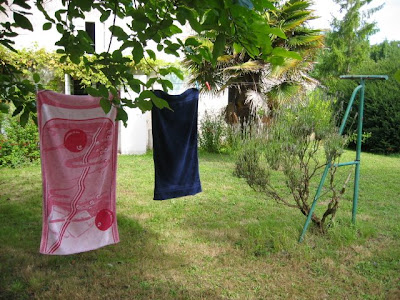
The old lavender bush (lavande) in the yard has seen better days: it’s a bit scraggly now, but its fragrance remains sweet. The Boutrits planted the clothesline next to it, so that our drying beach towels smell quite wonderful. The towels didn’t have much occasion to get wet, I’m afraid. We did manage a trip to the beach this trip, during a fleeting interval between rainstorms. The water was cold, the wind colder, the combination unbearable — but it wouldn’t be summer without going for a swim at least once. I did my duty, in a hurry.

Behind the house is a field of sunflowers (tournesols), all of which turned away from my camera. Perhaps they are shy.

Quite eager to pose are the orties, my principal nemeses in France. Leaves and stems are covered by tiny bristles: touch them, and it’s as if you’ve touched a burning ember. You’ll see the mark and feel the sting for a day, at least.

Left to their own devices, they grow to great heights over vast spaces, supported by a network of roots that connect them one to another and that drive deep even as they spread wide. If you don’t get the whole root (which in older plants can attain the thickness of a young parsnip, a foot long), the nettle will grow back almost instantly. You must strike early, too, because each plant contains approximately twelve billion tiny seeds, each of which is capable when mature of giving rise to an entire field’s worth of new nettles.

With a nearly maniacal vengeance, I’ve rid the garden in Beynes of them over the years, but l’Enclouze is a farm and therefore hopeless. If I see any nettles near the house, I uproot them, but that’s the best I can do. Even that modest effort is futile, because nettles from other nearby fields will always be contaminating us. Soon the nation of France will be entirely consumed by them.

In closing, here’s the terrace by the kitchen, with its wishing well and its arbor, created by grapevines (vignes) and those bright-red, waxy-petaled, trumpet-shaped flowers the names of which I don’t know in any language. Though I took this picture last year (when I posted it in this space), the scene remains much the same — and I’m grateful for that.


Read more!

31 August 2008

Charles Kuralt and the Age of Miracles

No matter which party wins the Presidential election in the United States in November, I face the prospect of being governed by a person younger than I. Barack Obama was born 18 days after me, Sarah Palin three years later. I will be older than the President or the Vice-President of the United States. That such a thing was possible had occurred to me only as a vague, rather theoretical idea, over which I never lingered. (To make matters worse, it’s being reported that Governor Palin is about to become a grandmother — which means that, technically, I am now more than old enough to be someone’s grandfather.) Yes, some day I’ll be older than the President — and some day, man will visit Mars.

It’s a pity Obama didn’t pick a younger man as running-mate. Then we could line up all the candidates like a remake of The Mod Squad, with McCain as the crusty Captain Greer. Wouldn’t that be cool?

Somehow it’s easier (and surely less frivolous) to dwell on the historic. An African-American man is the nominee of a major party for the Presidency of the United States — that fact alone is awe-inspiring. In my lifetime, which I persist in describing as short, I have seen my native country go from segregation to a nomination. I may yet live to see an administration. I honestly didn’t believe it would happen.

If the Republicans win, a woman will be Vice-President of the United States. She’s now primed automatically to be a leading candidate for the Presidency in 2012. If a President McCain were to step down because of health or to die in office (realistic possibilities), she’d be the incumbent. This is an age of miracles — and it makes me think about Charles Kuralt.

I didn’t know Charles Kuralt, and he surely did not know me, though we worked in the same building and sometimes on the same broadcasts. I recall that during election-night coverage in 1992, Kuralt observed on the air that he had voted for the first time for a presidential candidate younger than himself. So far as I know, no interest groups protested this expression of political bias on his part — obviously he meant he’d voted for Clinton. If Dan Rather or Connie Chung had said such a thing, you’d still be hearing the ruckus. Kuralt’s popularity was titanium and Teflon. He could run over your dog when he was On the Road, and you’d still watch his shows and happily buy his books.*

That night in 1992, Kuralt seemed immensely old, and it was difficult to imagine anybody older. He was in truth younger than he looked, and hadn’t yet turned 60, but I was a kid of 31 and careless. Kuralt didn’t say how he was coping with the reality of being older than the President, and I wish he had, because that might have helped me now. Sometimes his words stick with me.

Indeed, as I write this, I begin to wonder whether it wasn’t Mike Wallace who spoke. Such is the force of Kuralt, though, that I doggedly give him the credit. (Besides, he’s dead and can’t sue me.)

To cite another example of that force, I recall Kuralt’s broadcasting from the Soviet Union, either for the Seven Days in May show or for Vladimir Horowitz’s return to Moscow — I didn’t go on either trip, but I watched on TV like everybody else. Kuralt spoke of the powerful emotional reaction to hearing one’s national anthem played in a foreign country, and years later I understood what he meant when I passed through a Parisian Métro station and heard a band playing “New York, New York.” It’s not a song I love, but it’s the anthem of that city, and you never hear it in this one. I was caught off-guard. I stood there only a moment to listen, then hurried up to the street, overpowered by patriotism, homesickness, and love. And I remembered Charles Kuralt in Moscow.

He was a masterful writer for his own voice; when I read his books, I find the prose flat and disappointing, the thoughts banal, until I remind myself what he sounded like. Then the rhythms emerge, and I pay closer attention. Confessing that he was about to be older than the President was probably not a statement Kuralt wrote out in advance, but I hear his voice in those words, and I hear him now.

*NOTE: You can almost hear him narrating the story, can’t you? “We went to see a man about a dog the other day. We ran over it, we told him. He was a good sport about it, though. Said he never much cared for animals. Invited us onto the porch for hot coffee and homemade biscuits. His wife collects matchbook covers. She’s got about a thousand of them. Then it was time to go.”


Read more!

30 August 2008

The Palin Nomination

The news was greeted with surprise on this side of the Atlantic.

Most of us in Europe were surprised by Senator John McCain’s selec­tion, announced yesterday, of Michael Palin as his running mate. We have been in deep confusion over the American presidential campaign for several weeks, stymied over such questions as why the United States requires two years for a political process that most European nations can achieve, start to finish, in two months. Moreover, the French are puzzled that Barack Obama isn’t already President, since he is so man­i­fest­ly one of the two or three most fascina­ting creatures on earth today. I am confident that, if he loses in November, he will be offered the Presidency of France as a consolation prize.

One cannot overstate Obama’s popularity here. I know that’s the sort of news that dooms the chances of any American politician; the admi­ra­tion of the French, like a penchant for endives, arugula and Swiss board­ing schools, is an automatic disqualifier for high public office. But Obama’s following in France is a fact and it must be recognized. Elect him, and Parisians will begin eating Freedom Fries in solidarity.

Palin (left) is expected to appeal to voters who dress like him.

Against this backdrop of bewilderment, the selection of Michael Palin is especially confounding to our understanding of American politics. We vaguely recall that we have seen him on television wearing a dress, and we have seen him in movies holding either a fish or Maggie Smith. That lady is known here as “Moggy Smeese” and viewed as an out­stand­ing representative of the pernicious triviality of the English. (Our great French actresses are never funny, and that is a point of pride with us.) Palin’s career in comedy makes us wonder why McCain didn’t choose someone more familiar to us, indeed idolized by us: why were Jerry Lewis and Jim Carrey passed over? We have reason to believe that Palin, like Moggy Smeese, is English, and previously it had been our under­stand­ing of American government that the President must be a U.S. citizen, as Lewis and Carrey are.

Addressing McCain’s weak support among conservative Christians, Palin also shares Vice-President Cheney’s interest in extreme interrogation methods.

However, we Europeans are constantly learning surprising things about America. Eight years ago, we learned that in the United States, un­like other ostensible democracies, the candidate who receives the most votes on the Supreme Court, rather than in the general election, is the victor. Discovering that America is not truly a democracy has made it easier to grasp much of what has happened since — such as the election of 2004, which we understand to have been decided by suicidal maniacs bent on the destruction of the planet. In France, we probably would not let such people vote; we certainly would not let them rule. We would take to the streets. Aux armes, citoyens! Allez, les Bleus!

This is not Palin’s first run for public office.

Since yesterday, our analysts, both the political and the Lacanian kinds, have struggled to clear up our confusion. They explain to us that Sen­a­tor McCain hopes that Palin will deliver an important bloc of voters whom Obama alienated during the Democratic primaries: name­ly, all those Americans who have memorized every single Monty Python sketch. Obama’s steadfast refusal, even during the Democratic Con­ven­tion last week, to say “Ni,” to sing the “Lumberjack Song,” or to dem­on­strate a Silly Walk, only handed McCain this opportunity.

A McCain–Palin administration would appoint conservative judges.

Only a few pundits have striven to explain that Senator McCain chose a different Palin, who is neither English nor a comedian, nor even a man. This woman Palin, we are told, is the Governor of Alaska, but that sen­tence alone poses insuperable challenges to our comprehension, since the French word gouverneur does not have an accepted feminine equiv­a­lent, and since until now we have been under the distinct im­pres­sion that Alaska was in Canada.

Wherever Alaska is, Palin boasts close ties to the logging industry.

We followed the Democratic Convention with great interest. So many of our all-time favorite personnages were in D’Enfer-Coloradó: both Beel and Eellary Cleen-Tong, former Président Hal Gaure, former Premier Ministre Tiède Kénnédy, and of course Obama himself.

But the Republican Convention won’t be a ratings winner here. We don’t care much for their personnages, particularly the notorious war crim­i­nal Georges Bouche. Though some of us have learned the name of Sénateur Jean Mack-Haine, we find him dull. So he once visited Vietnam — what Frenchman on holiday has not? The Club Med there is passé. Was there really no one better to choose? At least Mite Romné speaks French! (Or so we are told.)

Palin (left) is reputed to be a skilled debater.

It’s possible that we will take a moment to scrutinize La Gouverneur Palin, but mainly to see whether she is as chic as Michelle Obama; we will sigh happily that neither is quite so chic as Carla Bruni. It is a spec­ta­cle, this American election, but generally we prefer American movies: they are shorter, the acting is better, and there’s always the chance of a cameo by Jim Carrey.

The Americans, they are a funny presidential race, n’est-ce pas?

However, Palin’s debating techniques are somewhat unusual.


Read more!

26 August 2008

Facebook

Name: Giuseppe Verdi
Nickname: Mean Joe Green
Friends: Marilyn Horne, Dolora Zajick, Plácido Domingo
Interests: Politics, Shakespeare
Motto: Pari siamo!


It will come as no surprise, from a guy who makes his pocket money by writing about opera, that my success rate is poor at keeping up with current trends in popular culture. Generally, if you want to know when to bail out of your investment in a given trend, you need merely look to me. For example, Madonna was a worldwide phenomenon by the time I took an interest in her — when I saw Truth or Dare. The picture overwhelmed me. I became an instant fan, roughly one decade too late. Almost immediately, the rest of the world lost interest in her. She, like so many other women I could but shall not name, has never recovered from my crush on her.

Mine is not a reliably anti-Midas Touch. I didn’t manage to kill off certain other trends, though I’ve been inarguably late in adapting to them. Other people are still using cell phones, for example, though I waited years before buying one. E-mail seems to be prospering quite nicely, despite my initial reluctance to participate in it. It remains to be seen what will become of Facebook, the Internet networking service, though I feel certain that, so long as I refuse to inscribe myself, it will prevail.

Suddenly, all of my friends have joined Facebook and are writing me indignant messages demanding to know why I haven’t joined. Without joining, I can’t access the site. I can’t know precisely what goes on in Facebook, and thus I can’t know what the appeal is. From the outside, it seems redundant. My friends are already my “friends.” I am in relatively frequent contact with all of them. Do I need Facebook to facilitate communications in which I already engage? What’s more, aren’t there technological advances enough as it is?

I have a blog (as you may have noticed), and so if you are Sally Boldt or Jimmy Swenson, or any of a number of my old friends, you will Google yourself like a normal person, see that I am thinking of you, and write to me in response, even if I haven’t written to you lately. Really, I’m doing my part already.

Madonna: She may never forgive me the harm I’ve done her.

And if I have written to you lately, and you haven’t answered, I doubt that Facebook will light the fire beneath you. No, Satan is lighting that particular fire. (It’s called Hell, and it’s where anyone goes who doesn’t answer my mail.)

“Ah,” say my friends, “Facebook makes it so easy to get in touch with people you haven’t seen in years.” This is interesting, but it presupposes a desire on my part to be found by those with whom I no longer communicate. That desire is in reality quite limited to a very few people. If my long-lost college roommates really want to get in touch with me, they will Google me, or themselves, and arrive at this blog, at which point it will be easy to contact me. (Are you paying attention, Jonathan Foell?)

Meanwhile, another friend of mine finds herself being stalked by a former beau on Facebook. I am unaware of having any stalkers; I prefer to live in ignorance.

Facebook seems to function also as a means of introduction to strangers who share your interest in model trains, or training models, or whatever. My personal interests are so eccentric that I’m not sure I want to know anyone who shares them: do I want to join any club that would have me for a member? And am I really comfortable telling strangers about my fetishes?

Moreover, some of the happier occasions of my life have been those moments when a common interest was revealed unexpectedly. I recall fondly a night when I attended an interminable opera by Philip Glass in the company of several friends who wanted desperately to keep up with the times and who did so by going to the Brooklyn Academy of Music. I found the piece anti-theatrical and nearly anti-musical; I was bored stiff. Retreating to the lobby for a cigarette, I ran into one of my companions, whom I didn’t know well at the time.

“What do you think?” she asked.

“It ain’t Rigoletto,” I replied.

She drew herself up and snarled, “I like Verdi!”

“So do I! He’s my favorite composer!” I exclaimed. And on the spot Rena Grant and I became the dearest of friends (indeed, I’ve often thought that it was primarily my love of Verdi that prompted Rena to excuse my many lapses in intelligence, politics, and countless other realms), without the benefit of any networking service. Would the pleasure be the same, if the connection were made by other means?

Not a character from an opera by Philip Glass

Whatever people do on Facebook, it seems to demand a great deal of time, which, between dial-up and my writing career, I can’t afford. Moreover, I note that certain iconoclasts among my friends have joined other, more obscure networks, and now write inviting me to join those. Clearly, Facebook alone is inadequate.

Yet even as I lay out thoughtful arguments against joining, I know it’s only a matter of time. Peer pressure will be too great to resist, and I’ll tire of explaining my continued and protracted abstinence. Eventually — some time next year, perhaps — I will sign up.

And then you will know that the phenomenon has run its course, and it is time to do something else.


Read more!

21 August 2008

A Formal Announcement

Ending weeks of heated speculation, I am taking immediate steps to remove my name from the list of possible running mates for the major-party nominees for the presidency of the United States. After careful deliberation, I must respectfully decline both Senators’ interest. I am going now to rededicate myself to my family, although of course I will continue to speak out on the pressing issues that matter to rank-and-file Americans everywhere.

I urge my supporters to accept my decision and not to draft me as a write-in, to press for a roll-call voice vote, or to shout my name in high-pitched voices during the keynote speeches. No, my friends. Now is the time for all Americans to get behind the nominee of their party’s choice. Not too close behind, just an appropriate distance behind. And it is important also that we remain fully dressed while we get behind our nominees. We don’t want them to get funny ideas about us. God bless America!

Some may rush to say that I am being hasty, that the scandal will blow over and I will emerge a viable candidate. To them I say, “Which scandal?” For it is true that I have yet to denounce my pastor; indeed, I don’t even have one. It is also true that I have yet to disassociate myself from my top political adviser, Feldstein, despite his many controversial positions, which include sitting, standing, slouching, and immigration. It is equally true that I am not now, nor have I ever been, married to any of the women I have slept with. I do however want to take this opportunity to deny categorically that I have ever slept with Evan Bayh. I am not bayhsexual.

I understand that the press, as well as advisers to both campaigns, has questioned my skimpy legislative record, my lack of executive-branch experience or military service, my credentials, my judgment, my morals, and my handwriting. Senator Obama’s staff doubts that I could deliver my home state of Texas, and Senator McCain’s staff doubts that I could deliver my other home state of New York; President Bush has thrown himself into the debate by expressing doubts that I could deliver France. And Vice-President Cheney has stated publicly that I don’t know how to attach electrodes to the testicles. Pollsters assert that my principal constituency lies among middle-aged white college graduates who have met me at a cocktail mixer in Dubuque in 1996. To these nattering nabobs of negativity, I say, “Let them come to Berlin!”

Seriously. It’s a nice town.

I want to thank my family for standing behind me, although not too close and fully clothed, during this time. My wife, if I had one, would wear a good, Republican cloth coat. My children, if I had any, would wear good, Democratic tie-dyed dashikis. And my dog would wear a good, Libertarian collar, except that the whole point of being Libertarian is not wearing a dog collar. So my dog, if I had one, would be free-range, which would appeal equally to the Greens. And my dog would stand behind me now, too, although perhaps only partially clothed. It’s up to him. Or it would be, if I had a dog.

My parents, retired mill-workers who came to this country with nothing in their pockets but lint and a credit card, once dreamed of an America where their son could grow up splitting rails and building log cabins, eventually running for the vice-presidency and maybe buying them a nice retirement condo in Florida with rec-room privileges.

My friends, we are living that dream, you and I — at least the part where my parents dreamed of having a son, if not all the rest of it. But let us never forget: my parents did wake up, eventually! I talked to my father yesterday, and he was wide-awake. You could tell by the way he didn’t snore.

I am proud to represent their dream. I am proud to represent the spirit of change that is sweeping this country — change from a government of incompetent, unqualified, Ivy-educated, Texan baby-boomers to … I’ll have to get back to you on that.

I am proud to represent the hopes and aspirations of a statistically negligible percentage of Americans, proud to be an American, and proud to reject the nomination for the vice-presidency.

Thank you, and God bless Peoria.


Read more!

Welcome to the Death Star

There’s a moment early in the first Star Wars movie when Darth Vader invites Princess Leia to look out the window, whereupon he blows up her home planet. Although I can’t be certain, I suspect that my face may have reflected Leia’s expression on two occasions in my life: in June, 2001, when I accidentally erased every document on my computer, including an entire novel; and yesterday morning, when my computer crashed for no apparent reason.

Such incidents are disturbing to anyone, surely, yet to me, as a writer, they’re especially upsetting. How technology — how my life — has developed to such a point that I can write so much without leaving a trace, is anyone’s guess. But there you have it. The very idea of writing with pen and paper inhibits my creativity now. (To say nothing of the difficulty of pursuing a work in progress without being able to see any of the prior chapters.) I’m dependent on my brave little laptop for so many things, and I was reminded yesterday how little there is in Beynes to divert me that doesn’t require the use of the computer. Yes, yes, there are books and radio, there are the pleasures of cooking and of watching the grass grow — but that’s about it.

Better back up those files, Mose.

It’s to be remembered that, regardless of the technology used, writers have been losing manuscripts by any means possible for as long as there have been writers. A sudden gust of wind or rain, or even the tiniest conflagration will damage ink, paper and parchment; Moses tried using stone tablets, and you know what happened to those. The writer’s inspiration evaporates easily, and every minute risks the equivalent of the knock on the door that stunted Coleridge’s “Kublai Khan.” Even once a work is published, it’s not safe, as a recent re-viewing of The Name of the Rose reminds me.

Yet modern digital technology is so fast-moving, the consequences so great of gestures so small, that the writing seems more fragile than ever. In 2001, my single keystroke wiped out an adult lifetime’s work, and though other technology exists to recover files, I spent an entire year getting my novel on its feet again. During that time, the market for fiction dried up, not least to other advances in digital information technology, and my book remains unpublished. Had not my finger slipped, who knows what career I might have now? For all we know, I might have gotten in under the wire. In a sense, I’ve never recovered from the loss.

Thanks especially to my brother, I’ve gotten more diligent about backing up files. Very little of the current novel would have been lost yesterday. But repairing a computer can take a very long time in this country: most often, Paris merely ships the wounded Mac to Holland, where the real repairs are performed, and the customer is obliged to muddle along without a computer for six weeks or longer. I had to contemplate pushing back every deadline I have. That’s not merely a discouraging thought but a series of them, grisly dominos that keep toppling down.

I persist in writing because, I tell myself, I do not have a choice. It is the will of destiny that I should write. That’s a lofty sentiment, and sometimes very cheering, but once one admits the possibility of destiny’s will, one must admit that it could be exerted in other ways, too. It’s no good believing in a God who makes bunnies and kittens if you do not also accept a God who makes tsunamis that kill tens of thousands of humans at Christmastime; otherwise, you don’t truly believe. Yesterday I found myself wondering whether the same destiny that wills me to write might not also will me to fail. Even if the will in question belongs not to a deity or to any other external supernatural force, I am screwed, since the will must therefore be my own.

These are the things you think about, when your computer crashes. It is easier to blame technology.


Read more!

15 August 2008

Genres of the Convention

Although I’m not in this picture, I was somewhere in the room when it was taken.
Madison Square Garden, 1992.


There are few more reliably poignant reminders that I no longer work in broadcast news than the nominating conventions of the American political parties, which doggedly persist in taking place even though I’m not there to cover them. “Cover” is perhaps the wrong word to use, since it implies that news might actually be involved, which is only rarely and fleetingly the case. Dismayed by the mayhem of the Democratic convention in Chicago, 1968, organizers in both parties began to do their utmost to present to the nation a serenely polished spectacle in which very little would happen of interest to anyone on earth. News organizations continue to pour enormous resources into covering the conventions, however, in the fearful hope, or hopeful fear, that someone may slip up and do something significant.

The press is currently trying to drum up excitement in the Democratic convention — will Hillary sabotage it? Has she already sabotaged it? Is this Obama’s party, or Clinton’s? Don’t be fooled. By the time they get to Denver, there will be no drama for Obama, and the press knows it already. They’re simply trying to justify their expense accounts ahead of time.

Rock on. New Orleans, 1988.
I missed out on this one, actually.

I attended five conventions, three Democratic and two Republican, in 1988, 1992, and 1996. At my side on all these excursions was Dan Rather, whose roughing up in Chicago in 1968 has come to symbolize both the mayhem of that week and the last gasp of newsworthiness at any convention. By the time I arrived on the scene, technology had advanced to the point that it was no longer necessary for Dan to wear an elaborate headset like the one he’d worn on the floor of the Chicago convention — but the sight of him in any headset at all was startlingly powerful. He was a television icon, like Spock in his ears or Matt Dillon with his pistol.

He used to roam the halls, greeting delegates and reporters alike with the cheery request to “Call me if any news breaks out.” People would chuckle, but he wasn’t joking. He was likewise serious when he’d say to me, “Take a good look around. This may be the last time.” He didn’t mean the last time for me, but the last time for the networks. Covering a convention is an expensive proposition, and though it’s a gesture of good citizenship, the rewards are few. As conventions get duller, fewer people watch. During my tenure, all three major networks cut back on the hours devoted to convention coverage, and all three cut back on personnel, too. The lavishness of it, by turns circus, parade, and Roman orgy, could not survive.


I’ve written here about the summer-camp excitement of attending a nominating convention. It’s not unlike a Star Trek convention, too, for we are brought together by a passion that others do not share, and we find thereby a community. We treat as major celebrities people who are not widely known to the general public (“Look, there’s Walter Koenig/Evan Bayh!”), we boast of our knowledge of trivia while speaking arcane languages (Klingonese/policy), we are encouraged to buy overpriced memorabilia (an authentic copy of a phaser/a Pat Buchanan button), and many of the conventioneers feel the need to wear strange costumes (Wisconsin cheese-heads being but one example). Having witnessed both ladies in action, I can assure you that the appearance on the dais of Nichelle Nichols or Barbara Jordan excited a precisely equivalent frenzy among their respective audiences.

At least Star Trek conventions are colorful. At the nominating conventions, our eyes are assaulted by red, white and blue — it’s everywhere — until we get headaches, and in more severe cases, we start to see spots. Pink, purple and green ones. We have regrettably little time to get to know the cities where conventions take place, though my glimpses of Chicago and San Diego in 1996 inspired me to linger through the weekend after each convention had ended, and to return several times on my own. We can’t get into the good restaurants, because big shots like Peter Jennings and Bob Dole got there first. For fear of a security breach, we can’t afford to hook up with attractive conventioneers — but fortunately, there seldom are any. Rob Lowe may have gotten laid in Atlanta in 1988, but I didn’t.

I miss the conventions. I miss the speeches, which with only one exception (Buchanan in 1992) were incredibly, invariably dull. I miss the foolishness — I miss watching Al Gore dance “The Macarena.” I miss the skullduggery, the wariness accorded to the politicos by the press, and vice-versa, while each side feeds voraciously off the other. I miss the pomposity and audacity (“The next president of the United States, Michael Dukakis!”), the eccentricity (“The great state of Missourah nominates… ”), the pageantry, the inevitable balloons. And I’ll miss it again this year.


Read more!