Showing posts with label Food. Show all posts

20 January 2017

Meryl Streep’s Hardcore Kitchen, or ‘It’s Complicated’


Empty nest: Meryl Streep contemplates the dining room, while her kitchen lurks in the background, like the shark in Jaws.

Hollywood has long presented audiences with all kinds of glamour to fuel escapist fantasy and aspirational dreams. We lose ourselves in the lives of better-looking, better-dressed people in lavish settings. But sometimes Hollywood gets carried away, and I found a prime example of excess in Nancy Meyers’ It’s Complicated, a film from 2009 which I watched recently because it was either that or Tank Girl. My roommate drives a hard bargain, though evidently he’s got a thing for blonde protagonists in improbable circumstances.

I’d seen a couple of Meyers’ other movies, and so I thought I was prepared for this one. Meyers would yet again cater to the fantasies and aspirations of women who may be over 35 and therefore who, as far as the rest of Hollywood is concerned, do not exist. I figured Nancy Meyers would yet again give us a heroine of a Certain Age who is prosperous and accomplished and sexually desirable to multiple men, and who makes good decisions after some missteps. People who have seen even more of Meyers’ movies warned me that there would also be really nice kitchens. It’s Complicated goes beyond mere fantasy, however, to the realm of pornography.


But it’s only her 397th glass today!
And it must be four o‘clock by now.

The first fantasy/aspiration I noticed was the wine. About three scenes in, I realized that people had been drinking wine ever since the movie started. Drinking wine is something that women like to do. I know this, and I sympathize — but as the movie continued, the wine kept flowing. Again and again, in scene after scene, we see wine and more wine. (Please note the Special Advisory at the end of this essay.)

I also noticed — and sympathized with — the representation of friendship among women as a sisterhood. This involves drinking wine, talking about sex, and Mary Kay Place. Well, who wouldn’t want Mary Kay Place for a friend? I’m not even a woman, and yet I know for a fact that I would enjoy talking about sex with Mary Kay Place over a bottle of wine. “Hey, Mary Kay Place, my close personal friend,” I’d say, “men are slobs, aren’t they?” And Mary Kay Place would say, “They sure are! This pinot grigio rocks. Let’s get some ice cream, change into our flannel pajamas, and binge-watch Mary Hartman, Mary Hartman.”

That would be fun. Don’t try to deny it.


Rita Wilson overshares over wine,
while Meryl polishes off her 418th glass of the day.

There are two other gal pals, one of whom I don’t recognize and the other of whom is Rita Wilson, who comes on a little strong and isn’t as non-threatening as Mary Kay Place is. We might not ask Rita Wilson to stay up and watch Mary Hartman, Mary Hartman with us, though it might be fun to give her a little more wine and then watch Sleepless in Seattle, just to hear what she has to say about that tramp, Meg Ryan. Come on, Rita. Have another glass and tell us how you really feel.

Eventually Meyers gets around to addressing her principal theme, the Sexual Appeal of the Mature Woman — but that’s not where the pornography comes in. Sure, Meryl Streep plays the middle-aged mother of three children who is sought after by two men, one of whom happens to be her ex-husband. (It’s a sign of how far these actors have journeyed that, in this movie, Alec Baldwin is the funny one and Steve Martin is the serious one.) But the Meryl-Is-Sexy part of the movie is pretty realistic. Almost a documentary.

Meryl Streep complains a few times about how awful she looks, now that she’s middle-aged and has had three children, but she’s just fishing for compliments because she looks fabulous and everybody knows it. Baldwin and Martin crave her, but they don’t maul her, because this is a romantic comedy. Baldwin goes in for the side of her neck and the shoulders — you remember those, don’t you, from Sophie’s Choice and The French Lieutenant’s Woman? Of course you do. And they’re still gorgeous. They deserve their own Lifetime Achievement awards. One apiece. There are probably plastic surgeons in Hollywood right now, working hard to make other women’s necks and shoulders look as good as Meryl Streep’s neck and shoulders look.


Just watching you in the bathtub is erotically stimulating
and not at all creepy.

Meyers doesn’t show us any scenes in which Baldwin or Martin gives Streep a foot massage, but you can be pretty sure they’re in there somewhere, maybe in the DVD extras, because foot massages, like sensual shoulder-kissing and Mary Kay Place and a reliably constant supply of wine, are things that women want more of.

Also, and most importantly, both Baldwin and Martin actually talk to Meryl Streep, and Martin actually listens to her, and as I can attest from my own personal experience, this is something that women definitely want more of. Martin’s character likes French movies, which we find out because he listens when Meryl Streep tells him she used to live in Paris, so he invites her to a French film festival, even though presumably that means reading subtitles and staying awake or at least not snoring like a cement mixer through the whole movie — and at this point I’m thinking, “Yo, Nancy Meyers, are you sure this Steve Martin character is straight?” For a lot of straight men, just watching this movie would be a challenge.


We know things have gone to the next level,
because these two have switched to brandy.

Still, in a culture that so often addresses what men want — comic book characters, gun violence, car chases, explosions, women as objects who are under 35 and who don’t care whether you remember their birthdays — it’s nice to see a movie that caters to what women want, for a change. And again, this isn’t the pornographic part.

No, the pornography is in the kitchen.

You see, Meryl Streep — or Nancy Meyers, or both of them — is a kitchen size queen.


Is it just me, or is it hot in here?

When we first see Meryl Streep’s kitchen, she’s taking stock of her suddenly Empty Nest, after her three air-brushed, genetically engineered, fully sanitized J. Crew adult children leave home. The kitchen is very, very beautiful, and it is as if Meryl Streep steps into a magazine. It’s like the way she stepped into Travel + Leisure in Out of Africa, only here the magazine is Architectural Digest, which, as we know, is to kitchens what Playboy is to naked ladies. A scientifically calibrated amount of sunlight fills the spacious room, bedecked with just enough cute personal items to let you know that human beings sometimes venture into this kitchen. There’s music playing, so you can’t quite hear the kitchen screaming “Home! Warmth! Fulfillment!” at the top of its lungs.

However, as we will soon discover, this is not “the kitchen of my dreams,” which Meryl Streep has wanted for ten years. Reflect on that. Ten years. For ten years she has had to suffer with this kitchen, instead of reveling in the kitchen of her dreams. Ten years. With this kitchen.

As we gaze upon this kitchen, we also see at least one of every cooking utensil known. Meryl Streep probably owns the gadget I just saw at Williams-Sonoma the other day, which is specifically and exclusively designed to cut up cauliflower, because obviously paring knives are not good enough for serious cooks, even if you live in Manhattan and barely have storage space for a paring knife, much less a paring knife and a cauliflower gadget. If you were a serious cook, you would find the space and you would own that gadget. Maybe several of them, because who can ever cut enough cauliflower, and who can be bothered to follow methodically the helical growth of the florets with a cheap-ass pedestrian paring knife that came from goddam Target?

Meryl Streep’s character, we later discover, owns a bakery-restaurant-store sort of establishment, and she can tell at a glance when there’s too much powdered sugar on the pastry, so she is a serious cook.


At the kitchen island, which we shall dub “Madagascar.”

But she is also committed to family, which is why the island-slash-table in her eat-in kitchen is as big as a king-size bed. Her three children and her future son-in-law can glide as one from the J. Crew catalogue to gather around that table to share the gourmet-yet-cozy meal that Meryl Streep has lovingly prepared for them. Seriously, it probably takes Meryl Streep all afternoon just to set that table. She has to do yoga and weight training and stretching exercises just to pass around the wine. This may explain why her shoulders look so great.

Now, supposedly we’re in Santa Barbara, which isn’t Manhattan, so I’m not exactly startled by the fact that Meryl Streep’s kitchen is the size of my entire apartment. I mean, when your immaculately landscaped yard is the size of Central Park, that’s what you do, you have a big kitchen. No, the surprise is that Meryl Streep’s big kitchen isn’t big enough. I have been in Williams-Sonoma stores that were smaller than Meryl Streep’s kitchen. But it will not do.


We are in a bakery-restaurant-store slightly larger than a factory warehouse, but we should sit as close as possible, because I find you sexually desirable, you erotically empowered middle-aged woman, you.

Enter Steve Martin as the architect who designs the kitchen of her dreams. Before designing that kitchen, he actually reads her e-mails on the subject. Reading e-mails probably isn’t as sexy as listening, but it shows how sensitive Steve Martin is. He respects her dreams. He wants to know all about them. Once he fully understands her dreams, he will fulfill them. That is what sensitive men do.

Automatically, Meryl Streep knows that if she e-mails Steve Martin an invitation to Rita Wilson’s dinner party next Tuesday, Steve Martin is not the kind of man who is going to say, “Oh, I never saw that. I will be going out with the guys instead. Don’t wait up.” No, no, Steve Martin will say, “Oh, I read that as soon as you sent it. I already marked the date on my calendar. And I just bought a new blazer to wear that night, so that Rita Wilson will be reminded that I’m not one of the slobs like her husband, and besides, I always do my utmost to look good for you, particularly when it is, as Tuesday will be, precisely 147 days to your birthday. Shall I pour you some wine and rub your feet now?”

Yes, Meryl Streep knows exactly what kind of man Steve Martin is. And that’s how we know she isn’t going to end up with Alec Baldwin. Alec Baldwin spends most of his time showing us how much he wants incredible sex with the middle-aged mother of his children, but Meryl Streep isn’t going to settle for incredible sex with the father of her children. No. That is not good enough.

Neither is that kitchen.


I have included several pictures of Meryl Streep’s puny, limp, pathetic, unsatisfying kitchen, because really, there are no words.

That kitchen isn’t even the only kitchen Meryl Streep has at her disposal. Later in the movie, she takes Steve Martin to her bakery-restaurant-store, which is the size of a Wal-Mart, and sadly Nancy Meyers leaves out the part where they have to use a golf cart to get around. However, this may be where Nancy Meyers got the idea to have Anne Hathaway use a bicycle to get around her office in The Intern. (How zany, yet how practical!)

Once again Meryl Streep reminds us that she is a serious cook, by whipping up a spur-of-the-moment batch of chocolate croissants, even though it’s the middle of the night. (How madcap!) And Steve Martin again demonstrates his exceptional sensitivity by helping her in the kitchen — I repeat, helping her in the kitchen! We are not supposed to notice that Steve Martin bruises the dough, though he does, and consequently it will not flake properly when baked, and Nancy Meyers will have to throw it out after she’s finished the take. However, this is not a big deal, because this is Hollywood and wasting dough is routine there.

Also, you can tell we’re not supposed to notice, because obviously Meryl Streep would never favor a man who bruises her pâte feuilletée.


If he’s that much of an oaf, who knows what he would do to her shoulders!

We see yet again that Meryl Streep is a serious cook because she has her very own jardin potager the size of a soccer field, and of course she has a rumpled-yet-adorable straw hat to wear while she is picking picture-perfect tomatoes that are all exactly the same size, shape, and color, and that effortlessly line up in orderly rows when she places them in her basket, while you wonder whether that just happened by chance, or is Meryl Streep really a witch after all, or did Nancy Meyers hire a tomato wrangler for this movie?

And yet we know that Meryl Streep is an ordinary woman, an Everywoman, with whom we can identify and to whom we can relate, because her name is Jane — just plain Jane — and doesn’t every woman have a jardin potager the size of Nebraska and a light-filled kitchen the size of a shopping mall stocked with every item in the entire Williams-Sonoma catalogue and probably Pottery Barn, too, and an impeccably dressed ex-husband with great hair who is literally fainting from the desire to kiss her shoulders and (probably) rub her feet, and who (mostly) listens to her when she talks and who can’t stop praising her incredible sexual appeal, even when she is picking tomatoes in her jardin potager?


And yes, because she is a serious cook and used to live in France, she calls it a “jardin potager,” not a “kitchen garden.”

But Meryl Streep wants more, she deserves more, so she has to find another man who will kiss her shoulders and rub her feet and build her a kitchen the size of Alaska and listen to her when she talks, and who even reads her e-mails.

Because that kitchen is not big enough to satisfy a serious cook like Meryl Streep. Women should never have to settle, and what woman would settle for a kitchen like that? That kitchen is not the kitchen of Meryl Streep’s dreams. Women should fulfill their dreams and own their own businesses and have incredible sex and whip up chocolate croissants in the middle of the night and drink wine whenever they damn feel like it. Women should not only fulfill their own dreams, they should also fulfill Meryl Streep’s dreams, or hire Steve Martin to fulfill Meryl Streep’s dreams, and what woman would dream about a kitchen like that, anyway? Meryl Streep certainly would not dream about a kitchen that is merely spacious, inviting, well-appointed, and flawless.

Sadly, Nancy Meyers seems to have omitted the scene where Meryl Streep moans, “Build that kitchen! Build it! Build it bigger! Bigger! Bigger! Yes! Yes! Yes!”

Maybe that scene, like the foot massage, is in the DVD extras. For mature audiences only.

I need more wine.


Because we are your friends, we are laughing with you when we laugh at your tiny kitchen.

SPECIAL ADVISORY: If you watch this movie, do not play the drinking game where you take a drink every time the actors take a drink. Trust me on this one. You may, however, try taking a drink in every scene where no wine is involved.


Read more!

21 February 2013

My Burger Kingdom for a Horse

The chevaline stall — you should pardon the expression — in a market in Poitiers.

The current scandal over beef burgers “tainted” with horsemeat has me mystified, to the point that I’m tempted to downgrade it to a mere moo-haha — though it’s been hyped and sensationalized in every press outlet. Granted, one would prefer to know what one is eating, and even I observe the strict dietary rule of never eating anything that’s smarter than I am. (This rules out orangutans, dolphins, and, in some but not all cases, Presbyterians.) But unless one is an exceptionally strict vegan, the difference between eating a cow and eating a horse strikes me as extremely fine.

It’s true that little girls seldom develop sentimental attachments to cattle, as they do to horses, and movie audiences are far more likely to attend a screening of The Black Stallion than The Black Angus. Cattle don’t conform to the aesthetic model of strength and grace that horses uphold so beautifully.

Moreover, the Norman Conquest of Britain assured future generations of English-speaking diners that only certain meals would remind us where they came from: we eat “beef” (boeuf), not “cow,” “pork” (porc), not “pig,” and “venison” (venaison), not “Bambi.” The Normans never quite got around to providing us with a euphemism for “horse,” probably because those animals were too scarce and valuable; I don’t know what excuse they can make for failing to rename “rabbit.”


The chevaline stall at the market at Beynes can be seen in the background here. Unlike the fishmonger and the other butchers, the chevaline vendor comes to town only one day per week, instead of two.

With language as a foundation, British and American cultures over time built up a wall between the farm and the dinner table, one at which only hardcore foodies chip away. Supermarkets and prepackaged products are further manifestations of most modern consumers’ insulation from the realities of what they eat, and my own experience bears this out: I was shockingly old before I understood that tuna comes from the sea, not from a can; that it is fish-shaped, not cylindrical; and that, in nature, it is raw, not cooked, and smells like tuna, not like catfood.

Most of the excited news reports on the hamburger scandal mention that horse is eaten in many otherwise respectable countries, and that one of these is the cradle of haute cuisine, France. It’s therefore incumbent upon me to state that I have eaten horse, not only in France but also in Cuba, a country so lacking in horses that for a time its cavalry rode bicycles. In Havana one night, I ate horsemeat stewed with tomatoes, onions, and bell pepper. It was delicious, but it was prepared much the way any other dish might have been prepared in that country, and doesn’t tell one much about the distinctions of caballo.*

The French have come up with a word for horsemeat, chevaline, which is most often sold by specialist vendors in markets; I don’t recall ever seeing chevaline in a supermarket, and perhaps this reflects a desire to be absolutely sure that consumers understand what they’re ordering. In France, I’ve eaten ground horsemeat in a steack haché and in a thinly sliced portion that looked like (and may have been called) a hanger steak. The flesh is, as you’d expect, much leaner than that of beef, the flavor darker and yet not quite as strong. It’s red meat — no big deal, unless of course you don’t eat red meat of any kind.


A chevaline shop in Paris.

Chevaline vendors usually purvey steaks, ground meat, and great big sausages, in red casings, that look quite like bologna. I’ve never eaten horse sausage, though I have eaten very tasty donkey sausages, hard and garlicky, in Corsica. (This does mean that, over the years, I have sampled most of the cast of Winnie the Pooh, excepting Owl.)

As a few news reports have mentioned, nobody wants to eat American horsemeat. We reject it because we’re squeamish, and the Europeans reject it because American racehorses are pumped full of performance-enhancing drugs. A chacun son goût.

I hope these observations may serve as a corrective, in some small way, to the lurid coverage of the scandal in television, print, and the Internet. But, as I say, don’t come crying “Ew, gross,” unless you say neigh to meat of all kinds.


A horse is a horse, main course.

*NOTE: Dan Rather joined me at the dinner in Havana when we ate horse stew. When it was presented to us by a Spanish-speaking waiter, Dan asked me to translate. Knowing that he likes goat, and unsure how he’d feel about eating horse, I told him it was cabrito, which sounds close enough to caballo to cover my deception. I confessed the truth only several hours later.


Read more!

18 February 2012

Vigne, la Révolution!

Nous sommes les Saint-Pourçain!

We are plucked from the vine when we are still tender, then we are crushed and forced to work for tyrannical overlords.

We are kicked out of our cellars and shipped around the world while they stay home and drink Coca-Cola.

We are made to listen to the idiotic things you say to each other over a glass of wine.

We are made to accompany inferior dishes prepared by substandard chefs.

We are even forced to swallow cheeses made from pasteurized milk.

And then you have the nerve to seize the time slot for our little wine fair in February and hand it over to the Cattle Show.

We are not savages. We are the Saint-Pourçain.

And we are not A-OK.*

Occupons la Foire des Vins!

(Actuellement Foire des Bovins. Merci.)


*NOTE: We are, of course, A.O.C. Thank you for respecting this small but important detail.


Read more!

16 August 2011

The Orzo Crisis at Air France

Follow the money: Who’s paying Air France to serve so much orzo?

When I first began flying Air France, the airline was still entirely state-owned, and setting aside the political and economic implications of privatization, and the cutbacks in service that have affected every company in the business lately, I feel the difference most keenly whenever the flight attendants come around with supper. Frankly, I suspect foul play.

After all, one can easily excuse the airline’s saving money by serving orzo — slippery little seed-shaped pieces of pasta — here or there. But to serve it constantly, both as a starter (“orzo salad”) and as a side dish to the main course, at the same meal, suggests that the fix is in, and the supplier must be somebody’s nephew.

Orzo isn’t a vegetable (and neither is anything else in the “salad”), and it isn’t French, either. Back in the day, Air France seized the opportunity to show off, and to share with travelers some of the best of French cuisine and wine, or at least to hint at the possibilities. Nowadays, the company seems to be throwing anything it finds at the passengers — and what it finds is orzo.

On my first flights, Air France treated me as if I were a passenger on an ocean liner in the Golden Age. Upon boarding, I was served a glass of champagne. After takeoff, the attendants came around with a cocktail cart, carrying more champagne, and other French wines, as well as the more usual beverages. The attendants also handed out printed menus, detailing the food that would be served at dinner.

After a brief interval, the attendants came around again with the promised meal, and more champagne, if you wanted it. The quality of the food wasn’t anything near what you’d find in a restaurant in France, but it was varied, tasty, and vastly superior to what you’d find in economy class on any other airline.

And the menus themselves were a marvel. I kept the first ones: printed on slick paper, about 5 inches by 7 inches, with a full-color illustration of vegetables from an old Vilmorin seed catalogue on the cover. Some day I’ll frame them and hang them in my kitchen.

On the Concorde, we got truffle omelettes.
I don’t expect comparable treatment in economy class, however.


In recent years, Air France eliminated the complimentary champagne upon boarding, and the size of the menu shrank to a small card. Then the cocktail service was eliminated, and now there’s no more menu, either: the attendants simply inquire whether we want one of two options. Even the wine has shrunk, from a standard mini-bottle (containing enough for a couple of small glasses) to something that resembles a test tube and barely has room for a label. So much for promoting the great wines of France.

It was a shock, when the Orzo Era began, to discover that, following the famous orzo salad, orzo was also served with the main course. If French cuisine stands for anything, it is variety, and serving the same thing twice in one meal is anathema.

It’s easy to see why orzo would hold some appeal for the caterers on Air France, since it’s so resilient. Unlike fresh vegetables, it won’t spoil, and unlike larger pasta, it won’t dry out quickly. And unlike smaller pasta, such as couscous, it’s less likely to spill everywhere.

But couscous would at least be the sort of food one can find in France: some French people of my acquaintance don’t even know what orzo is, and I’ve never seen it in any restaurant or kitchen here. (I have found it on grocery shelves, however.)

Along with the rise of orzo has come a decline in the rest of the cooking. On my most recent flight, I had a choice of beef or pasta. Although (somewhat to my surprise) the main-course pasta in question did not consist of more orzo, it was nevertheless pasta — that is, exactly the same thing that we’d been served for a starter.

The beef was no prize, however: a tough, tepid, unidentified stew entirely lacking in vegetables but served with a gelid lump of mashed potato, quite possibly of the “instant” variety. Americans who flew in the 1960s and ’70s — or who ate frozen TV dinners in the same period — would recognize this dish immediately.

At least there’s been an effort to make the orzo salad more interesting. When I first encountered it, it was bland, mixed with a few stray pieces of carrot. Now it’s been mixed with curry and a few raisins, so at least there’s some flavor.

Other airlines have responded to recent economic crises by cutting back on catering, of course, but it’s to be noted that these days even the Americans do a better job on transatlantic flights: Continental’s food is superior to that of Air France. Given the justifiable pride that the French take in their cooking, that’s a scandal.

There is this consolation, however: because it is so difficult to get a truly bad meal in France, the traveler is guaranteed to eat better, wherever she goes upon arrival.

However, if the traveler so desires, she can make her own orzo at home.


Read more!

13 August 2011

Le Temps des Mirabelles

This has long been my favorite table for tête-à-têtes.

Today marks the anniversary of one of my favorite restaurants — indeed, one of my favorite places of any kind, anywhere, and a “home away from home,” wherever my home happens to be at the moment. On this day in 1984, Annick LeDouaron opened the door to La Mirabelle, serving traditional French cooking on the Upper West Side of New York City. She took the name from the small yellow plum that — by sheer coincidence — grows in my garden in Beynes, and is harvested around this time of year.

Where else on earth is my arrival cheered even before I walk in the door? After moving to Paris, whenever I called to reserve a table on return trips to New York and left my name, I’d hear a happy cry of “You’re back!” across the telephone. I can’t count the number of special occasions I’ve celebrated there: birthdays, departures, homecomings. When times were a bit more flush for me, I’d bring special dates to the Mirabelle, just one on one, although in recent years my dinners have been shared with large groups of friends.

When I’m homesick and can’t get to France, I come here.
Mme Danielle’s paintings hang all around the restaurant.


While it’s perfectly possible that I may rate your friendship very highly even if I have never taken you to the Mirabelle, it is certain that, once we have dined together there, you have truly made the grade.

I didn’t find the Mirabelle until a decade or so after the grand opening. It must have been a Bastille Day, because Danielle Ruperti insists that she doesn’t sing the Marseillaise any other day of the year — and she sang it while I ate my first supper in the restaurant. This was easily one of the most thrilling performances I have ever witnessed. I was captivated from that moment onward.

Mme Annick at the reception desk.
Signed photographs of celebrities hang on the wall behind her — and sans blagues, most are regular customers.


Mme Annick (as we refer to her*) was still doing business then in a residential hotel on 86th Street at Riverside Drive, but within a few years she uprooted to her present location, on 86th at Columbus Avenue. And it’s one measure of the way she does business that, over the years, she has held on to her customers and to her staff. You see the same faces there, you eat the same dishes, and you find comfort and community in the absolute fidelity at work: to people, to food, to wine, and to the most sacred principles of French hospitality.

Mme Danielle began working with Mme Annick at another restaurant, several years even before the Mirabelle opened, and it’s always a pleasure to see how much the two women appreciate each other. Not only does Mme Danielle sing — French popular standards in a robust, vibrant alto, to the delight of customers like me — but the walls are festooned with her paintings, floral still lives and country scenes. (One of her works now hangs in my study in Beynes.) I can’t think of many places I’ve worked where I’d be made a star, the way Mme Danielle is here.

Mme Danielle, ma bien-aimée

I’m often struck by the sense that the Mirabelle is a story, and it’s a story of women — French women, who crossed the stormy Atlantic to build a future here. “We’ve all got stories,” Mme Danielle told me, just before I moved in the opposite direction, leaving New York for France. Indicating her colleagues, she said, “You could write a book about every one of us.” Believe me, I’ve thought about it. (And yes, I think we would have to include a few recipes.)

Mme Annick is from the north of France, Mme Danielle from the south — you can hear it in their accents. You can see it sometimes in their demeanor, too: it was many years (and something of a personal triumph for me) before Mme Annick welcomed me with a bisou, though such a greeting had been standard with Mme Danielle for a long time. The children of both women have worked at the Mirabelle over the years, which heightens the sense of community I find here.

“Petite” Annick, another of the stars of the staff.

A typical meal here begins with a glass of Lillet blanc — and despite the fact that my sister-in-law is from Bordeaux, it’s a beverage I have seldom drunk anywhere but at the Mirabelle. (It just wouldn’t taste right if anyone other than Mme Danielle poured it.) Most often I have come with an appetite, and often, too, my dinner companions haven’t arrived yet, so I nibble on the toasted slices of bread while I wait. When we are assembled at the table, Mme Danielle arrives to tell us the day’s specials, in English and in French, to be sure everyone understands exactly how wonderful the specials are.

The stuff on the menu is wonderful, too, and I can’t count how often I’ve started with a salad of endive and blue cheese. For a main course, the menu boasts rognons de veau (veal kidney) that are delicious — and what’s more, I’ve never found any place in France that can touch the Mirabelle recipe. Nobody else does kidney right, and especially on cold winter nights, nothing else is quite so satisfying to me. (But the ris de veau — veal sweetbreads — are a favorite, too.)

The “waitress station” and the wine rack.
In the evening, you are liable to find the tarte du jour here.
(Unless I’ve already ordered the last piece.)


My dessert is always and invariably a slice of the tart of the day, with its light, homemade crust and tangy fruit (which varies according to what’s available at the market — of course). Naturally we drink quite a lot of wine with our meal, and there’s usually an after-dinner drink, too.

By the time we leave, Mme Danielle has sung at least a few times, and we have all chatted and caught up on the news; then we wander off into the night. I suppose that it’s possible to polish off a Mirabelle dinner in under three hours, but I can’t imagine why anybody would want to.

The bar, by the door to the kitchen.
Mme Danielle’s bartending skills have won praise
from The New York Times.


I once took my godmother to dinner at the Mirabelle, and at one point, when I was away from the table, she and Mme Danielle got to talking. “We feel about Bill as if he were one of our own,” my godmother explained.

“We feel the same way,” Mme Danielle replied.

So yes — I celebrate this anniversary day.

Restaurant la Mirabelle
102 West 86th Street at Columbus Avenue
New York, NY 10024
(212) 496-0458

Madame, Monsieur, your table is waiting.


*NOTE: Bernard long ago informed me that to designate a woman as “Madame” with her first name — as we refer to Mme Annick and Mme Danielle — is actually better suited to the address of the proprietress of a brothel than to the respectable owner or waitress of a nice restaurant. But to call the ladies by their last names strikes me as impersonal (and rather false), and to address them simply by their first names seems excessively familiar. And so the habit has held.


Read more!

10 August 2011

Guido & Mark

Bon vivant par excellence:
Guido in Litchfield, July 2011


Years ago, Guido Organschi gave me my first whisky. I was a freshman in college at the time, and his younger son had brought me home to Litchfield for a visit. I sat in the living room, Guido handed me a glass — exactly as if I were a grownup — and I, unprepared for the shock of hard liquor, shuddered upon impact. “Smoooooooth,” I said, trying helplessly to disguise my innocence.

It was smooth, in fact, though the quality was lost on me. That didn’t matter to Guido: his mission was to expose me to good things. Years later, he’s still plying me with delights, and his most recent gift to me, a bottle of Irish whisky, is so good that I am, yet again, at a loss to thank him properly.

The living room in question.
Maybe we ought to hang a commemorative plaque.


Litchfield is largely inaccessible to people who don’t have a car, and on this occasion I was again indebted to Mark Dennis, who has been throwing excellent food and wine at me for almost as long as Guido has, and who drives me into the Connecticut countryside for periodic visits.

Sitting on the deck at Guido’s house, I was struck yet again by the friendship between Guido and Mark: whenever it enters into their heads to get together, they do it. If Guido’s younger son, Alan (the first to link us all), or any of the rest of the family and friends can join them, so much the better. Good company is as essential to both men as good food and drink. But they are perfectly happy to proceed independently of us all, ignoring the generational gap in a way that, when I was a boy, I wouldn’t have thought possible.

Mark, contemplating what he’ll do to me if I don’t put down the camera.

Like Alan, Mark was my college classmate. While we were still at Brown, Guido and Mark pegged each other as kindred spirits. Together, they’d explore Federal Hill in Providence, sampling the bona fide Italian specialties in little groceries and restaurants. Mark was already on the path to becoming an expert in wine — he used to carry a little notebook in his front pocket, to record his impressions of the wine, and those of his friends, as well.

Marcus, the archetype of the big brother, still makes me feel
as if I’m a pesky 12-year-old.
Now that I’m 50, this is quite an agreeable talent.


The correct response to Mark’s insistent “What do you think of the wine?” was never “It’s good; I like it.” No, we must rise to the occasion: “It’s round on the palate, square on the jaw, smack in the face.” Or somesuch.

Guido never to my knowledge took notes on anything he served up to any of us, but the affinity for the finer things has been the basis of this grand friendship between him and Mark, spilling out and benefiting all the rest of us. Moreover, they’re models for us, not only in their tastes but in their bond. Age doesn’t matter to friends, and distances can be surmounted, so long as you care enough to make time for the good times.

So now I lift a glass in celebration of two friends — and thanks to them, I’ve got some very nice beverages to pour into that glass.

Maureen, a relatively recent but most welcome addition to our merry band. Like Guido, she’s a photographer. I cringe to think what she’ll make of my efforts.


Read more!

08 April 2011

Why There Will Never Be Another Julia Child

An excerpt from the long-anticipated memoir, My Life around France, by an unknown American author.
At 12.30PM we rolled to a stop in La Place du Vieux Marché, the square where Joan of Arc met her fiery fate. There the guidebook directed us to Restaurant McDonald’s (“McDonald’s Restaurant”), which had opened in a medieval quarter-timbered house. Paul strode ahead, full of anticipation, but I hung back, concerned that I didn’t look chic enough, that I wouldn’t be able to communicate, and that the waiters would look down their long Gallic noses at us Yankee tourists.

It was warm inside, and the dining room was a comfortably plastic-and-particle-board space, brightly colored. At the far end was an enormous counter with several cash registers, behind which something was cooking that sent out heavenly aromas.

I sniffed the air. “Paul,” I whispered excitedly, “is that what I think it is?” Paul nodded.

Grease. Already I felt at home!

There really is a McDonald’s in historic Rouen.
The city refused to permit the company to remodel the building, which is why the restaurant has no Golden Arches and doesn’t look like a conventional McDonald’s.

We were greeted by the assistant manager, a slim middle-aged man with dark hair who carried himself with an air of gentle seriousness. Paul spoke to him, and the assistant manager smiled and said something back in a familiar way, as if they were old friends.

“May I take your order, Madame?” the assistant manager said — in English!

“I’d like a Big Mac,” I said, adding, “Did I say that right? And also a Diet Coke,” since I was trying to watch my figure.

Within seconds, the assistant manager had placed my order on a little plastic tray, with Paul’s Big Mac and fries right next to mine. Paul paid, and then he led me to a nice table not far from the door. The other customers were all French, and I noticed that they were treated with exactly the same courtesy as we were. Nobody rolled their eyes at us or stuck their nose in the air.

Actually, the staff seemed happy to see us. As we sat down, I heard two businessmen in grey suits at the counter asking questions of another cashier, an older, dignified man who gesticulated toward the menu and answered them at length.

“What are they talking about?” I whispered to Paul.

“The cashier is telling them about the Chicken McNuggets they ordered,” he whispered back. “How they were raised, how they will be cooked, what side dishes they can have, and which parts of the chicken the McNugget comes from.”

One of the businessmen raised his voice and gestured more vigorously. “Is something wrong?” I asked.

“He wants to order wine,” Paul replied. “And they don’t carry it.”

“Wine?” I said. “At lunch?” I had never drunk much wine other than some $1.19 California burgundy, and certainly not in the middle of the day. I was happy with my Coca-Cola. I like something really sweet with my meal, and wine is so bitter.

Suddenly the dining room filled with wonderfully intermixing aromas that I sort of recognized but couldn’t name. The first smell was something greasy. “That’s your Big Mac,” Paul identified it, “fresh from the heating lamp.” Then came another warm and greasy fragrance from my french fries. This was followed by a whiff of something astringent, which was probably a delicious sauce being squeezed out of a little red packet labeled “KETCHUP.” My stomach gurgled with hunger.

We began our lunch with the Big Mac, or, as it is known in France, “le Big Mac.” I was used to Big Macs in American McDonald’s. But this Big Mac was remarkable for the spongy buns, the flavorless sesame seeds, the unidentifiable and yet lumpily familiar “special sauce,” the dense and unforgiving meat patties, the anonymous pickles and onions, the plastic-like tomato and papery lettuce. Why, it tasted exactly the same as the Big Macs in America!

And the cheese! I was afraid that the French might use some unusual kind of cheese, perhaps even a cheese with a flavor. But Paul explained that all McDonald’s everywhere use the same processed American cheese-type product on all their Big Macs. Indeed, it was sticking to my fingers already, just the way it did back home.

“Bon appétit!” Paul said. I closed my eyes and inhaled the rising perfume of my sandwich. Then I lifted a single french fry to my mouth, took a bite, and chewed slowly. The potato was crisp on the outside yet delicate on the inside, with a light but distinct taste of grease that blended marvelously with the ketchup. I chewed slowly and swallowed. It was a morsel of perfection.

At last, a truly French french fry! This country was turning out to be so much easier than I’d expected!

Then it was time for a special treat, which Paul had ordered without my realizing. A deep-fried apple pie, with the lacy flakes of pastry on the outside, the inner crust that tasted of wet leather and paste, and the gooey fruit filling that was so hot that I burned my tongue and couldn’t tell whether it tasted like anything at all.

Another revelation!

It was exactly like the apple pie in the McDonald’s back home! In Pasadena, we used to have McDonald’s apple pie five or six times a week. But at the McDonald’s in Rouen, I experienced my first French pastry — just like all the pastries I’d ever had before.

Paul and I floated out the door into the brilliant sunshine and cool air. Our first lunch together in France had been absolute perfection. It was the most exciting meal of my life.

“Promise me that everything we eat on the trip will be exactly like this, darling,” I said.

“But of course!” Paul laughed. “And remember, we’ll always have McDonald’s in Paris.”

Julia and Paul:
Here’s to the spouses who give us the gift of France.


NOTE: In real life, Julia Child was known to praise McDonald’s french fries.


Read more!

05 February 2011

Je vais au marché!

Mon primeur: “If I’d known you were taking pictures,
I’d have worn clean trousers,” he said.


Foolishly, perhaps, I still consider the United States a civilized country — or at least “semi-barbaric,” in the celebrated locution of Frank Stockton’s “The Lady or the Tiger?” However, I am forced to question that opinion when I comparison shop for groceries.

Certain staples are not only available in France, they’re much cheaper than what finds in the States. First among these is, of course, cheese. Even the low-end stuff in France is superior to most of the cheese in America, and it’s at least as good as the imports that one finds in Manhattan’s markets, such as Fairway, Gourmet Garage, and Whole Foods. However, the price of cheese in New York is so high that I swear off the stuff when I’m there.* The only affordable stuff has no flavor and appears to have been crafted from leftover plastic.

One advantage of the G20 supermarket is its bargain bin.
Nearing their expiration dates, cheeses are even cheaper —
and better aged, therefore tastier.
Total cost of the (house-brand) cheeses here: 9.47 Euros.

Shopping in France also means a marked rise in the probability of finding carrots that taste like carrots (as opposed to American carrots, which taste like nothing), and even a convenience store carries French food, including some pretty exotic stuff. The Coccimarket in Beynes stocks canned gésiers de canard confits (duck gizzards preserved in fat), for about 4 Euros; they’re not homemade by a farmer’s wife in Gascony, but they’re correct, as the French say, and on my budget, I couldn’t afford them, or anything like them, in the States.

Since I’ve got no car in Beynes, I do most of my shopping at the nearby supermarket, G20 (pronounced zhay-van); occasionally I take the train to nearby Plaisir, where there’s an Auchan hypermarket that stocks everything you ever heard of. In addition to name-brand products, these stores carry house brands, and sometimes bargain brands, too (“EP” at G20, “La marque pouce” at Auchan), helpful to those on a budget.

The fishmonger's stall in Beynes:
The marché is the only option in town for fresh fish.


In a way, this kind of shopping is cheating, because in France you’re supposed to go to the marché and move from stall to stall, each of which has a specialty: fruits and vegetables; bread; poultry; fish; pork and charcuterie; and beef and lamb, to name the standards. Prices tend to be higher, but the quality is hard to beat, when you know what you’re doing.

However, like many immigrants, I find it easier to shop in a supermarket, and the following vignette will help you to understand why. Back when Beynes still had a butcher shop, I was still trying to figure out metric weights; the butcher asked how many kilos of pork chop I wanted, and I blanked. Even in pounds, I had no answer: I just wanted two crummy pork chops. At G20 or Auchan, I can pick up a pre-packaged barquette without answering any questions at all.**

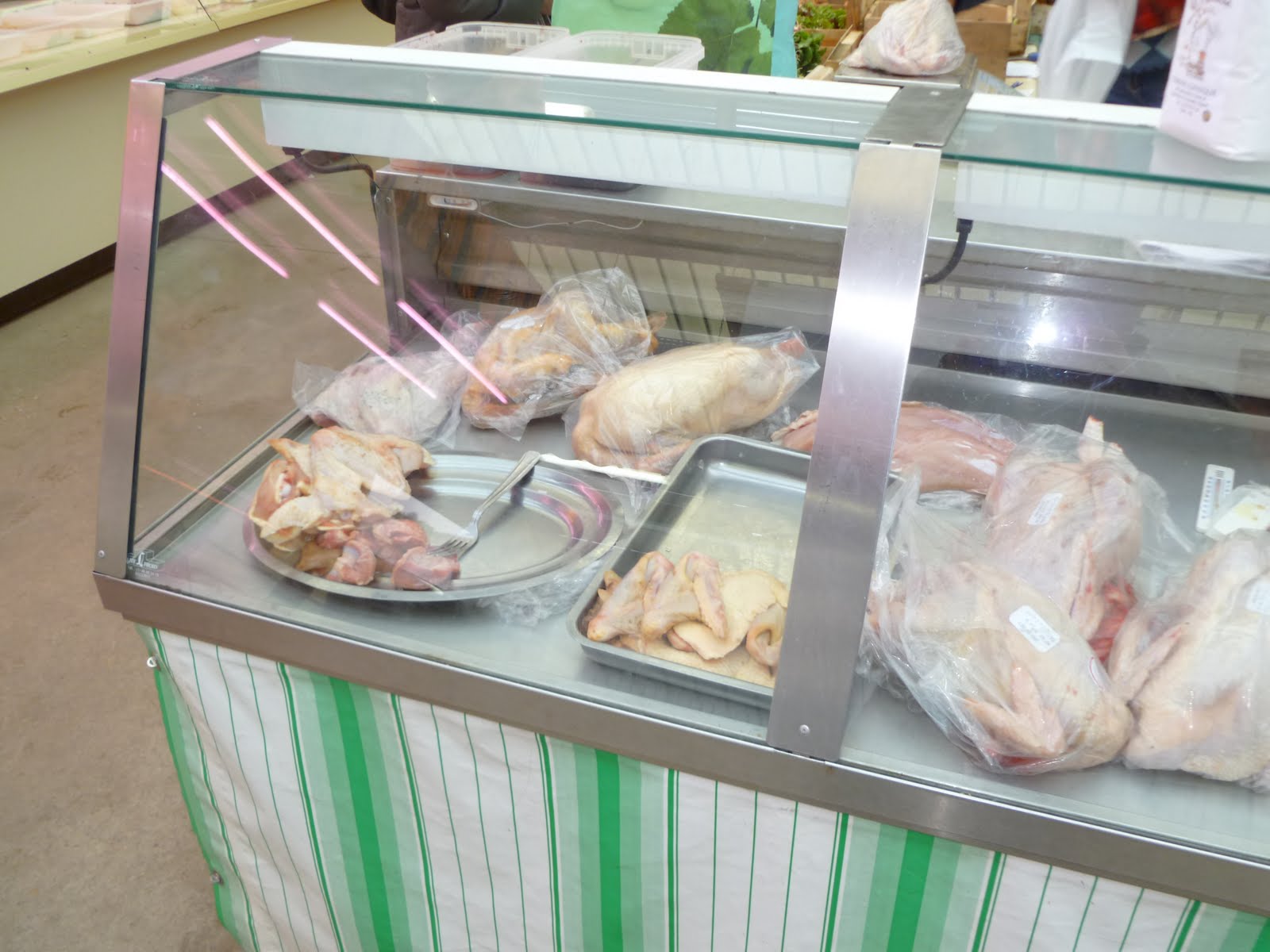
La volaille chez mon primeur

Nevertheless, I am a disciple of Henri Boutrit, and so, on market days (Thursdays and Sundays), I venture forth. My most faithful patronage is reserved for the vegetable vendor, who drives the long road from his family farm in Chartainvilliers, in order to bring us fresh produce. It’s excellent stuff, which accounts for the long lines of dedicated customers; and the care with which he selects each piece doesn’t make those lines move very quickly.

But it’s worth it. My primeur stocks foods I can’t find elsewhere, and in some cases, food I’d never seen before. Over the years, we’ve fallen into a friendly rapport, though we still don’t know each other’s names. We share translations and kitchen tips, and we search for the right descriptions, from either culture, to help me get the food I want: for example, do I want the beetroot that’s the size of a baseball (my suggestion) or a boule de pétanque (his)?

Carrots that taste like carrots, with Brussels sprouts from Chartainvilliers

This week, when I wanted red cabbage, he warned me that there had been frost on the farm, and he wasn’t sure the cabbages were any good. He sliced them open, one by one, found them all wanting, and threw them out. I got green cabbage instead (and it’s excellent). I defy you to find this kind of personalized attention (to say nothing of self-sacrifice) at Piggly Wiggly.

In summer, when he carries yellow squash — which I grew up on and adore, but which most French people are unfamiliar with — he looks to me to share my grandmother’s recipe for Goliad squash. He’s learned not to remove the greens from beets and turnips, because I like to sautée them; and he tries to choose topinambours (Jerusalem artichokes) that will be comparatively easy to clean and prepare.

Légumes oubliés: navets jaunes (yellow turnips), topinambours (Jerusalem artichokes)
Yes, that’s real dirt.


Topinambours are légumes oubliés, “forgotten vegetables,” mostly roots, which prior generations of French people stopped eating after 1945, because under German occupation, they had nothing else to eat. Younger French people are rediscovering them, but they’re still a hard sell among older customers — and in Beynes, especially on Thursdays, I’m one of the youngest customers in the market.

I try to set a good example for my neighbors, experimenting with all sorts of vegetables, and whenever I have particular success with something I’ve purchased, I make a point of telling my primeur — so that my neighbors will hear, and want to try for themselves.

Personalized attention: Mon primeur avec une cliente.

I have a better sense of what I’m eating, when I’ve seen it arrayed in crates, direct from the Grand’Ferme; and even when it comes from G20 or Auchan. I’ve come to take a greater pleasure in my senses, too, in the colors, shapes, textures, and fragrances of my vegetables — so long as they have any (and in France, they do). My food is not something that just happens, it’s real, and I’m engaged with it.

As I think about it, I’m not sure whether communing with vegetables (and farm animals) makes me more or less civilized, actually: I may be the semi-barbaric one in this story. But I’m not about to change my ways now.

New turnips (with their greens!), carrots (that taste like carrots!), with onions in the background


*NOTE: On a recent stay in New York, my cheese-free diet led to a loss of about 5 pounds. At last, I resorted to throwing a party for a number of friends — because I could justify purchasing cheese for others, even if I couldn’t justify purchasing it for myself. Naturally, I ate most of the stuff.

**Since my traumatic encounter with the butcher, I have learned to punt. I’ll say, for example, “Well, there will be two of us at dinner, and we’re not big eaters.” The butcher will recommend a weight, I'll ask for something smaller (and therefore cheaper), and everybody is compromised but happy.


Read more!

19 January 2011

Study: Cheese Good, Experts Say

According to a study released today, cheese is good, being both tasty and delicious, as well as filling, when consumed in generous amounts over an extended period of time.

“The benefits of cheese are clear,” said Dr. Jane Fondue, senior director of the Camemburger-Limbert Foundation for Advanced Studies in Raclette, Wisconsin. “A well-made cheese can provide the consumer with flavor and satisfaction, these being the twin measures of goodness we have identified through years of scientific research in our laboratories.”

Over a period of seven years, test subjects were fed a variety of different cheeses, including gruyère, bleu d’Auvergne, bûcheron, and morbier; while in a parallel test, blindfolded participants were fed chalk, paste, and small pebbles. Results showed overwhelmingly that cheese is better than all the control substances used in testing.

(A related report will be released later this month, showing that, following the initial test, subjects refuse to put anything in their mouths so long as they are wearing blindfolds.)

“I love cheese, because it is good,” one test subject, Konrad Will, told the Camemburger-Limbert researchers. “It is versatile, as well, since it can be eaten fresh or aged, and it can also be melted, whether by grilling, baking, or in a fondue dish. Also, cheese is good with a glass of wine.”

According to the data compiled in the study, this is a statistically good thing.

“Our findings show that cheese is good almost by definition, and it is especially good when it comes from foreign countries, such as France,” continued another participating researcher, Dr. Jonathan Feldstein. “The same cannot be said of small pebbles, for example, whether they are domestic or imported.”

However, he observed that some possible responses to the study’s findings remain controversial among other scientists and policy-makers.

“Ultimately, the goodness of European cheese may not lead to a significant change in U.S. foreign policy,” agreed Dr. Mark Dennis of the rival Livarot-Mongering Institute. “Moreover, certain health benefits of cheese are still currently debated, except in comparison with consuming large quantities of chalk, which clearly is not as good as cheese.

“Nevertheless, we cannot escape the indisputable scientific fact that I would like another piece of cheese.”


Read more!