10 August 2010

Patricia Neal

While many of Patricia Neal’s most acclaimed performances have thus far eluded my moviegoing, I admire everything I’ve seen of her. She was a gifted actress, past any question or doubt. And yet one reason I find her performances so compelling surely has less to do with her talent than with something beyond her control, of which she was completely unaware: when both women were young, Patricia Neal and my mother looked alike. Strangers would comment on the resemblance, and those who know Mom may see it in the photograph of Neal, above.

The resemblance grew vaguer as both women aged, and it was never more than physical. If Mom ever smoldered (as Neal typically did), I’m unaware of it and hope to remain so. Neal led a life that was worthy of a Glenda Jackson movie — something few of us can say for ourselves — while Mom’s dramas have been, for the most part, small scale and private. Now, on the heels of Mom’s birthday and my reflections on the influence of one actress, Mary Martin, on Mom’s life and my own, Patricia Neal has died. This has given me cause to consider Neal’s somewhat similar influence on our family.

In Ike Godsey’s store, with the doll that Elizabeth craves but for which there is no money, Olivia contemplates the limits of a parent’s ability to provide for her child.

Neal’s performance as the original Ma Walton, in a made-for-TV movie called The Homecoming, is not first among the credits listed in her obituaries this week, and in terms of assessing its effect on our family, I can’t divorce it from the performance of Miss Michael Learned, who stepped into the role once The Waltons became a weekly series. Learned’s Olivia Walton is more modulated than Neal’s, more sensitive perhaps, certainly less angry, and more genteel. But Learned didn’t look like my mother.

And around the time that The Waltons came to television, my mother came to realize that her son wanted to be a writer — just like John-Boy.

Most parents would prefer for their children to support them in old age, rather than the other way ’round, and Mom never really did give up hope that I might take a more serious interest in developing “something to fall back on,” such as accounting. (Really.) Herself a child of the Great Depression, Mom doubtless found absolutely nerve-wracking the prospect of a son who chose a career in any of the arts. Only when I got to CBS and began to earn a decent income from my writing did she begin to relax.

But long before that day, the models of the Walton family seemed to give her some kind of courage, optimism and assurance. And there were years when, just like Olivia Walton, Mom would offer me the Christmas present of a Big Chief notebook, something to write in, the way John-Boy did.

It can’t have hurt that, in Patricia Neal’s face, there was the possibility of self-identification. Most of us go to the movies or watch television and identify with the characters we see on-screen, whether they look like us or not. But if the actors do look like us, if they speak with an accent like ours, if they remind other people of us, then we may find it easier to put ourselves in their shoes, and to explore the thoughts and emotions of circumstances other than our own.

And in circumstances such as parenting — where there are instruction manuals, though they’re mostly worthless — it is surely helpful to find models on-screen, who act out different scenarios so that we can see the results, before we start experimenting on our children.

My parents didn’t have much warning that I’d want to write; I’m not sure they’re prepared for the idea even now. But the Waltons helped them both to take a deep breath, to give me a hug and then to step back — and to let me write.

As I say, that has only a little to do with the artistry of Patricia Neal. I might serve her better by writing about her stunning performance in A Face in the Crowd, which I saw at last only a few weeks ago. (I’ll get around to it, I promise.) But for the moment, I’m struck by the way she helped to blaze the trail that brought me where I am.


Read more!

09 August 2010

A Conversation

The scene:
The headquarters of “Family Values for U.S., Not You,”
a leading think-tank.


SHE: Well, I admit I was disappointed in Judge Walker’s verdict.

HE: Sweetheart, we didn’t stand a chance! Our lawyers didn’t even present our good flimsy arguments.

SHE: I just keep thinking that, if only I’d taken the stand to testify —

HE: And miss out on one more opportunity to terrify the voters? Are you serious?

SHE: What do you mean?

HE: From the very beginning, we’ve been trying to depict gay people as scary. We’ve hinted that they may be child molesters, or that they may convert children to a gay lifestyle, and we’ve made it clear that this would be the very worst thing that could ever happen.

SHE: Because that’s what would happen. And it would be the worst thing ever.

HE: [Pause.] Right. But my point is that, by telling the court that you feared for your physical safety if you testified, you made the public idea of the Gay Boogie Man even scarier than ever! Bad enough that the gays might corrupt straight people — now we’ve put out the idea that the gays might kill us! It’s genius!

SHE: But if I’d been able to explain to the court why it’s wrong to overrule the will of the people —

HE: This time!

SHE: — then maybe the judge might have sided with us.

HE: He’s openly gay. We needed a judge who was biased the right direction, a straight who hates gays. That’s why we’re saving ourselves for Scalia.

SHE: He hates gay people?

HE: He’s compared gay sex to bestiality! Gee willikens, you think Judge Walker was biased? He’s an empty scale compared to Scalia.

SHE: So all we have to do is bring this case to the Supreme Court! And then Scalia will take care of everything!

HE: Exactly! That’s been my plan, all along. Hurry up and get to Washington. You see, sweetheart, in the 21st century, all politics is personality. And the courts are just more politics, not less.

SHE: But Scalia can’t overturn a ruling on grounds of homophobia, can he?

HE: He’s done it before — but this time, he won’t have to! He’s the smartest guy on the court. He’ll come up with some intellectual cover. State’s rights, probably — that’s always useful when you want to reject a minority group. Will of the voters is good, too, though it’s trickier. Mostly, though, he’ll talk about the consequences of legalizing gay marriage, and he’ll argue that these are contrary to the traditional, moral underpinnings of our society.

SHE: Didn’t Judge Walker anticipate those objections and successfully disarm them through the use of logic and the evidence presented at trial?

HE: Logic won’t matter to Tony in a case like this. His real argument will be: Because I’m the daddy, and I say so. But he’ll probably belittle Walker, call him every insulting name he can think of, and that’s the only part the media will focus on. Why, jeepers, Tony’s so smart, people won’t even understand half of what he’s saying. Look at his ruling in Bush vs. Gore in 2000. It made no sense at all. Total gibberish. But it did the trick.

SHE: Shouldn’t we be worried about Kennedy? He’s ostensibly the swing vote, and he wrote the majority opinion in Lawrence versus Texas in 2003, overturning Bowers versus Hardwick. People say he actually believes in civil rights for homosexuals — for everybody! And Walker pretty much addressed him directly in his decision. Even quoted him! That doesn’t leave Kennedy much room to disagree with the Walker decision.

HE: I’m not worried. Kennedy will feel the pressure — from Tony, for starters. And Stevens won’t be there to influence him. Kennedy will hold his nose, but he’ll knuckle under, just the way he did in 2000.

SHE: My goodness! Once the Supreme Court rules in our favor, then gay marriage will be effectively demolished for at least a generation!

HE: That’s right! You see, we really didn’t need to put on a good show in California. All we have to do is appeal — and keep raking in the money in the meantime.

SHE: [Thoughtfully, after a long pause.] But what happens to us after that?

HE: Look, the issue of gay marriage has been a useful tool for our side for years now. You don’t lose by winning! And once we do win, voters will want to stick with the winning team. We’ll use this wedge to start chipping away at other so-called rights and freedoms that the perverts enjoy. Some state Republican Party platforms are already proposing new anti-sodomy laws aimed exclusively at gays. We’ll wipe out hate-crime laws; we’ll reinstate every kind of discrimination we can think of. We’ve still got lots of work to do. And believe me, these are issues that bring out the votes — and the money.

SHE: So that we can protect the morals of our society!

HE: So that we can keep power to ourselves! Shoot, even Obama voters backed Prop 8.

SHE: I almost feel sorry for Obama. After Walker’s verdict came out, his spokesman said yet again that the President opposes gay marriage but supports equal rights — and Walker had already pretty much ruined that for him, showing that those positions can’t be reconciled. For a former professor of constitutional law, Obama must feel pretty uncomfortable right now.

HE: I admire your Christian charity, but really, this is good for us. At some point, Obama is going to have to come out and say, “Look, I think this thing is going to happen, sooner or later, without any action on my part. It may take 40 years, but it’s coming. I know that’s disappointing to many of you, who believed me when I campaigned on Hope, but too bad. I’ve got other priorities right now, and on the question of gay rights, Hope is the only policy I’ve got: I hope things get better. I hope somebody else does something about this. And I hope I’m reelected.”

SHE: If he says a thing like that, he’ll lose so many supporters!

HE: Exactly! You see, it’s all good — for our kind.

SHE: Well, thank you. You’ve made me feel better. Do you want to come over for dinner? I haven’t had time to cook, of course, but John is ordering in Chinese food for the kids.

HE: That would be lovely. And will little Timmy be there?

SHE: Why — yes.

HE: How is Timmy these days? I don’t see enough of that boy! Such a bright, sturdy lad. That Little League practice is certainly paying off, isn’t it? Such a fresh complexion. And that boyish smile! He’s going to break hearts — he probably already has!

SHE: Uh. [Pause.] Timmy’s fine.

HE: Well, then, let me just close up here, and I’ll meet you in the parking lot.


Read more!

08 August 2010

La Première Année de Cuisine: Translator’s Afterword

With one last embrace from her dear Maman and a few instructions on making coffee, we come to the end of Madeleine’s adventures in the kitchen; La Première Année de Cuisine contains several more pages (indeed, the ending sneaked up on me), but these are devoted to ap­pen­di­ces: a recapitulation of recipes that can be found within the chap­ters themselves, a glossary, a section on cuts of meat, with diagrams of the animals and recommendations for what parts of what animal are required for what dishes. I did my best to translate that material in earlier installments, and without the narrative, I’m not sure these sections would hold a comparable interest.

Indeed, for this reader, the narrative is what’s most striking about La Première Année, and it’s what compelled me to share the book with you. I know absolutely nothing about our esteemed author, L. Ch.-Desmaisons, yet I admire her (or his) approach: to teach by example, and to make of that example a character who is so readily identifiable. I was won over instantly by Madeleine’s reaction to the proposal that she learn to cook: she balked. Cooking must be tedious, she thinks, and besides, she’s liable to get her hands messy. It’s the 1895 equivalent of a little girl’s saying, “Eww, gross!” in 2010.

Thereafter, Madeleine is instructed in the traditional model. Her imme­di­ate objective is to be helpful to her mother, but the long-term goal is that she become a wife and mother, herself, one day. There’s only the vaguest suggestion that she might earn an independent livelihood through her skills, and it’s Tante Victoire, of all people, who consist­ent­ly represents that possibility. She, after all, used to work for a living, and if she ever had a family, we know nothing about them. Madeleine doesn’t reflect very long on that model, however; she’s more interested in learning from Tante Victoire how she may be more like her own Maman.

And yet there’s a particular feminism to Madeleine’s story, for it depicts her induction into a powerful tribe of women, who share their wisdom with her. If I’ve occasionally used illustrations of fairy-tale witches here, it’s not only because I find Tante Victoire intimidating (in part due to the illustrations in the original book, which I’m unable to reproduce here), but also because I see reflections of ancient, almost Wiccan rituals as the book goes along. The women gather, they trade arcane knowledge, and together they concoct the sustenance of their tribe. They disdain the uninitiated, in the persons of the neighbor woman and of the visiting cousin, who don’t know how to prepare rabbit and beef properly, but those characters are meant to remind us that, although there are other ways of doing things, the time-tested methods, based on ancient lore, are soundest. For the most part, then, this book is a celebration of the strength of a community of women: Tante Victoire, Maman, Mademoiselle Fleuron, and the novice, Madeleine.

Ultimately, we can begin to understand that it is this womanly wisdom that kept France alive during its tumultuous, blood-soaked history. While the menfolk were thinking up new excuses to fight to the death, women sustained the nation, using whatever was at hand to feed the people.

For this admirer, the genius of French cuisine is thrift; out of privation, imagination flourished, and out of necessity, a universally envied art form was born. When Tante Victoire cautions Madeleine against peel­ing away too much potato or carrot, it’s simply because, the next time there’s a war or famine, there may not be another vegetable to eat. We have to make the food we have go as far as possible.

Only 25 years prior to the publication of La Première Année, Parisian women managed to resist the Prussian siege by adding sawdust to baking flour, and by raiding the zoo of the Jardin des Plantes in order to put some kind of meat on the table. Madeleine would have lived to see the Nazi Occupation, when she’d have been obliged to devise similarly imagi­na­tive recipes, just as the mothers and grandmothers of my friends did.

This book doesn’t go into detail, but it’s true that, in Madeleine’s day, almost everything (including bones and vegetable peelings) that wasn’t eaten would be used to make stock: nothing could go to waste. Even in prosperous times, the French have made delicacies out of scraps that other cultures (including present-day America) routinely throw out. Charcuterie is typically made of stuff that would wind up as dog food (at best) in the States; here, not only does it not go to waste, but it’s pre­pared in a way that preserves it, too, so that it can be set aside and eaten — with gusto and in infinite varieties — during an uncertain hour.

Most of what we think of as classic French cuisine was codified in the generations immediately prior to Madeleine’s, a period that coincides with the American practice of slaughtering bison just for the tongue and the hide. That would never do in France.

One indicator of the French concern with thrift can be seen in the choices of foods that Madeleine and her readers are taught to prepare. These are solid, nutritious dishes, and most are quite simple. The recipes in this text require no elaborate techniques or truly pricy ingre­di­ents. The reason is simple: if the student cook failed, she wouldn’t blow the family budget in the process.

In translating this book, I haven’t learned these traditions and prin­ciples so much as been reminded of their worth. I have, however, been obliged to expand my vocabulary. Quite a lot of the words in this book are ones I use every day — in French — but never had to learn in English. Other vocabulary, especially in the lesson on cleaning a cast-iron stove, was entirely new to me. Throughout the translation, I’ve tried very hard to preserve the archaic charm of the original language, even when it would have been easier to rely on more contemporary English (“Eww, gross” being one example). At every step, this has been a useful exercise. Thanks for joining me.


Read more!

04 August 2010

Mosedale’s ‘The Church of Shakespeare’

Charm in fiction is an elusive quality that yields particular pleasures to the reader. I’m still trying to figure out how to achieve charm in my own prose, yet I’m convinced already of this: the reader’s pleasure is con­nected to the writer’s. If the novelist is enjoying himself, the odds are greater that the reader will, too. Few people have ever derived more pleasure from Shakespeare than John Mosedale did, from reading and watching his plays, from talking and thinking about him. And so it is that his novel, The Church of Shakespeare, is not only pleasurable to read, it’s charming.

The premise is simple: young Bix Baxter’s enthusiasm for Shakespeare threatens his otherwise happy marriage. His wife, Etta, has given him five years to get the Bard out of his system, whereupon she insists that he resume his place in the workaday world. Bix acts and directs, he reads and recites … and he misses the deadline. A deadline is serious business to a lifelong journalist such as John Mosedale, and it’s serious to Etta, too. She walks out. But instead of eschewing Shakespeare, Bix immerses himself even further, first with an amateur staging of all three Henry VI plays (precisely because they’re obscure), and then with the creation of the Church of Shakespeare. Perhaps needless to say, the success of the church only jeopardizes further Bix and Etta’s marriage.

The Flower Portrait
Now known to be a fake, it makes an appearance in the novel.


While reading, I was reminded of Mark Twain’s policy that a good story be like a plank with knotholes to be plugged with anecdotes and digressions: for great portions of the novel, John is scarcely bothered with plot, but he gives us in recompense witty observations on New York life, from the mechanics of gentrification to the influence of the Times, as well as thoughtful meditations on love and on Shakespeare’s art. The dialogue is brisk and credible even when stylized (a few sound like Damon Runyon, another of John’s pet subjects), and John crowds his stage with eccentrics, misfits, and outcasts — for the Church of Shakespeare, like any church, attracts lost souls, whom John depicts with sympathy and humor.

Foremost among the lost is Bix himself, who on occasion seems much older than the thirty years John ascribes to him. The sympathy of writer for protagonist is so strong, and — let’s face it — very few thirty-year-old New Yorkers share Bix’s nostalgia for civility and his distaste for cell phones. To my knowledge, John’s love of Shakespeare never threatened to wreck his own marriage, yet a slight blurring between author and subject contributes to our sense that we’re reading something personal, and that John is sharing with us the things that please him.

While it seems fanciful at first, no suspension of disbelief is needed to accept the concept of a Church of Shakespeare or the redemptive power that the characters find in the plays. John doesn’t even stoop to the easy defense that the King James Bible is nearly contemporary to Shake­speare, and besides, neither John nor Bix proposes that the playwright be made a religion. Insofar as the plays represent a philosophy, it is one of embracing the multiplicities of experience. We’re often reminded that Shakespeare doesn’t take sides, and John doesn’t, either. Every char­ac­ter has his own motivation, to be respected if not always under­stood or shared.

The reader isn’t required to have memorized Shakespeare (though several of the novel’s characters have done so); when I began reading, I pulled down the Collected Works I’d brought to France, sure that I’d need to consult it. I haven’t read the Henry VI plays in about ten years — alas, they’re not included in my Collected Works. (Which turns out to be merely the Collected Major Works, a sort of Top 20 Greatest Hits.) Yet John sets up his story so beautifully that I didn’t need to cross-reference. Even when — rather obstinately — John goes on about Lesser Works such as King John and Titus Andronicus, he provides enough background to ensure our understanding, and more importantly, he’s careful to make utterly clear why his characters respond to each play as they do.

John and Betty Mosedale, Together at the Theater
Jude Law’s Hamlet was the next-to-last Shakespeare performance that John attended.
Photo courtesy of the Mosedale Family


Though he also gives us riffs on such well-known plays as Richard III and Hamlet, I wouldn’t be surprised if John weren’t trying to tempt some of us to read (or re-read) the Lesser Works, such was his mission­ary zeal. Surely his enthusiasm for Love’s Labours Lost and Henry VI is so great that I wish John were here to discuss them with me; he makes a compelling case for reexamination, though he didn’t quite win me over. Throughout the novel, even random lines and chapter head­ings inspired me to pick up the Major Works, just to sustain the flavor of the words. I could practically feel John’s approval, each time I did so.

Ultimately, The Church of Shakespeare is a pastoral romance set in the urban jungle, a light entertainment, yet it isn’t insubstantial. It’s the work of a grand old man who does not hoard his treasures, but plays with them, holds them up to the twilight to watch their sparkles — then passes them on to us. Even if you never knew John Mosedale, you’ll enjoy this book; once you’ve read it, you’ll wish you had known him. And in a way, you will have.


NOTE: The Mosedale family were eager to see the book in John’s hands, so they published it with Lulu.com. Given the state of conven­tion­al American publishing today, I have no idea how the book would fare when shopped around to skittish editors: even charm may repre­sent risk, which is anathema in today’s climate. I’m glad John didn’t have to endure the process. The finished book is a “trade” paperback of good quality, and bargain-priced. It’s also available in an electronic edition, though I’m not sure Bix would approve of that.


Read more!

01 August 2010

La Première Année de Cuisine, Part 22

MADELEINE’S JOURNAL

TWENTY-THIRD ENTRY

The homecoming. — Madeleine’s good sense.

The clock had struck for our departure. We packed our trunks and we left Valfleury.

I am certainly quite happy to see Papa, Maman, my little sister and my brother again; but I can’t help but regret leaving this pretty countryside, where for a month I have passed such happy days.

“Happy!” you will say. “But Madeleine’s Journal speaks to us only of her housework, her cleaning, her preserves, her jams. If busying oneself this way is the way to have fun in the country, Madeleine truly is unde­mand­ing.”

“Well, yes,” I shall reply to you, “yes, I worked, yes I learned many new things, and that’s precisely why I shall retain such a good memory of Valfleury.” If I had spent my days without doing anything, simply strolling about the garden, sleeping on the grass in a meadow, yawning and stretching like a lazy-bones, by the end of eight days, the countryside would have bored me: I’d have worn out Tante Victoire, who should have asked nothing better than to take me back to my house.

Instead of that, I used my time wisely, and I return to our home with all sorts of good recipes learned, good habits acquired, and my health, ah! My health is magnifique.

And on that point, since I am in a great hurry and since before leaving I wish to say goodbye to every little corner of the property, I shall stop my journal here, and I shall pick it up again, if it should please God, upon my return home.


(Two days later).

Here we are again in X……* Maman found me in singularly good form, taller and with a very reasonable appearance.

“Truly,” she said to my father a short time ago, “I don’t know if it’s the air in Valfleury or the company of Tante Victoire that has changed Madeleine to such a point, but here she is, reasonable and hardwork­ing, as I did not believe I would see her for a long time yet.”

Hearing this, I ran, I leapt into my mother’s arms and I kissed her, while saying to her, “Dear Maman, perhaps both Tante Victoire and the countryside have something to do with this transformation; but that which completed it, it is above all the desire I have to please you, to know enough to be able to help you in the housework, to relieve you and to diminish your troubles. And above all of that, it’s also the great tenderness that I feel for you and that I shall keep all my life.”

Maman clutched me to her breast without saying anything.… And when I looked at her, I saw a few tears in her eyes, but the gay smile on her lips made me understand that these were sweet tears: those of happi­ness upon seeing me again.

CHAPTER XIV

Coffee, café au lait, chocolate, tea.


167. Black coffee. — Prepare black coffee in a special coffee pot called a filter.
To make black coffee, put the ground coffee in the upper receptacle of the coffee pot. Over it, pour boiling water, which will pass over this powder and which, through a plaque pierced with fine holes, will flow into the lower receptacle, taking with it the aroma of the coffee.
When the flow has finished, serve the coffee immediately and very hot.
Coffee which is reheated should be reheated in a bain-marie and never boiled.

168. Café au lait. — Café au lait is a mixture of black coffee and milk.
To prepare the coffee destined to be united with the milk, make a mixture of one part coffee and one part ground chicory, then proceed as you would for making black coffee.
The grounds of the coffee (or ground coffee having already been used) can also be used. Boil it with some water and then use this water to prepare the coffee destined for the café au lait. In this way, one uses less fresh coffee and less chicory than when one does not use the grounds.**

169. Chocolate. — Chocolate is prepared either in water or in milk. In both cases, begin by cutting into small pieces one square for each cup.***
Then place it in a saucepan with very little water or milk, and let it melt over a fairly high flame.
Take care to stir it without ceasing so that it will not stick.
When the chocolate is melted and it has the consistency of a light paste, that is to say after about a quarter-hour of cooking, add the nec­es­sary milk and some sugar, if you fear that the chocolate will not be sweet enough. Leave the mixture on the fire just until it boils, then serve.

170. Tea. — Tea is not properly made unless, in preparing it, one uses boiling water and a very hot teapot.
To prepare the tea, first pour boiling water into the teapot in order to heat it. Throw out this water. Place in the teapot the tea leaves to be used, in the proportion of one-half teaspoon of tea per cup. Then pour one-half cup of boiling water into the teapot. Close the teapot tightly and allow the tea to steep for a few minutes. Then one finishes adding the necessary quantity of water.
A well-brewed tea should be golden yellow and have a nice perfume. Badly prepared tea is brown and has a bitter taste.


* TRANSLATOR’S NOTE: Right up to the end, Madeleine refuses to spec­i­fy the name of the town where she lives, a subject on which I speculated earlier.

**That’s right — there are no instructions on what to do with the milk, when to mix it into the coffee, etc.

***The traditional method is to use a bar of what Americans typically call “baker’s chocolate.” In France even today, milk chocolate is con­sid­ered a candy fit only for children.


Read more!

30 July 2010

Pixar’s ‘Toy Story 3’

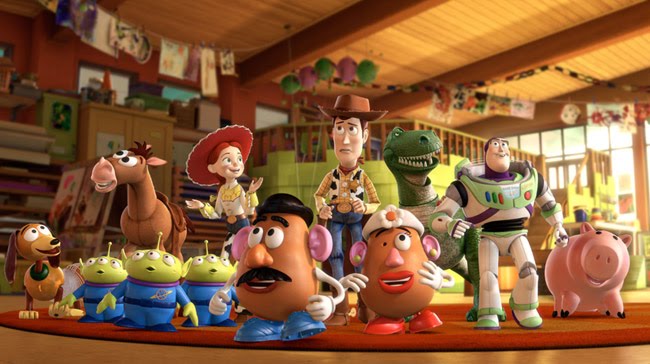
Death be not plastic: The anxiety begins.

In life, the process of maturation, a theme that runs through most Pixar movies, leads inexorably to death, a phenomenon that’s concerned some of these films, too, most notably Finding Nemo, in which the hero’s mother and all his siblings are killed in the first five minutes of the picture. Yet somehow, despite the Toy Story movies’ frequent suggestions that the toys’ owner, young Andy, would some day grow up, and throughout the narrow escapes that Woody and his friends enacted, I hadn’t really contemplated the mortality of these particular characters. They seemed more concerned with friendship — and love — than with death; the worst fate they ever risked, it seemed, was getting sent to a museum, where no child like Andy would play with them anymore.*

But even in a successful movie franchise, toys aren’t merely outgrown. They get worn and thrown out with the trash, or forgotten and left behind. They break and are destroyed. Just like people. And the toys in Toy Story have always been more real than any of the humans around them. So I shouldn’t have been surprised that, in this final installment of the trilogy, the question of mortality would loom large and very real, beginning in the opening scenes.

Just as Finding Nemo discouraged a generation of kids from flushing unwanted fish down the toilet, so Toy Story 3 may launch a boom in donations of used toys to needy children.

In that wonderful sequence, we see what Andy imagines as he plays, including a trainload of orphans speeding over a cliff, and a dazzling “death by monkeys.” Flash-forward to the next scene, eleven years later, when college-bound Andy has parted with most of his old toys: the gang is reduced to a handful of survivors, and the Potato Heads espe­cial­ly are worse for the wear.

Death hovers over the rest of the movie (which we are conscious is the last in the series), and the threat culminates in a stunning climax in a junkyard. The minute the gang arrives, three characters are run over by a truck — bam, they’re gone. The rest manage another series of spec­tacular escapes, until they realize that this time, there’s no way out.

Playtime is over.

The folks who make Pixar movies typically earn the emotional points they score; that, as much as the technical assurance and wit they bring to each project, is what sets them apart from the vast majority of popular entertainments today. So when Woody and his friends confront death, the moment is profound and powerful. The courage shown by the characters is matched (at least) by that of the filmmakers, who prolong the scene past the point of suspense, until a strangely peaceful accept­ance falls over us all. You find yourself thinking, “I hope I go like that: with dignity and a last gesture of affection, a sense that I have not been alone.”

I won’t spoil the ending for you, but in thinking about that scene, I remember the death of Spock in Star Trek II: The Wrath of Khan. I wasn’t a hardcore Spock fan (McCoy was my hero), but the scene tapped into a deep well of feeling, the accumulation of years of following these characters, being entertained and sometimes enlightened by them, playing with their toys and dreaming up new adventures for them. And suddenly the Enterprise looked more like real life than fantasy: with Spock’s death, we understood that the “five-year mission” was really a part of our personal journey, too.

You’ve got a friend in me.

The original Star Trek TV series had been off the air for 13 years when that movie was made; Toy Story 3 arrived in theaters 15 years after the first Toy Story had its premiere. Its first audiences were even younger than I was when I discovered Star Trek; they have grown up with Woody and Buzz, and they are at least as invested in their fates as I was in Kirk and Spock’s. I expect that that scene in the junkyard in Toy Story 3 is going to speak to at least a couple of generations of movie­goers with the same kind of force. As was the case with its predeces­sors, Toy Story 3 signals from the outset that it’s a classic.

First-graders may not know a pasodoble from Play-Doh,
but “Buzz Español” is funny, no matter how old you are.


Another way that the Toy Story movies have differed from most other recent “family films” is that, when playing to the grownups in the audience, they don’t wink (much) or talk over the children’s heads (often). The movies aren’t snarky: they’re witty. The jokes are solidly constructed, grounded in character and emotionally honest. Even the material targeted to children feels real and (usually) important. It’s no accident that most of the Toy Story characters sport retro designs: adults remember playing with toys that looked like these. If you’re the right age, when you first saw Buzz Lightyear, you thought of a sort of deluxe Major Matt Mason** — a toy that hasn’t been made since the 1970s, long before today’s kids were born. Thus our nostalgic emotions have been engaged from the start; the excellence of the writing and the filmmaking do the rest.

This is perhaps an overlong justification for the tears that filled my eyes a couple of times in the course of watching Toy Story 3, another popular entertainment that aspires to a higher kind of art. I celebrate its creators’ achievement, and I urge you to see the movie. (That is, if you haven’t seen it already.)

Prelude to a holocaust: Arriving at the prison camp.

*NOTE: The other dire fate faced by our heroes would be a trip next-door, where a child like Sid would play with them. Reportedly, Sid makes a return appearance as a garbage man in Toy Story 3, but I honestly didn’t recognize him. Another excuse to see the picture again!

**According to that irrefutable source, Wikipedia, Tom Hanks is a Matt Mason fan since his own boyhood, who hopes to make a movie about the character.


Read more!

28 July 2010

The Performance That Changed My Life

Spend time in theaters and concert halls, and you start to keep a list, close to the heart, of great evenings or mere moments when an artist transformed the world for you. You count yourself lucky to be alive, at the right time and the right place, to enjoy such an experience. My list starts with the night I saw Beverly Sills in Rossini’s Siege of Corinth (which is why I talk about it all the time), but the list keeps growing, to the present day and, I hope, beyond.

We collect these performances. Some people call this a scrapbook, but I call it my autobiography, written in the voices of others.

Recently, though, it’s become clear to me that the performance that changed my life most, is one that I didn’t actually witness.


When my mother was young, she made a trip to New York City, where she saw Mary Martin in Peter Pan. That performance didn’t inspire Mom to go on the stage, or anything else so obvious as that, but it changed her perspectives forever.

Having grown up in a small town, she hadn’t seen many plays, let alone full-scale Broadway musicals. She’d seen her share of movies, I guess, but before that trip to New York, she had little experience of being in the same room with the people who were singing and dancing and making her laugh or cry.

In short, she had little preparation and less warning for the phenome­non that was Mary Martin. Years later, Mom remembers, “She just sat down on that stage and sang to me.”

You may feel the same way, as you watch this.


It’s a matter of recorded fact that Mary Martin’s Peter Pan was magical.* She made us believe in magic, in eternal youth, in flying. And even in fairies: I doubt that anyone ever was born who didn’t clap for Tinkerbell when Mary Martin asked it. She was irresistible. To see her today in “Neverland” is to conjure a special nostalgia, not only for our memories of her, and of who we were when we first saw her or first heard this song — but also for a time when belief was easier.

Older now, we know that “thinking lovely thoughts” can keep us young, though it can’t entirely prevent our growing up. My mother might have arrived at this conclusion independently, without help from Mary Martin, but surely corroboration from another cock-eyed optimist from Texas encouraged my mother’s pursuit of happiness.

I oughta put up a statue … but somebody else already did.
The Mary Martin statue in her hometown, Weatherford, TX


How did Mary Martin’s performance affect me? Well, each time I have prepared to fly off on some theatrical adventure, I have seen Mary Martin in my mother’s eyes and heard both women in a single voice. I have, for example, announced that I was not going to look for another paying job just now, but instead I was going to sign up for a non-paying job on a Broadway musical. I have declared that I was going to drop out of graduate school on a mere promise of getting to stage an opera. I have stated my intention to travel halfway ’round the world, just to hear somebody sing — and when I was younger, that meant asking my mother to drive me there.

Each time I make such a pronouncement, my mother draws back, just a little teeny bit. I can see the wheels turning as she runs through all the practical reasons I really should not follow through on my hare-brained schemes. Work on a Broadway show? Why not just run away and join the circus?

But quickly then she is transformed. Her resistance falters; she melts a little, perhaps. What might have been a lecture, or even an argument, is not merely choked back or sighed away, it evaporates. And Mom ends up saying, “How wonderful!”

She is thinking of Peter Pan, and the magic that she felt in Mary Martin’s performance, all those years ago. Then suddenly, my ambition makes sense to her: He wants to be a part of that, too.

Though I saw this process many times, it took me years to understand it. At last I asked Mom: “You’re thinking of Mary Martin, aren’t you?”

“Yes,” she said, “I am.”

So here’s to Mary Martin, and the performance that changed my life. And so long as I’m lifting my glass in a toast —

Happy birthday, Mom.


*NOTE: That Martin’s performance was not only magical but also perhaps the most dangerous in history, we know because the television network had to pull the program off the air: Martin persuaded far too many little children that they, too, could fly, and they were jumping out of windows and off of rooftops across the country. When NBC remade the program in color, the same thing happened, all over again.


Read more!