29 January 2016

David Gilmour, 69, Reported in ‘Extremely Cautious’ Condition


“He won’t even go near the guitar anymore,” say family members. “‘Do you realize how easily I could electrocute myself?,’ he says.”


LONDON -- David Gilmour, 69-year-old guitarist and co-lead vocalist of the band Pink Floyd, is reported in “extremely cautious” condition at his home outside London, following a series of accidents that befell other people.

“Look, David remains an influential musician, a rock icon, and he’s 69 years old,” a friend told the Associated Press. “He sees the headlines. He knows what’s happening. Bowie, Alan Rickman, both 69. Glen Frey, almost 69. Paul Kantner and Natalie Cole — even Robert Stigwood and Pierre Boulez. Not 69, but also extremely influential. Céline Dion’s brother. It’s crazy. I mean, the odds are good that David is next.”

Gilmour has taken up a regimen that includes wearing a heavily padded jumpsuit and a bubble-wrap helmet, crawling very slowly on all fours on the rare occasions he leaves his bed, staying away from windows, and mashing up all his food for two daily feedings. “He’s ordered one of those plastic bubbles, like John Travolta had,” Gilmour’s wife, Polly Samson, told reporters. “Honestly, it can’t get here soon enough for me.

“Oh, dear God,” Samson added, “it’s almost Travolta’s turn, isn’t it?”


In happier, much less risky times.

Gilmour joined Pink Floyd in 1967; exponents of progressive and psychedelic rock, the band is perhaps best known for Dark Side of the Moon (1973) and The Wall, two of the best-selling albums of all time. Gilmour has also pursued solo projects, and in 2008, he received the Ivor Novello Contribution Award for music writing, which he now refuses to touch, for fear of cutting himself.

In other news, family members report that veteran actress Betty White, 93, has locked herself in her room. “She won’t come out,” says one friend. “She won’t eat anything — says we’re all trying to poison her. If we even try to open the door, she starts firing a pistol. And she keeps shouting, ‘They got Abe Vigoda, but they’ll never get me!’ We’re at our wits’ end.”


Read more!

27 January 2016

‘From Broadway to Hollywood’ at the Grove B&N


I’m pleased to announce the first event in Los Angeles (or anywhere else on the West Coast) in connection with Madeline Kahn: Being the Music • A Life: “From Broadway to Hollywood,” a panel discussion on Madeline’s life and work featuring friends and colleagues, moderated by author Eddie Shapiro (Nothing Like a Dame: Conversations with the Great Women of Musical Theater). We’ll be at the Barnes & Noble at the Grove on Wednesday, February 10, at 7pm.

Confirmed participants include:

Robert Allan Ackerman, who directed Madeline in a musical adaptation of Kafka’s Amerika and in Noël Coward’s Blithe Spirit at Santa Fe Festival Theater in 1982–83.

Maris Clement, a member of the ensemble of On the Twentieth Century, the 1978 Broadway musical that nearly wrecked Madeline’s career (yet earned her a Tony nomination).

Julie Dretzin, a co-star of Wendy Wasserstein’s The Sisters Rosensweig, for which Madeline received the Tony for Best Actress in a Play in 1993;

Michael Karm, a co-star of the Broadway musical Two by Two, and also Madeline’s acting coach for her first film roles, including her Oscar-nominated turn in Paper Moon;

J.D. Lobue, director of every episode of the sitcom Oh Madeline, her first foray into series television.

Each of our participants (and, for that matter, Eddie’s interview with Judy Kaye in Nothing Like a Dame) helped me tremendously while I researched the book. They shared memories, filled in blanks, and generally helped me to understand not only what Madeline did, but also why she did it. I began to see Madeline more clearly as a working actor, and also as a person.

Beyond that — they’re all really nice people. So if you’re in the L.A. area — come on by. Admission is free, and there will be a book signing afterward.


To be determined: whether I,
like Madeline in California,
will be obliged to drive a car.


Read more!

19 January 2016

Talking about Madeline at the 92nd Street Y


Our host, Valerie Smaldone.

UPDATE: THE EVENT HAS BEEN RESCHEDULED. CORRECT DATE AND TIME ARE TUESDAY, APRIL 5, AT 7PM.

On Tuesday, April 5, at 7pm, I’ll be at New York City’s 92nd Street Y to join interviewer extraordinaire Valerie Smaldone and three sensational actresses to discuss the life and work of Madeline Kahn. Valerie also acts, and I can hardly think of four women I’d rather talk with about the career of an actress — I expect I’ll learn a lot.

Like Madeline, Barbara Barrie was an Oscar and Tony nominee with a lifetime’s worth of credits when she signed on to co-star in Eric Mendelsohn’s Judy Berlin. Working with a young director on his first feature film, in no-frills conditions proved challenging to both actresses. Shooting at night in the cold November weather, Barbara nearly froze: she remembers still shivering even when she got home in the mornings. Her performance went on to earn her an Independent Spirit Award nomination.


Barbara Barrie.

Barbara’s son Aaron plays Madeline’s son in the film — and there’s another family tie, of which I was unaware when I interviewed her for my book: Barbara’s husband, the late Jay Harnick, produced three stage musicals in which Paula Kahn appeared (or claimed to).

Maddie Corman played Madeline’s niece — and George C. Scott’s daughter — in the Fox sitcom Mr. President in 1987–88. As a teenager working with seasoned veterans, she was all eyes and ears on the set, observing and absorbing everything around her. One happy result of her experience: she does a flawless impression of Madeline.


Maddie Corman.

Madeline hadn’t worked with a child actress since Tatum O’Neal in Paper Moon, and the working relationship she and Maddie set the tone for later relationships with younger colleagues. Madeline never condescended but approached Maddie as a peer, praising her when she did well, even asking, “How did you do that?” when she admired a particular scene.

Like Maddie, Ally Sheedy was a Madeline Kahn fan even before they worked together, and both began acting when they very young. Ally met Madeline when they co-starred in Alan Alda’s Betsy’s Wedding, and they bonded when bad weather prolonged location shooting in North Carolina. They spent hours talking and taking long walks. The all-star cast of Betsy’s Wedding had opinions on how to do everything, which complicated Alda’s attempts to realize his artistic vision — and probably tried his patience, too.


Ally Sheedy.

The movie marked a reunion for Madeline with Julie Bovasso, who (until she was fired, days before opening) directed her in David Rabe’s Boom Boom Room, for which she received her first Tony nomination. Bovasso was an acclaimed acting teacher, and when Madeline decided to take classes with her, Ally went along — affording her an opportunity to contrast Bovasso’s “huge, volcanic” acting style with Madeline’s more intimate approach.

After the panel discussion, I’ll be signing copies of Madeline Kahn: Being the Music • A Life, and proceeds from book sales will benefit Ovarian Cancer Research Fund. For more information and to order tickets, click here.


Madeline as Trixie Delight, the film role of which she was proudest —
until she played Alice Gold in Judy Berlin.


Read more!

10 December 2015

A Brand-New Rossini Opera at the Met


Rossini’s La Donna del Lago returns to the Metropolitan Opera Friday night. Joyce DiDonato once again stars in Paul Curran’s production, which had its premiere at Santa Fe in 2013 before moving to the Met (with a different backdrop) last February. Tenor Lawrence Brownlee, Joyce’s “Giacomo, disguised as Uberto” from Santa Fe, rejoins her in the same role. We are guaranteed an evening of spectacular singing and glorious music that, as Joyce has observed in an interview, respects the story’s “emotional truth.”

However, after multiple viewings of this opera, it’s not the emotions but the underlying story that I find less compelling than I did, say, the first time around. At last, I have decided to heed the advice of Rossini’s biggest fan, Stendhal: I shall pretend that I speak no Italian, and I shall invent my own plot for this opera.


Stendhal: Don’t say he didn’t warn us.

La DiDonato del Lago, ossia
Great Scozia

Synopsis

Act I, Scene 1: The scene opens on Loch Kansas, where a chorus of townsfolk greets a new day that will bring the most exciting football game of the year. Ardena Scozia, a glamorous opera star, returns to her hometown by means of a boat that is conveniently left offstage. She sings of her love for Malcolm, her long-ago boyfriend, who is currently the general director of the Loch Kansas Opera Company. Unbeknownst to Ardena, this evening’s football game will pit the local team, the Pittsburgh Picts, against their deadly rivals, the Glasgow Grizzlies. The quarterback of the Grizzlies, Giacomo, has disguised himself as “Uberto,” an itinerant salsa dancer, in hopes of meeting the beautiful singer. She invites him back to her home for a cup of heather.


Act I, Scene 2: Giacomo is shocked to learn that Ardena’s father is Duglas, the former coach of the Glasgow Grizzlies, who is now coaching the Picts. He also learns of Ardena’s betrothal to Rodrigo, the Picts quarterback. Unbeknownst to any of them, Ardena is still in love with Malcolm, despite the fact that he is transitioning to contralto repertory. After Duglas has left, Malcolm invites Ardena to the football game.

Act I, Scene 3: Picts fans prepare for the football game by applying body paint in the team colors, blue and more blue. Ardena supervises. Malcolm declares his support for the team, but unfortunately it’s the wrong one (Aria: “Go, Go, Grizzlies!”), and Ardena’s friends mistrust him. The stadium lights are turned on, signaling that the game is about to begin.


Pep rally.

Act II, Scene 1: Still disguised as “Uberto,” Giacomo searches desperately for Ardena, because only she has the coin needed for the toss that will begin the football game. Once again he declares his love for her, but she tells him she could never love any man who doesn’t wear a skirt. He then gives her a ring, which he claims he won for playing at a Super Bowl, many years ago. Rodrigo has overheard their conversation and recognizes Giacomo’s true identity. Rodrigo commands his teammates to sack Giacomo, but Ardena, who is also the referee, calls a time out.


Act II, Scene 2: The game is incredibly violent, and in its aftermath Ardena is dismayed to see that the heads of losing players have been placed on pikes all over the field. She vows to find the NFL Commissioner, to complain.


Act II, Scene 3: Ardena is surprised to find all of the NFL Commissioners surrounding “Uberto,” who soon reveals his true identity. He tells Duglas and Malcolm that Bertram, the top draft pick, will be the Picts’ new quarterback, replacing Rodrigo, who has been sidelined for the rest of the season due to a severe head injury (on a pike). Malcolm admits that she’s a woman, and on hearing this news, Ardena joyously flings herself (Highland style, of course) into a live volcano. All rejoice, as a new peace reigns in Kansas.


THE END


Read more!

04 December 2015

Berg’s ‘Lulu’ at the Met


Petersen as Lulu in a promotional portrait.
I’m such a fanboy now that I want to get a pair of those hands to wear to all of her future performances.

Full disclosure: I am probably the least-fair critic of any performance of Alban Berg’s Lulu you are likely to find. The reason is my exceptional education in this opera, which I learned at the foot of Teresa Stratas, the soprano who created the title role in the world-premiere performance of the completed three-act score. Until Teresa and I started to talk about Lulu, I’d found this work absolutely fascinating and utterly unlistenable. But not long after Teresa started to explain it to me, I listened with greater and greater appreciation. Soon I called her to report that on many evenings I’d come home after work and play her recording of the opera. “Honey, be careful!” she replied. “That music can be dangerous!”

So it’s not merely my relationship with a singer closely associated with Lulu that seemed to doom my chances of ever witnessing a performance that met, much less surpassed my standards. That I attended the Metropolitan Opera’s new production three times — and would have attended more often, if circumstances had permitted — should tell you a great deal.


Dangerous Music: Stratas in the world premiere.
(“And comparisons are odious, honey.”)

Though a great deal of press surrounded the new production itself, by artist William Kentridge, my primary interest was in the singers, especially the leading ladies. Friends had heard Marlis Petersen’s Lulu and praised her extravagantly; she had decided to retire the role at the end of this run (last night).

And Susan Graham had decided to tackle the tremendous challenge of Berg’s score and the role of Countess Geschwitz, something I really wanted to see — because in the past I’ve been able to see only one performance when she created a role, or else I’ve seen her in roles she’s sung many times. Example: I saw only her only once in Les Troyens at the Châtelet, where she introduced the role of Didon to her repertoire — but five times when she returned to the role at the Met. And that in turn encouraged me to travel to San Francisco to see her Didon one more time, last summer.

This may be reflexive fan behavior, but I prefer to think that it’s something more. If this art — this opera — and this artist — truly mean something to me, then I must explore, study, immerse myself, in order to understand better.


Susan Graham as Geschwitz.

Susan has sung Berg before — but the “Sieben frühe Lieder,” not one of his mature works, certainly not Wozzeck or Lulu. As an artistic undertaking, then, this step into an entirely new kind of music was significant for her. At first hearing (the second performance), she won me over easily, and (predictably, perhaps) she seemed to warm most to the passages in which Geschwitz’s music chimes closest to the scores of Mahler and of Berg’s other immediate predecessors. Geschwitz’s final monologue proved tremendously moving, as Susan located a wellspring of tenderness and sorrow. At the penultimate performance, I found her more confident onstage, freer with her body as she acted, and even more resplendent vocally. And last night she carried all her best qualities before her as she crossed the finish line.

In interviews before opening night, she referred a few times to the unkind ways Lulu treats Geschwitz, as if mystified by Geschwitz’s unrequited devotion to her younger friend. To me, this characterization is one of the most easily understood aspects of the entire libretto: of course Geschwitz is slavishly devoted to Lulu, for all the almost-inexpressible reasons that I’ve behaved in similar ways with some of the objects of my own affections. By the final performances, I sensed — without knowing for certain how or why — that Susan was grasping her character’s emotions more completely. In Act III, Scene 1, Kentridge gives Geschwitz a particular, silent gesture, at the foot of a staircase as she reaches toward Lulu above her; by last night, the gesture had become especially poignant, and Susan’s entire body went into it. Yep, that’s what it feels like.

Petersen’s physicality as Lulu is only one of the extraordinary achievements in her performances: she delivers something quite like a modern-dance interpretation of Lulu, her choreography reflecting that assigned to Kentridge’s addition to the piece, a dancer who plays (or writhes inside) a piano far to one side of the proscenium. That Petersen can do all of this while singing a notoriously demanding score is almost beyond belief, and she’s doing so in varying states of dress, looking wonderfully sexy all the while.


Daniel Brenna with Petersen onstage at the Met.

The Met Titles meant that the audience could understand the jokes and ironic juxtapositions of the libretto — and the singers got laughs where Berg must have hoped they would. But Petersen’s theatricality proved so expressive, so perfectly attuned to the character’s moods, that she might do very well without titles at all. On first hearing, I was even more eager to attend the Met simulcast, with all its closeups, to permit me to see what her facial expressions were like — but when I got to the movie theater, there was a technical glitch, the screen was blank, and now I’ll have to wait for the DVD.

Lulu’s music requires a great deal of singing in very high registers, some coloratura, some Sprechstimme, and almost anything else you can name; she’s onstage for all but a very few extended passages. Petersen maintained a purity and beauty of tone throughout, without a trace of the metallic timbre that helped to lower one acclaimed Met Lulu in my estimation. (Comparisons are odious, but remember: 1.) I already admitted I’m an unfair critic; and 2.) that other soprano’s performance helps to illuminate just how delighted I am to find a singer who really does justice to this opera.)

Petersen explained to The New Yorker that, at the end of the final performance, she would deliver her own death-scream (as Lulu is murdered by Jack the Ripper, offstage), rather than letting another singer do the honors. It was a fitting way to bid farewell to the character, and indeed Petersen’s death-scream wasn’t like that of Jennifer Roderer (excellent though she’d been). Petersen had a guttural urgency — maybe Lulu herself was reluctant to leave Petersen’s body.


As for the rest of the cast, I was especially impressed with Martin Winkler’s commanding Acrobat, robust of voice and exuberant in his stage presence: somehow, in all my experience of this opera, the role had never seemed so important or so rich. Similarly, Alan Oke’s fully realized characterization brought the Prince into fresh new focus, though Johan Reuter (Dr. Schön), Franz Grundheber (Schigolch), and Daniel Brenna (Alwa) were all excellent without offering any revelations — for me. (I told you, I’m unfair.)

Kentridge’s production involves projected images and video, as well as curious props (see the gigantic hands, above) and the aforementioned piano-dancer. Much of this is, as we were warned, over-busy and distracting. Yet even from the first performance, I found it easy enough to ignore that which didn’t interest me and to focus on the staging itself, which was often straightforward and at times revelatory, as in the physical interactions between Lulu and Schön. Ultimately my biggest quibble may be with Geschwitz’s costume, which makes her look more ordinary and less exotic than I imagine her. But maybe that’s the point, and Kentridge’s choice did make me question why I’d always found Geschwitz exotic. Because she’s one of the rare lesbians in opera? Because other Geschwitzes wear men’s clothing? I’m not sure. Kentridge also sold tickets: I’ve never encountered a Lulu with better attendance, and fewer walkouts.

Derrick Inouye conducted the final performances, but by then I was under the spell of Lothar Koenigs, who brought out an almost lush quality in the score, Late-Romantic colors that I hadn’t heard from Pierre Boulez or James Levine. Koenigs’ performance made me realize that this opera, which I used to find denser and no pleasanter than an accident in a lawnmower factory, now strikes me as eminently accessible. How wonderful! For as audiences, we can also evolve artistically.


Portrait of the Artist as a Young Man:
Susan’s next development — “transitioning,” shall we say, to Prince Orlofsky, tonight at the Met. Expect me to report about this remarkable juxtaposition of roles.


Read more!

04 November 2015

Heggie’s ‘Great Scott’ at The Dallas Opera


Great DiDonat’:
Joyce in Dallas.
This and all photos by Karen Almond,
Courtesy of The Dallas Opera.

For the past few years, opera fans have been accorded privileged glimpses of the world backstage: rehearsals, clowning, and camaraderie among colleagues who, no matter how otherworldly their talents may seem, are just folks like us. Pictures, blog entries, and videos go viral on the Internet, and even the Met got into the act this season, with a clip of its Anna Bolena stars merrily shimmying away at their music stands during a rehearsal. This is all to the good, stimulating interest in new productions, connecting with fans, and perhaps making opera seem a bit more accessible to those who aren’t fans already.

One of the primary purveyors of this kind of veil-lifting has been Joyce DiDonato, who is in every way at the center of Jake Heggie’s new opera, Great Scott, which had its world premiere at The Dallas Opera on October 30. (I saw the second performance, November 1.) In Terrence McNally’s libretto, Act I is given over entirely to a rehearsal, during which scenes Joyce wears precisely the sorts of clothes she wears in real life, says precisely the sorts of things she says, and behaves pretty much as she does.

Her character, Arden Scott, has come back to her hometown for a gala benefit — as Joyce has done with the Kansas City Symphony — and there’s a question of singing the national anthem at the Super Bowl — as Joyce did at the World Series last year. Down to earth even when she’s all business, Arden interrupts an elaborate coloratura passage to exclaim, “This shit is hard!”
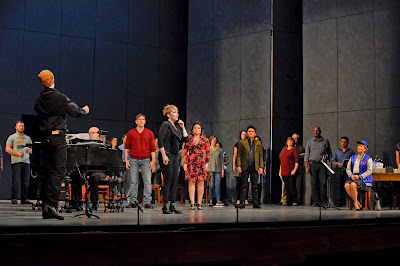

Life is a rehearsal.
The company, in Act I.

But home isn’t home to Arden any more (“She belongs to the world now,” observes one character, echoing something that I’ve been saying about Joyce for a while now), and after making music with her friends, Arden goes back to a hotel room “to fall asleep watching CNN”; Joyce has addressed loneliness on the road in this video blog. Arden is championing the work of an obscure bel canto composer, as Joyce very often does; and a living composer has written a new opera just for her, as Jake has done now.

What Arden — and Joyce — and Jake — do is indeed hard, and it can be wonderfully entertaining to watch and to listen to. When opera is at its best, though, what we take away from a performance has less to do with personality, and more to do with a particular artistic vision. It’s here that Great Scott falls short of the mark.


Don’t it make your brown eyes blue?
J-DiD and ARC-en-Ciel.

Make no mistake: Jake’s score is consistently ingratiating and often quite ingenious, and if you ever doubted that this man loves opera, doubt no longer. Here he pays homage to the operas of earlier times, with such treats as a nimble Rossinian septet (“Until the night”), a Rosenkavalier-style finale (augmented by a fourth voice and a skateboard), and page after page of Bellini and Donizetti pastiche that sounds more bel canto than the real thing. Above all, he’s written terrific roles for singers he clearly and justifiably loves. But the opera as a whole would prove more effective than it does, if only McNally’s libretto were more focused. I can’t say with certainty which of several themes is meant to be paramount, and none of those themes is fully developed despite ample opportunity within a meandering second act.

In the opera-within-an-opera, Arden plays a character who sacrifices herself: is this opera, Great Scott, supposed to be about the sacrifices a singer makes for her art? Is that why Arden stands alone like the Marschallin at the end? Or is Great Scott about the tension between classical and contemporary repertories — represented by the bel canto masterpiece and by the (unheard) new work? Is it about the tension between high and popular cultures — since the opera gala and the Super Bowl are playing out simultaneously in Act II? Is it about the vitality of American opera (not coincidentally the name of Arden’s hometown troupe)? Or about American opera’s capacity to embrace all music — to let our stages reflect the melting pot that is our nation?

Or are we supposed to take away a message about the relevance of the arts? After all, the new opera discussed here is Medea Refracted through the lens of “that mother who drowned her children in a car,” a subject from the headlines and one that makes Arden nervous. Meanwhile, one principal character complains that opera is less relevant than the music of Lady Gaga. And presumably for many people, there aren’t a lot of operas that hold more allure than a major sporting competition, the Super Bowl chief among them. (In Dallas, where I used to get beat up because I liked opera and didn’t like football, that contrast was especially meaningful.)


Bazzetti’s “Rosa Dolorosa, Figlia di Pompei” takes the stage.
Amor (Manuel Palazzo) hovers over Mayes, DiDonato, Pérez, and Rosel.

These questions had begun to trouble me fairly early in the opera, and more so as the afternoon went on, to the point where I found myself wondering whether the finale of the opera-within-the-opera might not turn out to be the finale of Great Scott. (Plot spoiler: it isn’t.) Nevertheless, my concerns didn’t diminish my enjoyment of a substantial number of pleasures.

First of these is the performance itself, expertly conducted by one of Jake’s most prominent exponents, Patrick Summers, for whom no style poses a challenge; and inhabited by singers whom I know quite well, onstage and off. Granted, I’ve only met baritone Nathan Gunn a couple of times, and fleetingly, but I’ve heard him many times. I’d never heard of tenor Rodell Rosel, though on this occasion he provided vocal clarity and a winning stage presence, game for the libretto’s (mostly easy) jokes at his character’s expense. All of these artists are good company, and Jake has tailored their roles to their measure.


Royals: DiDonato & von Stade.

Take the example of mezzo Frederica von Stade, the first champion of Jake’s music and one of the greatest treasures American opera has yielded. Jake knows her voice so well that, even at this (presumably!) late stage of her career, every note lies comfortably within its sweetest spot. She’s always been a radiant performer, she still is, and Jake wants us to know that. Her character, Winnie Flato, is at once Arden’s mentor and former piano teacher, a former singer, the general director of the hometown opera company, and the wife of the owner of the Super Bowl-bound football team. That’s quite a lot of responsibility for one person, no matter that she’s fictional.

As universally beloved in Opera World as Winnie is in her troupe, Flicka is a role model for today’s top American mezzos, Joyce included. So when Flicka and Joyce share an extended scene in Act I, the effect is poignant for reasons that have more to do with each woman’s stature, past and present, than with the roles they’re playing. And if you feel about these singers as I do (and chances are, you do), then what they’re actually singing is almost beside the point. Will this same scene prove equally moving when other singers — maybe even people I haven’t heard a thousand times — take these roles? If the libretto were stronger, I’d have fewer doubts. The music they sing is lovely and surely will be gratifying to other voices. I’ll have to hear them, though, before I can judge just how heavily this opera depends on this cast.


Pokerface? Paparazzi, Pappataci?
Burdette and Costanzo discuss Gaga.

A contrasting example, perhaps the only one, is that of Roane, the stage manager, sung here by the countertenor Anthony Roth Costanzo. If ARC-en-Ciel weren’t already a star (with an awesome fan name), I’d describe this as a star-making role, arguably this opera’s second lead, a showcase for his formidable singing, acting, and, yes, his dancing. Roane is loved in the abstract — he’s the sweet guy who keeps things running — but, he observes, no one takes time to get to know him. He’s not like the others in this company, and that’s an excellent reason to write his role for countertenor; instantly, we start getting to know him, and we like him more as a result. Yet while ARC-en-C. performs the role brilliantly and looks irresistibly crushworthy while doing so, I can in honesty imagine other countertenors bringing their best to a part that allows so much rewarding characterization and audience sympathy, without ever a mention of “la vendetta del padre” or “la spada del nemico.”

McNally would have served the opera better by upending our expectations more often. Arden’s old flame is given little to do, none of it surprising, and little time to do it — but he’s baritone Nathan Gunn, so you’re glad to see him. The seconda donna here is Tatyana Bakst, a caricature of the ruthlessly ambitious soprano, sung spectacularly by Ailyn Pérez in a crowd-pleasing, Slobbovian-accented performance. Yet how much more interesting this character would have been if she weren’t so obviously and comically cutthroat! What if Tatyana were like — just an example here — the young Joyce DiDonato, a perfectly nice woman for whom destiny has bigger and unstoppable plans? Or what if Tatyana were more like Eve Harrington, whose wiles remain concealed until she goes in for the kill?


Show-stopper: Pérez sings the National Anthem.
Bets are now being taken that this will become an audition piece for sopranos everywhere.

The company’s baritone and tenor are here used primarily for comic relief, both roles played with a blessedly light touch. As the baritone, the mighty Michael Mayes spoofs the Barihunk phenomenon in his shirtless scenes, proving at one point that he can sing superbly while looking away from the conductor and flexing his back muscles. Both he and Rosel excel in the faux bel canto passages, and this was fun for me, because it’s a style of music I haven’t heard Mayes sing. (He has sung — and been transformed by — the lead in the first Heggie–McNally opera, Dead Man Walking.)

Really, the best and most knowing backstage humor is contained in choreographer John de los Santos’ little ballet sequence, which Arden rehearses perfunctorily; I can’t tell whether Rosa Dolorosa’s lack of a stage director is intended to be funny, or intended at all. (Surely this opera’s real stage director, Jack O’Brien, noticed the omission.) But an opportunity for comedy was lost in the person of bass Kevin Burdette, one of the funniest men I’ve seen onstage. He plays the dual role of the opera’s conductor and its long-dead composer, allowing him plenty of stentorian outpourings but no chance to unleash his comedic skills. He fields his assignments flawlessly, yet this is a case where I wish the role had been tailored more closely to the performer.

Burdette, as that obscure bel canto composer, rightly observes that Golden Age composers often wrote for specific singers. “They were singing new music, and they were afraid, too,” Bazzetti says, citing the example of Giuditta Pasta. The catch is that, while Donizetti wrote Anna Bolena and Bellini wrote Sonnambula and Norma for Pasta, nobody ever wrote an opera entitled A Week in the Life of Giuditta Pasta for her. Sure, elements of her personality may have crept into the score alongside passages that showed off her voice to its best advantage — but it was always possible to separate the singer from the role.


“Until the Night”: La mia testa fa bum-bum.
Burdette, Rosel, Costanzo, DiDonato, Mayes, Pérez, von Stade.

So maybe it’s useful to point out a few ways in which Arden Scott does not resemble Joyce DiDonato. Joyce is too young for the part, for starters: so far as I can tell, her career hasn’t yet reached its precise peak, much less the downward slope that Arden hasn’t quite brought herself to contemplate. If there’s one thing that hasn’t changed since I first heard Joyce, it’s the certainty that she’s still got wonders up her sleeve, and that she’s only begun to dazzle us.

But perhaps this is an opera Joyce can carry forward with her, and it’s easy to see why she would want to. Arden certainly shares many of Joyce’s concerns, particularly her desire “to matter” — because it’s never been her ambition to sing prettily and go home. “I want to transform one life the way you transformed mine,” Arden tells Winnie, and that’s what Joyce has set out to do with every performance, every master class, every Facebook post, and every blog entry. It’s always about something and always aimed at somebody, whether it’s a fan or a young singer starting out, or anybody who has never heard a piece of music that she finds meaningful. “When I sing, I let the whole world know who I am,” Arden says. Bingo.


The music Jake has given her shows off his mastery of her sweet spots, her lyrical lines, her bel canto technique, a rainbow of her vocal colors, and an abundance of her warmth and humor. “This shit is hard,” but Joyce just keeps on singing, seemingly tireless. She’s onstage for most of three and a half hours, as aria follows scena follows another scena and an ensemble, with one mini-mad scene in Act I and a full-fledged bel canto mad scene in Act II, followed swiftly by that ghostly visitation. (Gena Rowlands in Opening Night had a firmer grip on reality than poor Arden does at times.)

After all the madness, it was the audience’s turn to go nuts, and rightly so. Together Joyce and Jake had given us a spectrum, a gamut, an Evening of Joyce, more Joyce than any other opera I’ve heard her sing, and what’s more, it seemed like (and nearly was) the Real Joyce, no matter what name her character takes. “She belongs to the world now,” and Great Scott shares her with us all, pretty much as we want her to be.

And yet “Art endures; voices do not,” McNally’s libretto insists. This first hearing of Great Scott did give us plenty of voices, voices at their admirable best. If Great Scott is to endure, there’s some tinkering yet to do, something that will put it within the reach of other voices. The words are the chief problem here. What we have right now is an entertainment. What we need is art — that matters. I can testify that every person involved in this opera has given us that before, and I’m certain they can give it to us again.


NOTE: After the performance, I told Jake I’m beginning to feel that he’s my alter-ego, writing for singers we both prize the music that I would write, if I possessed his gifts. And on an even more personal level, it was remarkable to find Jake and all these singers in the company where I first discovered opera. Who would have thought, when I started, that I’d wind up backstage, hugging so many people?


Read more!

03 October 2015

Lost Empires, the Sequel: The Life of Sue Mengers


As perhaps the world’s preeminent scholar in the work of author Brian Kellow, I long since congratulated myself for identifying the recurring theme in his work: “the pains Brian has taken to document worlds that no longer exist. …Brian is playing at Proust’s game. He doesn’t mourn the past but recaptures it by recording its details, and there’s something joyful at times in the process.”* Thus far he’s tackled outsize personalities and distinctive talents for whom the performing arts mattered: the singer Eileen Farrell, the Bennett family of actors, Broadway’s Ethel Merman, and The New Yorker’s Pauline Kael.

Brian’s latest book, Can I Go Now? The Life of Sue Mengers, Hollywood‘s First Superagent, didn’t seem at first to fit that pattern. Sure, I thought, the performing arts mattered to her, but mostly so that she could get a commission when one of her clients made a movie. Sure, she was an outsize personality — enough so to warrant fictionalized portrayals onscreen from Dyan Cannon, Shelley Winters, and Loretta Swit. But where did Mengers really stand within the gallery Brian has painted so far?

As I read, I understood — with increasing certainty — why Mengers mattered to Brian. She’s another representative of his Lost Empires, all right.


First, the personality. I’d heard about Mengers, but nothing could have prepared me to see her wit and audacity laid out this way. Particularly once her career is launched, there is virtually no page among the 284 in this book that does not contain two anecdotes and three zingers — or more. (If you’ve got friends who love gossipy Hollywood yarns, just sprinkle your conversation with quotations from the book, and they’ll fall at your feet.) We see instantly that Mengers was a colossal pain in the neck to almost everybody. At the same time we see that her humor, her charm, and her sheer outrageousness helped her to storm past all obstacles, including those she herself had posed.

A German–Jewish refugee and wannabe actress, Mengers rose from the secretarial pool to the highest echelons in her business. Brusque, often vulgar, she did everything people aren’t supposed to do when they want to succeed: hectoring, chainsmoking marijuana, forgoing underwear and making sure everyone knew it. Yet at the peak of her powers, she knew when she’d gone too far, and she’d come back with a quotably funny remark or with the sudden appearance of “Baby Sue,” her alter ego, the naïve little girl anyone could love. (Anyone except her mother, that is.) She knew when to sweet-talk, when persuasion was better than pushiness.

As Brian makes clear, Mengers possessed all the qualities to make her a wheeler-dealer of legend, but she backed these up with hard work. By day, it seems she was incessantly on the phone or in meetings, and by night she threw phenomenal parties and dinners. She was always on the go, and yet she devoted countless hours to reading screenplays. Always on the lookout for the next big project, she applied her astute, but not infallible, critical judgments. Her clients included some of the biggest names of her era, including Barbra Streisand, Faye Dunaway, Ryan O’Neal, and Peter Bogdanovich — and it was no coincidence that they made some of the most important films of her era, too. Brian talked to a staggering number of these folks, and every one has something memorable to say to him.


Mengers with one of her younger clients, Tatum O’Neal.
It’s fun to see how many figures from my book turn up in Brian’s.

Hardly had that era begun when Hollywood began to change. One of the changes originated with Mengers herself: for her superstars, the superagent commanded super-salaries. By our standards, the dollar amounts may not look like much, but they were far more than Hollywood actors received before Mengers came on the scene. Making a movie became an ever-more expensive undertaking.

The other changes, however, had little to do with Mengers. Even while her clients were making movies for grownups, establishing what we now perceive as a Golden Age, they were also crashing and burning, often due to substance abuse. Other filmmakers began to make blockbusters. For all their merit and craft, Jaws and Star Wars, and those that followed, required less thought from audiences than did, say, Chinatown, and thus blockbusters promised greater appeal worldwide.

A new mentality began to take over Hollywood. More and more, the studio executives were “Harvard MBAs,” who knew little (and arguably cared less) about movies. For Mengers, movies were a passion. For the new generation, movies were just another business, albeit a highly lucrative one. There was no place among them for Mengers, and long before her death in 2011, she was left behind.

In today’s Hollywood of comic books and reboots and mega-blockbusters, it’s almost impossible to imagine a filmmaker rivaling any of the classics of the 1970s. The originality and the infrastructure — and the will — simply aren’t there.

In her highly original way, Mengers laid the foundations of the infrastructure of her own Golden Age, and heaven knows she had an abundance of will. She is, in short, the very sort of person you’d expect to intrigue Brian — if you knew enough about her to begin with. Thanks to Brian, we can all understand better now the topography of another Lost Empire.


Standard Operational Bullshit:
Loretta Swit plays a character based on Mengers
in Blake Edwards’ satire of Hollywood, S.O.B.

*NOTE: I quote myself, of course. Because who else said it better?


Read more!